

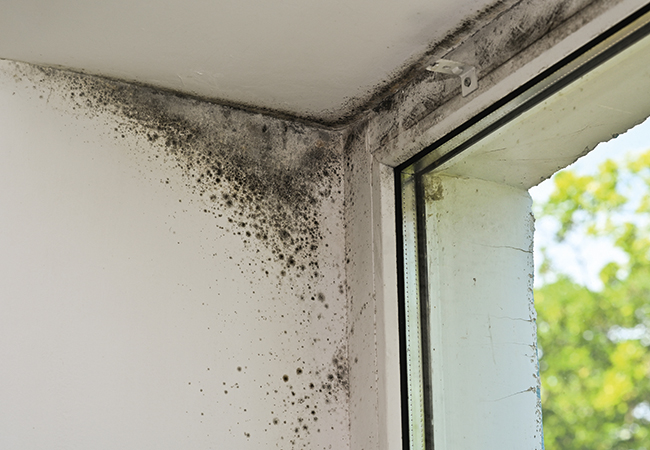
The rise in reports of damp and mould across the UK’s housing stock has exposed a systemic weakness in how homes are designed, retrofitted and maintained.
The scale of the issue is vast: in 2023, the BRE found that 65,000 homes in England are affected by category 1 damp and mould hazards.
Mould led to the death of two-year-old Awaab Ishak, who died from a severe respiratory condition caused by prolonged exposure to mould. In response, the government introduced Awaab’s Law, which mandates strict timescales for social landlords (and soon private landlords) to investigate and repair damp and mould.
Insulation failures
Many cases of mould and damp are the result of botched installations financed by government programmes such as the Great British Insulation Scheme and the Energy Company Obligation (ECO). These were targeted at low-income households and aimed to improve the energy efficiency of poorly insulated homes.
However, work carried out under both schemes was found to be not compliant with ventilation standards.
Hywel Davies, independent adviser on building safety and performance, says the situation has been years in the making. ‘Twenty-five years ago, there was a focus on energy performance in buildings, and some of us warned that we might not be building stuff that complied with the regulations,’ he says.
‘Now we’re dealing with these external wall insulation problems, among others. The National Audit Office has looked at 23,000 instances of failure. That’s 23,000 instances of non-compliance.’
If we can just give people better information about the importance of ventilation, that could be such a quick win
Regulation versus compliance
There is an argument that ventilation rates in the Building Regulations are inadequate, but Davies is not convinced the issue is down to a lack of regulation. ‘It’s a lack of compliance. If [housing] stock is built to meet current regulations, it should be adequately ventilated,’ he says. ‘The people who don’t comply need to face the consequences.’
Davies warns of a siloed approach to Building Regulations. While Part L (energy efficiency) drives the push for airtightness, Part F (ventilation) is often treated as a secondary consideration. Each part should be considered together, he adds, as ‘they allow ventilation and airtightness to be considered in a systematic way’.
David Bleicher, publications manager at BSRIA, agrees: ‘You can’t talk about airtightness without talking about ventilation. If you build a building that is completely airtight with no ventilation, you get mould, you get air-quality problems, you get health problems. So you must have adequate ventilation and it must be installed correctly.’
As well as regulations, guidance is needed to teach people how to follow them, adds Bleicher, who is editor of BSRIA’s new BG 90/2026: Mould in social housing. The guide was published in partnership with the UK Centre for Moisture in Buildings (UKCMB) and follows the ‘no insulation without ventilation’ principle to help providers move from repair to prevention, offering solutions for those retrofitting and maintaining buildings. It is free to access for social housing providers and full-time students on relevant courses.
While the guide is designed for social housing providers, Bleicher says it is also useful for contractors, manufacturers and engineers, adding that it is important for ensuring issues are dealt with proactively, rather than reactively. ‘In the past, we’ve seen mould problems ignored until they become a serious issue.’
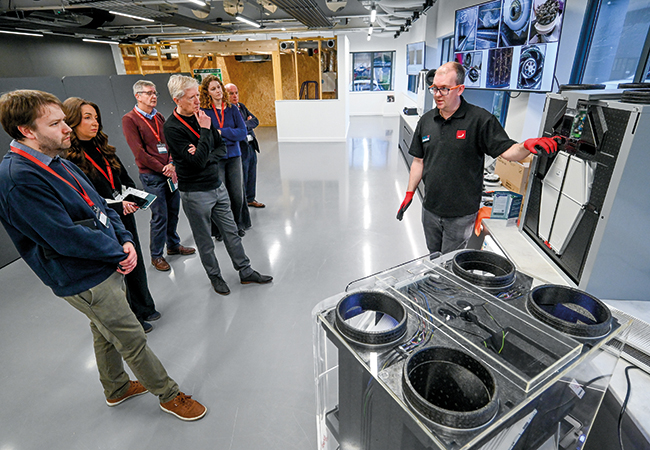
Demonstrating ventilation products at the Zehnder training academy
Skills gap
There is, however, a significant skills gap when it comes to the construction, installation, testing and maintenance of ventilation systems, says Bleicher – a statement with which Adam Taylor, CEO at Arm Environments and chair of the BESA Indoor Air Quality group, agrees. ‘A lot of the problem stems from a lack of knowledge. There is a lack of awareness of how important it is,’ says Taylor, who adds that residents’ lifestyles are often wrongly blamed for causing the mould.
‘There is the insinuation that if someone has mould in their home it’s because they are dirty, but that isn’t the case, particularly in social housing. There are lots of other reasons, such as high occupancy, smaller and smaller buildings, airtight fabric and a lack of education about the importance of ventilation.’
‘We can’t just blame the residents,’ echoes Bleicher. ‘There are many socioeconomic issues at play, such as overcrowding and fuel poverty, where residents can’t afford to heat their homes. It is not people’s fault that they’re cooking, drying clothes and showering. These are normal activities that everyone does, but in an overcrowded dwelling that isn’t effectively insulated, ventilation can’t do what it is supposed to be doing. All of these things can conspire together to cause significant mould issues.’
Bleicher says it can’t always be the responsibility of tenants to deal with the condition of the property when the ventilation is failing.
Finding solutions
Maintenance is the big elephant in the room, according to Taylor, who says: ‘We’re putting more sophisticated ventilation systems into buildings, but they are not always getting serviced.’
Bleicher explains the physical reality of neglect. ‘Ducts get plugged with dirt or damaged, motors lose speed. All these things mean a system that works on day one isn’t working correctly a few years later,’ he says.
To solve the maintenance crisis, Taylor references the Nordic model. After its own mould crisis, following the insulation boom of the 1970s and 80s, Sweden introduced Obligatory Ventilation Control in 1991. This stipulates that ventilation systems must be routinely checked and signed off by certified persons. BESA and GCP Europe are currently working on a similar standard for indoor environment quality that they hope will become UK legislation, explains Taylor. ‘When I look at Sweden, it’s like looking into our future,’ he says.
Bleicher says what is required is a solid training framework and recognised qualifications and accreditations. Training and competence are indeed now central to the conversation, and the Zehnder Group has invested in a dedicated training centre through its Zehnder Academy. Tony Rendell, head of the group’s operations and customer services, says the goal is to create healthy indoor climates with a deeper focus on indoor environmental quality.
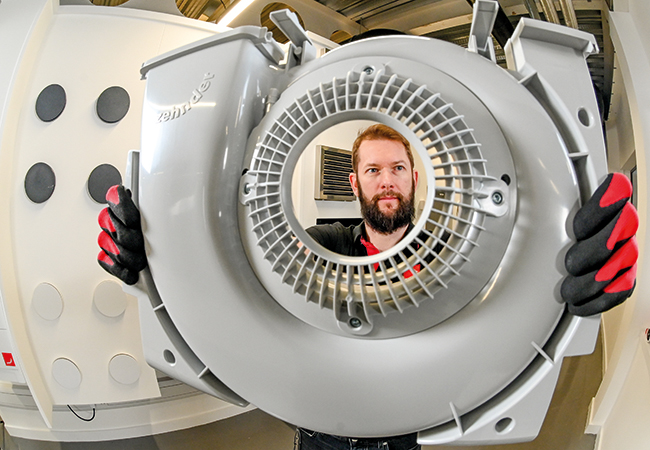
A ventilation component at Zehnder
‘We are investing to reduce the skills gap and improve industry knowledge. This can reduce preventable issues that come from poor installation and maintenance,’ he says.
Stuart Smith, commercial director at Zehnder, argues that ventilation is no longer a ‘plug and play’ product. ‘Thirty years ago, ventilation was simple and easy to install, but buildings were leaky. Today it needs specialist knowledge, but it’s still treated as an old product,’ he says.
Smith questions why ventilation is not more tightly regulated. ‘We still see systems today installed by non-specialists. We wouldn’t allow an unqualified engineer to install a gas boiler, yet we allow a non-specialist to install ventilation systems that we rely on to breathe. Gas boilers and air conditioning – these are certified and regulated. Ventilation systems are not regulated in the same way. Anyone can install one.’
At a European level, Eurovent is working to ensure systems perform as advertised. Its Indoor Air Quality certification programmes verify that systems can maintain CO₂ levels below 900ppm and effectively manage relative humidity, the primary driver of mould. The message is clear: bad ventilation can be worse than none at all.
Ultimately, the industry must shift its perspective to view ventilation not as an ‘add on,’ but as a critical safety system on a par with gas and electricity.
‘If we can just give people better information about the importance of ventilation, that could be such a quick win,’ says Taylor, who offers a sobering reminder of why the problem cannot be ignored.
‘If you get electrocuted, or your boiler explodes, it’s quick, it’s dramatic. With air pollution, mould and damp, it happens quietly and people are killed slowly – and it should not be ignored.’