The government has implemented its long-awaited Future Homes and Buildings Standards.
Designed to ensure new homes and non-domestic buildings are built with low carbon heating and high levels of energy efficiency, the standards contain several updates to the Building Regulations.
Under the Future Homes Standard (FHS) – which is due to come into force in 2027 – all dwellings built will have to produce 75% fewer greenhouse gas (GHG) emissions across their lifespan than those built under existing regulations.
New homes will not be connected to the gas network and, instead, will have to be linked to a low carbon district heating system or have an air source heat pump installed.
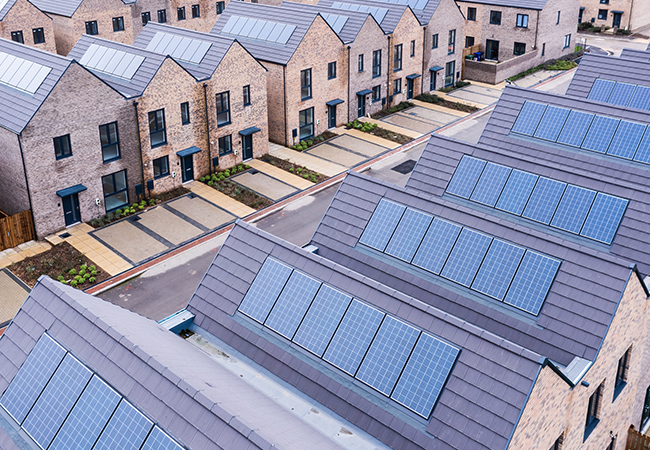
The FHS also requires solar panels equivalent to 40% of each dwelling’s ground-floor area to be installed, with exemptions for buildings more than 18m tall and sites where a 720kWh/year output cannot be achieved.
Specific changes in the new standards include:
- A new functional requirement (L3) for the provision of onsite renewable electricity generation for new homes
- Amending Part L of Schedule 1 to reflect the dual aims of reducing GHG emissions and conserving energy
- Amending the definition of ‘fixed building services’ to include lifts, escalators and moving footways in new buildings other than individual dwellings.
CIBSE welcomed the ‘extensive’ references in the standards to input from the Institution, including its guides and technical memoranda.
The FHS was originally announced under Theresa May’s government, when it was due to be introduced in 2025.