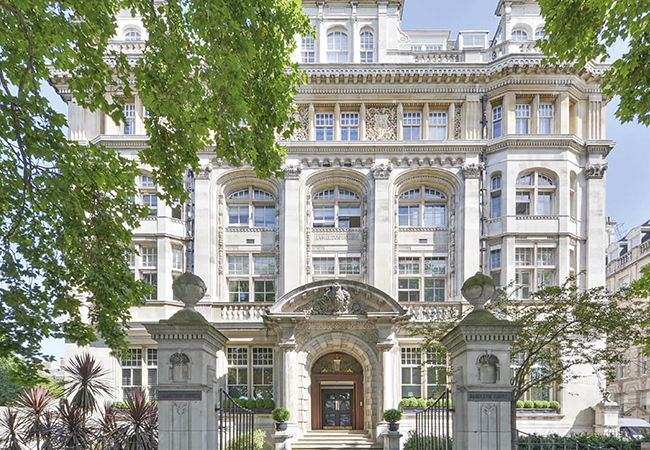
The impressive frontage of Hamilton House, on London’s Embankment
A net zero audit of the recently refurbished Grade II-listed Hamilton House, on London’s Embankment, shows that heritage office buildings can be early adopters of the UK Net Zero Carbon Buildings Standard (UK NZCBS; the ‘Standard’), even if there are no planned retrofit works.
The UK NZCBS pilot version was launched in September 2024, after the refurbishment works of the Victorian office building were completed. Applying the standard retrospectively through a net zero audit provided a structured approach to understanding the building’s current position and the practical steps needed to reach net zero.
Although the refurbishment was not guided by the Standard, developer Dorrington’s intention to operate Hamilton House as a modern, low-energy, all-electric office meant the building was well positioned for participation in the NZCBS pilot programme.
The audit revealed that Hamilton House had met the 2025 one-go operational energy limit of 105kWh.m-2 per year GIA for office buildings (general – whole-building route).1
Dorrington acquired Hamilton House in 2018, with the ambition of transforming it into a modern business centre offering flexible workspace, while retaining landlord control of whole-building systems. Between 2020 and 2024, the building underwent a phased refurbishment to accommodate serviced offices, tech-enabled meeting rooms, breakout spaces, tea points, kitchens and focus booths. Amenities such as a gym, cycle storage and showers were added, and large communal terraces were created, overlooking the Thames and Inner Temple Garden, for occupier wellbeing.
Hamilton House is naturally ventilated, with no mechanical ventilation introduced during the retrofit
Variable refrigerant flow (VRF) systems were installed for heating and cooling, alongside LED lighting and controls, central electric hot-water calorifiers, and a sensor-based energy monitoring system providing floor-level and end-use consumption data.
No fabric upgrades were done because of budgetary and heritage constraints. The building remains naturally ventilated, with no mechanical ventilation introduced. After the works were completed, the building was fossil fuel-free and achieved a significant reduction in energy use intensity, positioning it as a low-energy asset.
This raised some key questions: could Hamilton House achieve ‘net zero carbon aligned’ status today? If not, then when, and what was additionally required to be implemented – and at what cost?
Greengage was commissioned to do a net zero audit to assess the building’s alignment with the Standard and answer these questions.
The building’s refurbishment story
Designed in 1880 by Sir William Emerson, Hamilton House originally served an insurance organisation and, later, various merchants. By 2018, when Dorrington bought the property, it had become an operational business centre with declining occupancy, low rental values and outdated fit-outs that created dark, disjointed spaces. Heating was provided by gas boilers and there was no cooling – leaving south-facing offices uncomfortably warm in summer.
The building required substantial upgrades to be a competitive workspace. To maintain rental income and minimise disruption, Dorrington opted for a floor-by-floor refurbishment over four years, keeping occupiers in situ. This required careful planning to ensure business continuity and maintain expected service levels.
As layers of previous fit-outs were removed, the project team uncovered original terrazzo floors, cornices and mouldings. Generous floor-to-ceiling heights and original flooring were retained, preserving the building’s character and enabling material reuse.
VRF systems were installed with exposed cassette units and pipework, improving maintenance access and avoiding the embodied carbon associated with new suspended ceilings. Local controllers were placed in each office suite for occupier control. The gas boiler was decommissioned only after the final VRF system was installed in 2024, ensuring continuous heating availability throughout the refurbishment and enabling the building to become fossil fuel-free.
Meeting the Standard
Hamilton House met several key requirements of the Standard, including operational energy limits, fossil fuel-free operation, water-use monitoring and HVAC energy tracking. Although the VRF systems use R410A refrigerant, they are exempt from the global warming potential limit as they were installed before the NZCBS’s release.
The building benefits from robust metering infrastructure, with 33 sensors monitoring floor-level end-use energy consumption, voltage and power factor. This wealth of data provided strong evidence for operational energy performance and electricity demand-management reporting.
As the retrofit is complete and no further works are planned, the 105kWh.m-2 GIA per year limit achieved will, once verified, remain fixed for future verifications. The property manager will only need to maintain the existing baseline without capital-intensive interventions.
The net zero audit also identified low-cost building optimisation measures – informed by half-hourly energy, power and voltage data analysis – to further reduce consumption. These fall under non-reportable works, so do not trigger embodied carbon reporting requirements.
Measuring embodied carbon
For Hamilton House, obtaining materials and quantities information about embodied carbon from past contractors proved difficult, particularly where works were delivered under fixed-price contracts.
The Standard provides a data-collection flowchart to support this process, but retrospective reporting will remain a barrier for many buildings. This feedback was shared with the Standard during the pilot testing programme.
For future refurbishments, it is essential to review current design, procurement and construction processes for incorporating mechanisms to collect this data from the outset. Embedding embodied carbon considerations into every stage of refurbishment decision-making will ensure future compliance with the Standard.
The renewable energy challenge
Hamilton House does not currently have solar photovoltaic (PV) installed, so does not meet the Standard’s onsite renewable energy target. A feasibility study assessed potential capacity and annual generation, but the output fell short of the requirement. Installation is also subject to planning approval because of the building’s heritage status.
The Standard recognises such constraints and allows a reduced onsite renewable target to be proposed during verification. From our experience auditing office buildings in Central London, meeting this requirement is a widespread challenge because of competing roof-space demands – including tenant amenity areas, MEP plantrooms and biodiversity features.
Creative approaches, such as building integrated PV, biosolar roofs or solar canopies, may unlock additional generation, but many heritage buildings in such locations may ultimately need to propose reduced renewable energy targets.
The pilot version of the Standard required reporting of embodied carbon associated with refurbishment works undertaken within the embodied carbon reporting period, even if these works occurred before the Standard’s release. Although these works are exempt from meeting embodied carbon limits, gathering the required data retrospectively is challenging (see panel, ‘Measuring embodied carbon’).
‘Net zero carbon aligned’ office buildings
The Standard provides a viable framework for existing office buildings to achieve ‘Net zero carbon aligned’ status. Our audit experience shows that operational energy limits can often be met through low-cost optimisation measures and light-touch upgrades, such as LED lighting, controls improvements, and installation of building management or energy monitoring systems. Many of these interventions are classified as non-reportable works, avoiding embodied carbon reporting requirements. Where reportable works are required, embodied carbon assessments indicate that meeting the limits is achievable for low- to medium-cost measures.
Because the Standard’s limits vary based on the start date of retrofit works, early action is encouraged. Applying the Standard, identifying gaps and undertaking required works sooner allows building owners to lock in a higher operational energy limit that can be maintained for future verifications.
Communal terraces overlook the Thames and Inner Temple Garden to aid occupier wellbeing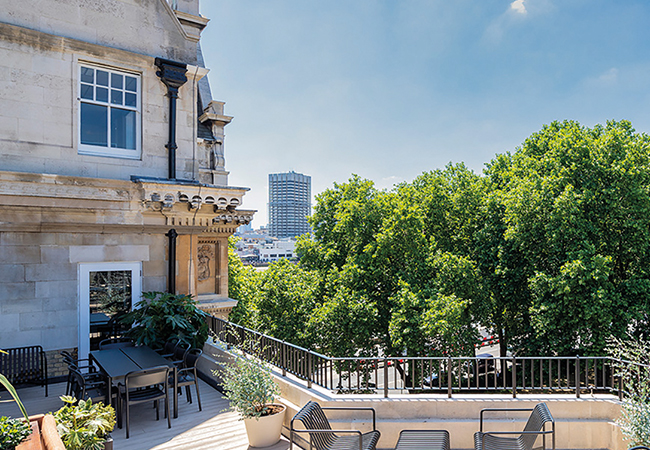
Meeting the Standard in heritage buildings requires careful planning and thoughtful integration of retrofit measures and onsite renewables. Hamilton House demonstrates that it is possible. With Version 1 of the Standard now published, we are reviewing the changes from the pilot and assessing their implications for Hamilton House’s potential verification.
As more real estate companies commit to organisational-level targets through the Science Based Targets Initiative, the Standard’s asset-level limits help bridge the gap and support the sector’s net zero transition in the UK.
Achieving the Standard also unlocks valuable co-benefits – from enhanced asset valuation and reduced climate-risk exposure to stronger appeal to ‘environmental, social and governance (ESG)-conscious’ occupiers, and greater energy independence in today’s volatile markets.
Launch of the Standard
Version 1 of the UK Net Zero Carbon Buildings Standard was published in March 2026. Following extensive pilot testing and wider industry feedback, the draft version was updated for clarity and usability. It includes additional annexes covering landlord- and tenant-only routes to verification, and an optional verified check at practical completion to determine whether a building is on track. A summary of the changes can be found at www.nzcbuildings.co.uk/resources
Watch a video with UK NZCBS CEO Katie Clemence-Jackson at bit.ly/CJKCJ0226
ABOUT THE AUTHOR
Apeksha Gupta is principal consultant ESG and net zero at Greengage Environmental
Note:
No building can be described as net zero carbon aligned until it has been though the UK NZCBS verification process
References:
1 Table OE-2 Energy use intensity limits, Existing Buildings following the one-go route, page 119, NZCBS Version 1