Commercial heat pump installations with fully specified thermal insulation systems
Assuming 1 million active commercial air conditioning systems in the UK, refurbishment of refrigeration pipe insulation could result in an energy saving equivalent to that generated by a medium-sized power station.
This is according to the Thermal Insulation Contractors Association (TICA), which in April published a white paper calling on government to incentivise the adoption of thermal insulation of pipework1.
In ‘Proof is on the roof’, CIBSE Journal Heating Supplement May 2025, TICA technical director, Chris Ridge, and Kaizen Energy Consultancy’s managing director, Lawrence Leask, explained how good specification and installation practices could reduce this profligate waste of energy.
In the white paper, TICA describes thermal insulation as a ‘low-hanging fruit for industrial and commercial decarbonisation’, but says it is an afterthought at each of the design, installation and ongoing inspection/maintenance stages.
On page 38, Leask describes one example of poor insulation in three calorifier inspection hatches, which he calculates are costing the building owners £2,061 a year in energy losses.
The paper suggests the government adopts a standard based on BS EN 17956:2024, which provides A to F energy-efficiency classes for technical insulation systems. Introduced in 2024, the scheme has, according to the white paper, led to European nations – including Germany and the Netherlands – drawing up mandatory performance requirements to incentivise thermal insulation surveys and improvements.
In the Netherlands, businesses subject to the energy-saving investigation obligation must conduct an insulation scan every four years or provide a technical insulation performance check (Tipcheck) not older than two years, and commit to implementing measures with a simple payback period of five years or less.
A Tipcheck is a standardised energy audit designed to evaluate and optimise the thermal performance of industrial and large-scale commercial insulation systems. Developed by the European Industrial Insulation Foundation (EiiF). Tipcheck follows the principles of recognised energy-audit standards EN 16247 and ISO 50002, and assesses insulation performance using the A to F energy-efficiency classes defined in EN 17956.
The white paper also describes how, in Germany, the DIN 4140 insulation installation standard advocates for achieving at least EN 17956 Energy Efficiency Class C. A subsidy programme for small and medium-sized enterprises is offered by the German government to support insulation improvements, covering up to 25% of costs.
EiiF recommends a minimum energy classification for industrial applications and suggests an Insulation Energy Efficiency Class C to EN 17956 for new installations in planning and design stage. For existing systems, it says that Class C be mandatory if the payback period for the insulation improvement is less than five years.
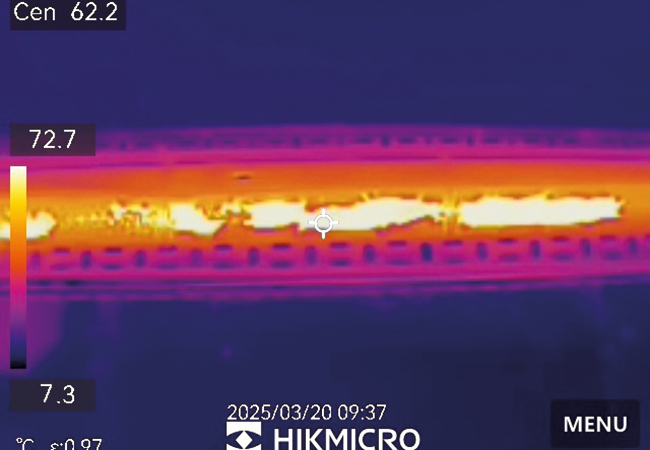
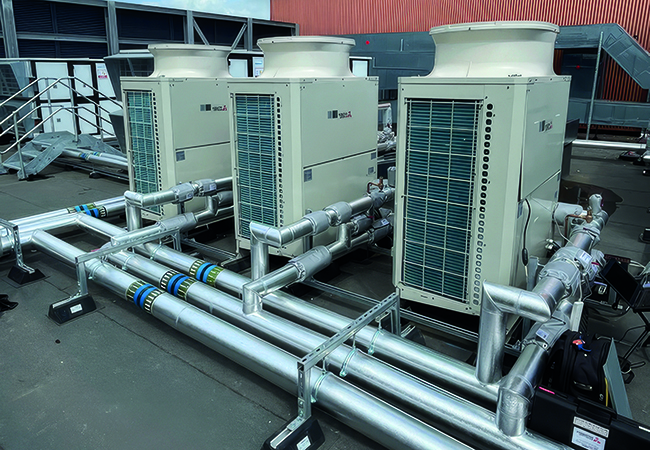
In commercial buildings, the white paper says there are many examples of non-UV elastomeric foam insulants being installed on externally located variable refrigerant flow pipelines, and that degradation of this insulation is adding to operational costs.
Thermal insulation integrity is not fully assessed during statutory TM44 air-conditioning inspections, adds TICA, and it suggests that the government introduce a minimum thermal energy rating similar to the energy rating required for the building.
It is also calling for the adoption of ‘enhanced insulation thicknesses’ in Approved Document L, to encourage additional carbon reduction.
As well as rating schemes, TICA wants government to provide support for training energy managers and FMs on thermal insulation awareness. It is also asking for funding to understand the impact of poor insulation on energy costs and overheating.
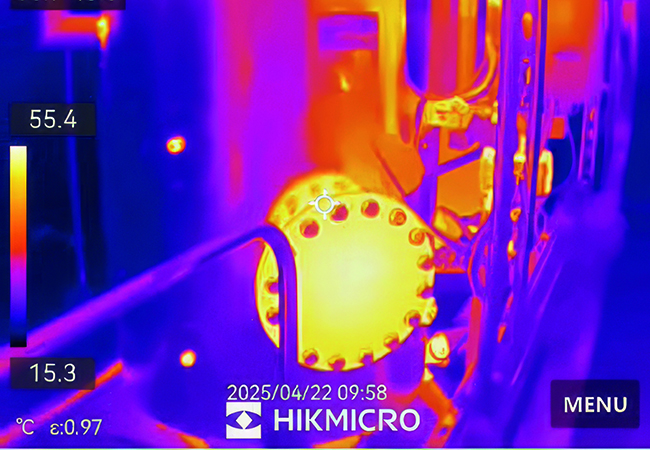
The camera reveals no insulation on the hatch
Identifying the heat-loss culprits
Lawrence Leask, managing director at Kaizen Energy Consultancy, found clear evidence of uninsulated pipework systems when he carried out a TM44 air conditioning inspection (ACI) for a large modern office block.
A TM44 ACI is legally required for any system or group of units that provide heating and cooling with a total cooling output exceeding 12kW (see page 6).
It does not capture heating systems, but Leask says he feels morally bound to report if he discovers something significant or easy to fix.
In this case, he used an infrared camera to identify three 500-litre calorifier inspection hatches (manways) and associated pipework that were poorly insulated (see image, left). ‘If you investigate the calorifier, the temperature of the fluid inside is 60°C, the inspection hatches have a diameter of 400mm and the heat loss will be constant,’ he says.
Assuming the temperature of the fluid inside is 60°C and the heat losses constant, Leask calculated that the energy losses from the three hatches would be 4,122kWh, at an annual cost of £2,061.
He also estimated that the necessary thermal insulation jackets would cost £585 and save 3,821kWh in annual energy losses. This equates to a yearly saving of £1,910 and a 708kg reduction in CO₂ emissions. Leask says the savings meant the payback on investment was only four months.
If these thermal insulation jackets had been installed in 2017, when the need was first identified, the savings over eight years would have amounted to 32,976kWh, representing a cost reduction of £16,488 and a decrease of 5,664kg in CO₂ emissions, adds Leask, who notes there was a Display Energy Certificate (DEC) for the building. This included an operational rating and a range of recommendations for improving energy performance.
The building had a DEC operational rating of F for CO₂ emissions (where A is the best and G the worst). The DEC assessor had recommended insulating the calorifier access cover plate and heating and pump bodies, but recorded the potential impact on carbon emissions as low, which surprised Leask.
In contrast, the building’s Energy Performance Certificate (EPC), which rates the building’s calculated energy performance rather than its actual operation, was A. Its recommendations for improving energy efficiency made no mention of thermal insulation.
For Leask, this highlights how relatively simple insulation improvements can be overlooked in energy assessments. ‘The opportunity to implement a non-invasive measure with a four-month payback period was effectively missed,’ he says.
Access the white paper here