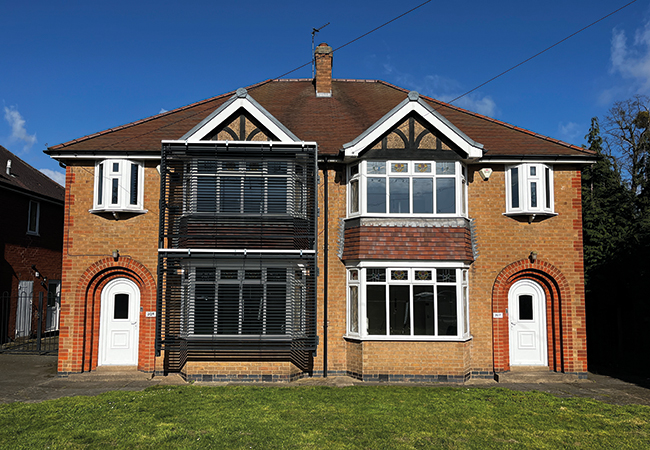
The identical test houses - one with external shading and one without
Can external shading really reduce indoor temperatures by more than 6°C in the UK? Initial results from a series of full-scale experiments on Loughborough University’s twin houses suggest they can. Testing during the summer months of 2025 and 2026 demonstrated that several external shading systems reduced peak indoor operative temperatures and overheating hours significantly.
Overheating has become one of the most pressing challenges facing homes in the UK. Climate projections indicate that heatwaves will become more intense and more frequent, while much of the existing housing stock was designed primarily to retain heat, rather than keep it out. Improving summer performance without increasing reliance on active cooling is therefore a growing priority for designers and policy-makers.
External solar shading has emerged as one of the most effective strategies for limiting unwanted solar heat gains before they enter a building. While the principle is well understood, however, there remains little measured evidence showing how different shading systems perform under real-world conditions.
A series of experiments has been undertaken at Loughborough University, using a pair of identical test houses. The research forms part of the Energy Resilience and the Built Environment Centre for Doctoral Training programme, and is supported by sponsorship from the British Blind and Shutter Association, with additional in-kind support from CIBSE.
In the study electric site lights, controlled by smart systems, replicate heat from occupants, lighting and appliances in both houses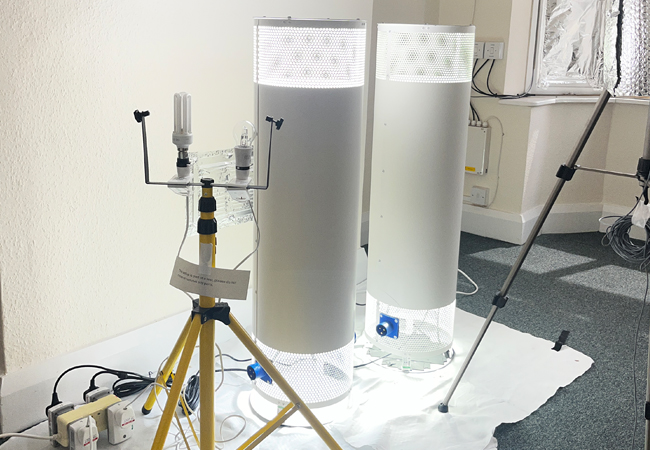
The two south-facing, 1930s semi-detached houses represent the UK’s most common housing type, accounting for around 25% of the stock. They are identical in their construction, layout and refurbishment. Using one as an unshaded reference and the other as a test dwelling fitted with external shading enabled each shading system to be isolated and evaluated under real-world conditions.
To ensure the houses behaved as realistically as possible, matching internal heat gains were generated using synthetic occupancy based on profiles recommended in CIBSE TM59 (2017). In both houses, electric site lights, controlled by smart systems, replicated heat from occupants, lighting and appliances. Night-time ventilation was also incorporated by opening bedroom windows during sleeping hours.
Shading devices evaluated included external roller blinds, external venetian blinds, awnings, Dutch canopies and concertina shutters. The experiments ran over multiple months, exposing each system to conditions from mild spring weather to intense summer heat. High-resolution environmental monitoring recorded indoor operative temperatures, outdoor air temperature, solar radiation and wind speed.
The initial results are clear: external shading can make a substantial difference. During heatwave periods, some shading devices reduced peak indoor operative temperatures by more than 6°C compared with the unshaded reference house. For several shading devices, overheating hours reduced by more than 50%. In bedrooms, night-time ventilation reduced the duration of elevated temperatures after hot days.
The findings reinforce the importance of controlling solar heat gains at source and providing opportunities for excess heat to escape as outdoor temperatures fall. The results revealed that not all shading systems are equal. Geometry, openness, projection, slat angle and operation all influence performance.
By generating high-quality real-world datasets for future modelling studies and developing methods to compare shading systems, this research provides practical evidence to support wider adoption of passive cooling measures across the UK housing sector.
An abstract has been submitted to the CIBSE Technical Symposium 2027, where full results will be presented.
ABOUT THE AUTHOR
Niloo Todeh Kharman is a doctoral researcher, Building Energy Research Group, Loughborough University