
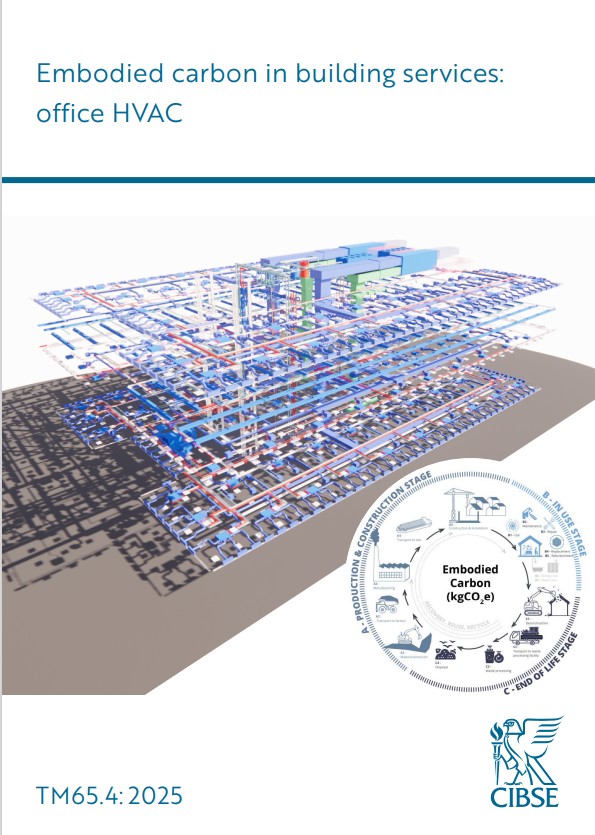
CIBSE has published TM65.4 Embodied carbon in building services: office HVAC, a new guide that provides vital insights into the life-cycle embodied carbon impact of the heating, ventilation and air conditioning (HVAC) typically used in UK office buildings.
Developed by Introba, and sponsored by CIBSE and Introba, the research investigates the embodied carbon of HVAC equipment and design strategies at product and system levels, helping engineers, designers and sustainability professionals make informed decisions that support net zero design goals.
The guide draws on manufacturers’ data and applies TM65 methodology to calculate embodied carbon impacts. It focuses on the embodied carbon of HVAC systems in a typical new-build, five-storey office building in the UK, comparing two timeframes: a typical building service life (60 years) and a tenancy period (12 years).
This approach highlights how design strategies influence carbon outcomes over time and supports decision-making at different stages of the building life-cycle.
TM65.4 represents an important first step towards understanding the embodied carbon implications of different HVAC design strategies in office environments. Where Environmental Product Declarations are not available, the results of this study can provide useful benchmarks at the early design stage.
TM65.4 Embodied carbon in building services: office HVAC is available at www.cibse.org/knowledge
A webinar introducing TM65.4 is taking place on 19 November. Register at www.cibse.org/growyourknowledge