
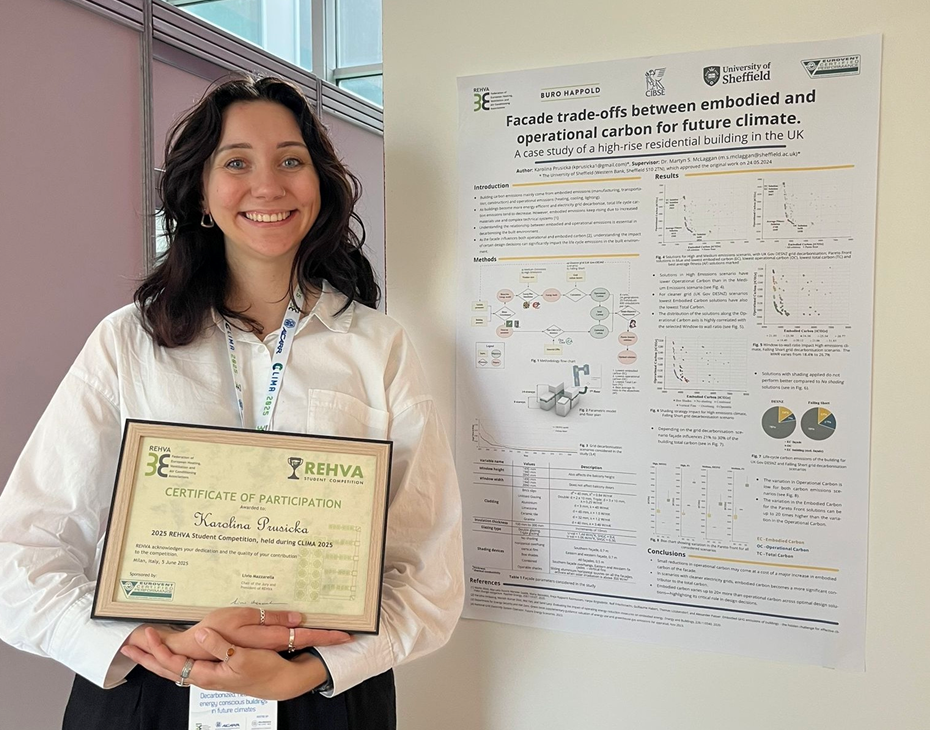
University of Sheffield graduate Karolina Prusicka – a sustainability and physics engineer at Buro Happold – represented CIBSE in the REHVA Student Competition at the CLIMA 2025 conference in Milan.
Her entry, based on her final-year degree project, investigated how façade design influences embodied and operational carbon in high-rise residential buildings.
Using a parametric model and multi-objective optimisation, the study analysed more than 600 façade configurations. Its findings show that operational carbon (OC) is strongly influenced by the window-to-wall ratio, while embodied carbon (EC) is more sensitive to material choices and shading approaches.
Under low carbon Grid scenarios, EC often becomes the dominant contributor to total emissions, with strategies that reduce OC, such as increased insulation or solar shading, potentially adding significantly to EC. The study concluded that optimising façade design for future performance requires a careful balance between EC and OC.
Prusicka was one of 13 finalists from across Europe. The competition was won by Beniamino Fambri, of Italy, with a paper on the detection and diagnosis of water-to-water heat pump faults using artificial neural networks.