

Sponsor: Mixergy
As buildings become more energy efficient and heat pumps increasingly replace higher-temperature heat sources, domestic hot water (DHW) presents designers with a particular challenge. This CPD considers how stratification, improved sensing and smarter control of hot-water storage may help reduce energy use and carbon emissions while maintaining appropriate water hygiene.
The changing challenge of hot water
Traditionally, providing DHW has been relatively straightforward. Fossil-fuel boilers could readily generate water at 60°C or above, while the energy associated with hot-water production and storage was often relatively modest compared with the energy required for space heating. That balance is changing.
Improved building fabric, lower air permeability and more efficient heating systems are progressively reducing space-heating demand. DHW demand does not necessarily fall at the same rate, as people still shower, wash and use hot water. Consequently, DHW can represent an increasingly significant proportion of the energy consumed in a low-energy building. At the same time, electrification of heat is increasing the application of heat pumps. These are generally most efficient when producing lower-temperature water, so requiring one to raise the temperature of stored DHW can reduce its coefficient of performance (COP).
A 2023 Government Office for Science expert roundtable1 on heat pump technology noted that, whereas the higher temperatures available from gas boilers suit both space heating and hot-water production, lower-temperature heat pumps are less naturally suited to DHW production. This means that the lower temperatures that can improve heat pump efficiency and reduce storage and distribution losses must be reconciled with the temperatures required to maintain appropriate water hygiene. Effective DHW design therefore needs to provide the required quantity of hot water when it is needed, while minimising unnecessary energy consumption and maintaining an appropriate and demonstrable regime for controlling microbiological risk.
The energy cost of storing hot water
A conventional hot-water cylinder is, fundamentally, a thermal store. Energy is put into the water before it is required and retained until there is a demand. The greater the volume heated, and the higher its temperature above the surrounding environment, the greater the quantity of stored energy.
However, storage inevitably results in heat loss through the cylinder insulation and from associated pipework. Increasing the temperature difference between the stored water and its surroundings increases this heat transfer. Consequently, maintaining an entire cylinder at a high temperature when only a small proportion of its contents will shortly be required can result in unnecessary energy use.
This is not a new problem. Research2 undertaken for the former Department of Energy and Climate Change into hot-water cylinders and heat pumps found that storage losses could significantly affect overall DHW efficiency, and concluded that lower heat pump flow and storage temperatures, combined with periodic sterilisation, offered the best system efficiencies in the systems examined.
Modern energy modelling is becoming more sophisticated in its treatment of these effects. The Home Energy Model3 separately considers hot-water demand, storage-tank losses and pipework losses, including the influence of pipe dimensions, insulation and the temperature difference between the water and its surroundings. In commercial buildings, distribution can be particularly important. Long pipe runs and secondary circulation systems may maintain substantial quantities of water at elevated temperature continuously. Improving the efficiency of the heat generator or cylinder while ignoring distribution losses risks optimising only one part of the system.
Do we need to heat the whole cylinder?
A nominal 300-litre cylinder does not mean that 300 litres of hot water must always be available. The useful capacity depends on the temperature and stratification of the water in the cylinder, the incoming cold-water temperature, the required delivery temperature and the pattern of demand.
As hot water is less dense than cold water, appropriately designed storage vessels can develop thermal stratification, with hotter water towards the top and cooler water below. As hot water is normally drawn from the top of the store, a useful quantity can potentially be available without the entire contents being at the same temperature. The principle is recognised explicitly in the developing Home Energy Model methodology,4 which models a hot-water store as layers, with draw-off occurring initially from the upper layer, with incoming cold water entering the lowest layer.
Maintaining stratification can allow a store to be considered in terms of usable hot-water volume rather than simply nominal cylinder capacity. In some actively controlled hot-water cylinders, controlled circulation can be used to manage the heated volume from the top down, allowing the proportion of the store that is heated to reflect anticipated demand.
This is not necessarily the optimum strategy with every heat source. Where an external heat pump supplies an indirect cylinder through a plate heat exchanger, charging the complete store may provide more favourable heat pump operation. By allowing much of the stored hot water to be used before reheating, the subsequent charging cycle starts with cooler water and provides a longer heat-pump run, reducing cycling and allowing more of the charging period to take place at lower water temperatures and potentially higher COP. A suitably designed external plate heat exchanger can also provide effective heat transfer between the heat pump circuit and stored water, helping to minimise the temperature difference required between them and, hence, the heat pump flow temperature.
The appropriate charging strategy therefore depends not only on the quantity of hot water required, but also on the characteristics of the heat source and its connection to the store. Where partial-volume heating is employed, potential benefits include reduced standing losses and shorter recovery to a useful quantity of hot water. Both partial- and whole-volume charging strategies can provide greater flexibility over when energy is put into the store.
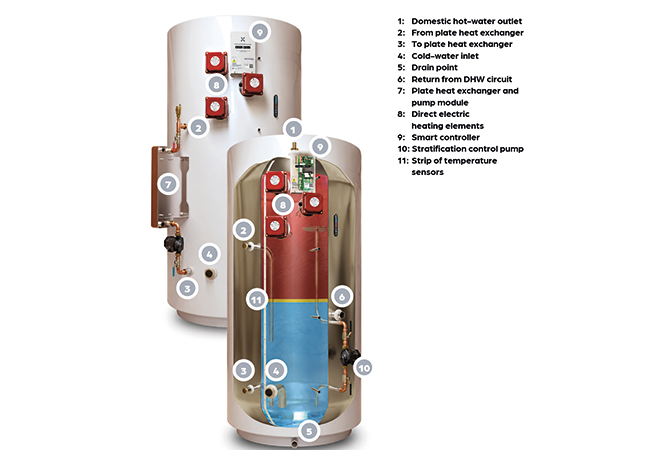
Figure 1: Example of a commercial hot-water cylinder using an external plate heat exchanger for indirect heating. When connected to an external heat pump, the complete store is heated during each charging cycle and the controls can delay charging until much of the available hot water has been consumed. The cylinder controls can also respond to PV generation and time-of-use tariffs, and use learned demand patterns to optimise the timing of water heating (Source: Mixergy)
Water hygiene sets a boundary
Maintaining regions of a cylinder at lower temperatures introduces another important consideration – water hygiene. Legionella bacteria occur naturally in water and can multiply under favourable conditions. The Health and Safety Executive (HSE)5 identifies water temperatures between 20°C and 45°C as suitable for legionella growth, particularly where other favourable conditions, such as stagnation and available nutrients, are present. Temperature control remains the traditional strategy for reducing risk in hot- and cold-water systems.
For conventional temperature-controlled hot-water systems, HSE guidance is clear that hot water should be stored at 60°C or above and distributed so that it reaches 50°C within one minute at outlets, or 55°C in healthcare premises.6
HSE guidance also emphasises that legionella control is not solely a matter of cylinder temperature. System design and operation should avoid stagnation and unnecessarily long pipe runs, remove dead legs and blind ends where possible, flush infrequently used outlets, and manage scale, sludge and contamination. This is particularly significant when considering lower-temperature storage. It is important not to confuse the 50°C distribution criterion with an acceptance that stored water may simply be maintained at 50°C. There is, however, an underlying time-temperature relationship in the thermal inactivation of legionella – the rate of die-off increases substantially as temperature increases. This provides the basis for considering control regimes in which normal operation takes place at lower temperatures, combined with periodic thermal disinfection.
CIBSE’s 2026 Domestic heating design guide7 now includes consideration of DHW storage below 60°C together with thermal-disinfection procedures (see section 4.5.1.1 of the guide).
A CIBSE Domestic Building Services Panel factsheet8 similarly notes that daily-use DHW temperatures may typically be between 50°C and 60°C, but recommends a controlled weekly thermal-disinfection cycle that is likely to heat all stored water to at least 60°C for at least one hour.
Lower-temperature operation cannot simply be justified on the basis that it saves energy. The complete hygiene-control strategy needs to be considered and, where an alternative to established guidance is proposed, its effectiveness needs to be appropriately demonstrated.
Temperature, measurement and water hygiene
Improved temperature sensing provides an opportunity to monitor and control the thermal condition of the store more precisely. A conventional cylinder may provide relatively limited information about its internal condition. A thermostat at a single location can indicate whether a particular temperature has been reached there, but does not necessarily reveal the temperature profile throughout the store.
Actively stratified hot-water cylinders can use controlled circulation and temperature sensing to manage the thermal boundary between heated and cooler water, allowing only the volume required to meet anticipated demand to be heated. Multiple temperature measurements through the height of a stratified store can also provide an indication of its state of charge, rather than simply whether a thermostat is calling for heat. From the temperature profile, the available quantity of hot water or stored energy can be estimated, providing additional information for monitoring and predictive control. In an actively controlled hot-water cylinder, a periodic cleansing cycle can extend the heated volume through the complete cylinder, including its lower and normally coolest region. Temperature sensing at or near the bottom of the cylinder can be used to confirm that the selected cleansing temperature has reached the lowest part of the store.
Continuously logged temperatures at several heights can also provide a record of conditions within the store, including confirmation that the lowest monitored region has reached the specified cleansing temperature. Such records may support monitoring and the site-specific risk assessment, but do not in themselves demonstrate control of legionella risk throughout the complete DHW system.
The cylinder cleansing cycle does not, however, constitute thermal disinfection of the complete DHW system. HSG274 describes thermal disinfection as a specific whole-system procedure involving appropriate temperatures and duration, circulation through the system, sequential operation of outlets and temperature verification. Cylinder temperature control therefore remains only one component of the overall legionella-control strategy. Any alternative operating strategy needs to be considered as part of the system-specific risk assessment and appropriately demonstrated.
A controllable thermal store
Once the temperature distribution within a cylinder can be measured and controlled, the store potentially becomes a more active component of the energy system. Instead of the simple instruction to maintain a complete cylinder between two thermostat limits, charging can potentially respond to anticipated demand. If a building normally requires a known quantity of hot water at a particular time, sufficient water can be heated in advance rather than maintaining maximum storage continuously. In some systems, machine-learning algorithms can use historical demand data to anticipate hot-water requirements and adjust the volume and timing of charging accordingly.
Charging may also be coordinated with external signals, including available PV generation and time-of-use electricity tariffs. Where surplus PV electricity would otherwise be exported, for example, it can instead be used to charge the hot-water store, allowing the cylinder to act as a relatively inexpensive thermal battery.
For example, at CIBSE’s London headquarters, an actively controlled hot-water cylinder has recently been integrated with the variable refrigerant flow (VRF) system serving the newly constructed Manly Trust Skills Centre, enabling recovered heat to be used for DHW production.
Smart control also creates opportunities to shift electricity demand in response to time-of-use tariffs or electricity-system conditions. Control can therefore extend beyond determining when the cylinder calls for heat to consider how much heat should be stored, at what temperature, from which source and at what time.
From energy efficiency to whole life carbon
Reducing delivered energy is important, but it should not be the only measure used to assess an improved DHW system.
Operating a heat pump at lower temperatures can improve efficiency and reduce operational electricity consumption. Reducing average cylinder temperature and the volume maintained hot can reduce standing losses. Better control of charging may allow greater use of locally generated renewable electricity and lower-cost or potentially lower-carbon Grid electricity.
The improved knowledge of the state of the store can also inform plant sizing. Where the state of charge and recovery performance can be determined, storage volume and heat-generator capacity can be assessed against the expected demand profile. In some applications, this may allow reduced storage volume or heat-generator capacity, and potentially reduce peak electrical demand, although this will depend on the particular load profile and required recovery time. If that results in smaller heat-generation equipment, there may also be benefits in capital cost and embodied carbon.
However, whole life assessment should also recognise what is added. Pumps, sensors, electronic controls and communications equipment contain materials and embodied carbon, and may have shorter service lives than the vessel itself. Maintainability, replaceability and eventual disposal, therefore, form part of the assessment. Claims for whole life carbon reduction should consequently be supported by appropriate evidence, rather than inferred automatically from operational energy savings.
The commercial opportunities and challenges
These considerations become particularly interesting as smarter storage moves from homes into commercial buildings. Commercial DHW demand is extremely diverse. Hotels, sports facilities, offices, educational buildings and other applications have very different demand profiles. Some have predictable peaks and others have prolonged periods of little demand followed by intensive use. This makes storage potentially valuable, but it also means that sizing and control based simply on nominal cylinder capacity may miss opportunities for optimisation. Heat source, storage, distribution, controls, usage and water hygiene together determine overall performance.
Smarter storage
Decarbonising DHW does not mean pursuing the lowest possible storage temperature. The aim is to minimise unnecessary energy use while meeting hot-water demand and maintaining appropriate water hygiene. That means questioning how much water genuinely needs to be hot, when it needs to be heated, how heat can be generated most efficiently, and how its hygienic condition can be demonstrated.
There is no single optimum charging strategy. Whether it is better to maintain stratification and heat only part of the store, or to charge the complete volume, will depend on the demand, heat source and wider energy system. Improved sensing and control provide greater scope to manage these interactions, allowing the hot-water cylinder to become an active part of the building energy system rather than simply a passive store. This has the potential to reduce energy costs and operational carbon while providing greater flexibility. These benefits, however, should not come at the expense of water hygiene or simply shift energy and carbon impacts elsewhere in the system. l
© Tim Dwyer, 2026.
References:
1 Government Office for Science. What impact can heat pumps have in domestic heating today, and how might that change over time as technology improves? London: Government Office for Science; 2023.
2 Kiwa Gastec at CRE. Investigation of the interaction between hot water cylinders, buffer tanks and heat pumps. London: Department of Energy and Climate Change; 2013.
3 Department for Energy Security and Net Zero. Home Energy Model: technical documentation. London: DESNZ; 2026.
4 Department for Energy Security and Net Zero. HEM-TP-11: Hot water storage tanks. London: DESNZ; 2026
5 Health and Safety Executive. Legionnaires’ disease: Technical guidance. Part 2: The control of legionella bacteria in hot and cold water systems (HSG274 Part 2). HSE; 2024.
6 Health and Safety Executive. Hot and cold water systems – Legionnaires’ disease. HSE.
7 CIBSE. Domestic Heating Design Guide. 11th ed. London: Chartered Institution of Building Services Engineers; 2026. ISBN 9781918034196.
8 CIBSE Domestic Building Services Panel. Heating and Heat Pump Factsheet. CIBSE.