

Swimming pools are among the most energy-intensive buildings in the leisure sector, with an indoor-pool leisure centre potentially using around seven times as much energy per square metre as an average commercial office1.
Heating the pool and maintaining warm, humid conditions are obvious contributors, but a substantial energy load is less visible – continuously circulating water through filtration and treatment systems.
A developing body of UK research suggests there may be significant scope to reduce that energy demand without compromising water quality or bather safety. The research also questions whether circulation should continue to be determined primarily by fixed turnover periods, rather than responding to bathing load and actual treatment performance.
Assessing circulation energy
The research has developed over several years. In 2019, Martin Wood and Lester Simmonds, of Pool Sentry*, working with researchers from Cranfield University and Public Health Wales, reviewed2 the role of filtration in managing cryptosporidium risk in commercial pools.
This was followed in 2021 by work3 involving Wood, Simmonds and Loughborough University’s Timothy Marjoribanks that revisited the long-established Gage-Bidwell Law of Dilution (see panel, below) and considered how effectively filtration removes contaminants from a well-mixed pool. That work helped provide a scientific basis for relating circulation requirements to the number of bathers – effectively the pollution load – rather than relying solely on the time taken to circulate a volume equivalent to the entire contents of the pool.
The potential energy consequences of this approach were explored4 much more extensively by Marjoribanks, Simmonds and Wood in a 2025 paper in CIBSE’s Building Services Engineering Research & Technology (BSER&T). Using Sport England data for 6,433 non-domestic pools, the researchers estimated that circulating pool water in accordance with current UK guidance consumes around 369GWh of electricity annually, costing approximately £100m. Filter backwashing, including replacement water and its reheating, adds another £22m. The resulting carbon footprint of circulation, water and associated heating was estimated at 98,400tCO₂e per year.
The study then considered what happens if circulation becomes more responsive to actual requirements. Reducing pump speed while pools were closed was estimated to cut circulation energy by 36%. Reducing flow to 80% of design flow during periods of relatively low bathing load could save another 19%.
The researchers calculated that applying both measures could reduce circulation energy by around 55%. Combining these operational changes with improvements in pumping efficiency towards Passive House Institute guidance5 (specific energy-efficiency target of 25-40W per m3.h-1 of circulating water) increased the potential saving to as much as 70%.
While achieving this standard is highly desirable, the authors of the paper note that it can be a slow, expensive process to implement. In many existing legacy pools, fundamental design defects in the pipework and system hydraulics mean that achieving Passive House targets is not always practically or economically viable.
These are modelling results, and the authors acknowledge considerable uncertainty in pool geometry, bathing loads, plant performance and operating practices. Importantly, however, the paper also presents measured results from two contrasting pools where pump-speed setback had been implemented.
The Gage-Bidwell law and filter efficiency
The 1926 Gage-Bidwell Law of Dilution states that, in a perfectly mixed pool, a single volumetric turnover (Tw) recirculates only 63.2% of the water, leaving 36.8% untouched. Consequently, it takes six volumetric turnovers to recirculate 99.7% of the pool’s water volume.
However, a critical design pitfall is confusing water recirculation with actual particle removal. The classic dilution equation, C/C0 = e-T, implicitly assumes 100% filter efficiency (E = 1.0), meaning every contaminant particle passing through the filter media is trapped on the first pass.
In practice, commercial sand filters often operate at much lower efficiencies, sometimes between 20% (E = 0.2) and 50% (E = 0.5) because of high filtration velocities, lack of proper coagulation or inadequate backwashing.
When filter efficiency is compromised, the actual rate of contaminant decay is significantly slower, governed by the modified decay model: C/C0 = e-ET. To reconcile this, the particle-turnover time (Tp = Tw / E) provides the actual time required to remove 63.2% of physical particles (such as cryptosporidium).
If E falls below 50% because of poor coagulation, six turnovers are mathematically insufficient to safeguard pool users, proving that filtration performance is as critical as pumping rates.
Source: Simmonds et al, 2021 and Marjoribanks et al, 2025
Bathing loads
Open-period circulation energy fell by 31% and 39%, while closed-period consumption fell by 29% in both cases, without deterioration in the reported turbidity or free-chlorine indicators.
The researchers also compared the UK’s Pool Water Treatment Advisory Group (PWTAG6) guidance with the German DIN 196437 standard. For more than 40% of the pools analysed, the difference exceeded 20% – potentially corresponding to a much greater difference in pumping energy. Both approaches are intended to provide safe, attractive pool water.
The argument has since moved beyond simply identifying potential energy savings. In 2026, Wood, Simmonds and Marjoribanks joined researchers and public health specialists from several European countries to examine8 how commercial pool circulation requirements are determined across Europe.
Their paper identified two broad approaches: traditional turnover periods based largely on pool type, and circulation determined by bathing or pollution load. The second approach reflects the principle that bathers are a principal source of contamination, so treatment requirements should have some relationship to the number of people actually using the pool.
This does not mean simply turning down the pumps when the pool looks quiet. Adequate disinfectant concentration must be maintained throughout the pool, filtration must remain effective, surface extraction and chemical dosing must continue to operate correctly, and the pool hydraulics must avoid poorly treated areas. Any reduction therefore needs to be supported by monitoring and an understanding of the performance of the particular pool.
Nor is this thinking entirely absent from current UK guidance. The PWTAG already recognises circulation related to bathing load, including the treatment of 1.7m³ of water per bather, and its guidance allows variable-speed drives to reduce circulation during periods of low use, subject to appropriate safeguards.
The 2025 research, therefore, did not trigger a sudden change in PWTAG requirements. The accumulating research points towards a potentially more significant evolution – from circulation primarily prescribed by fixed turnover periods towards an evidence-based approach that responds to bathing load and demonstrated treatment performance.
For building services engineers, the broader question is a familiar one. Much building services plant is sized for peak conditions that occur relatively infrequently, yet can subsequently be operated as though that peak demand were permanent.
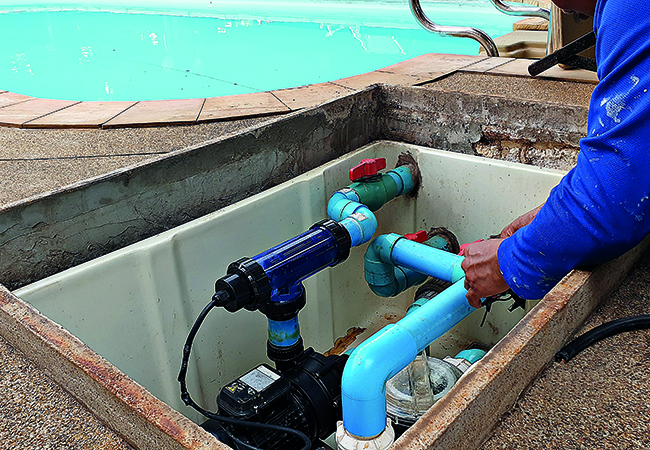
A technician fixing a swimming pool water pump
Variable-speed control
Swimming pool circulation provides another example of where better sensing, variable-speed control and a clearer understanding of actual load may allow plant to respond to demand, rather than operating continually for peak conditions.
The potential energy savings are substantial, but the developing research is equally clear that they must be demonstrated alongside effective filtration, disinfection and pool hydraulics.
The objective is not simply to circulate less water, but to determine how much treatment is actually required to maintain safe water for swimmers.
*Wood and Simmonds are employed by Pool Sentry, which provides pool monitoring, control and energy optimisation services, an interest declared in the 2025 paper. The authors reported no external funding for the research.
References:
1 Duverge, Jean Jonathan and Priyadarsini Rajagopalan. ‘Assessment of factors influencing the energy and water performance of aquatic centres’, Building Simulation (2020) 13: 771-86.
2 Wood M, Simmonds L, MacAdam J, Hassard F, Jarvis P, Chalmers R M. ‘Role of filtration in managing the risk from cryptosporidium in commercial swimming pools – a review’, Journal of Water and Health (2019) 17(3): 357-70
3 Simmonds L P, Simmonds G E, Wood M, Marjoribanks T I, Amburgey J E. ‘Revisiting the Gage–Bidwell Law of Dilution in relation to the effectiveness of swimming pool filtration and the risk to swimming pool users from cryptosporidium’, Water (2021) 13(17): 2350.
4 Marjoribanks T I, Simmonds L P, Wood M. ‘Balancing environmental, economic and public health: The cost of swimming pool water circulation’, Building Services Engineering Research & Technology (2025) 46(4): 529–44.
5 Gollwitzer, E, Grove-Smith, J, Peper, S, Schulz, T, Ahrens, O and Kaluza J. (2021). Passive House concept for indoor swimming pools: guidelines. Darmstadt, Germany: Passive House Institute.
6 PWTAG Technical Note 49 – Swimming pool circulation pumps and variable speed drives, accessed 28 Aug 2026
7 DIN 19643-1:2023-06. Treatment of water of swimming pools and baths – Part 1: General requirements. Berlin: Beuth Verlag.
8 Wood M, Simmonds L P, Chalmers R M, et al. ‘Managing bathing loads and circulation rates in commercial swimming pools: Rationale and perspective from UK and Europe’, Water (2026) 18(6): 713