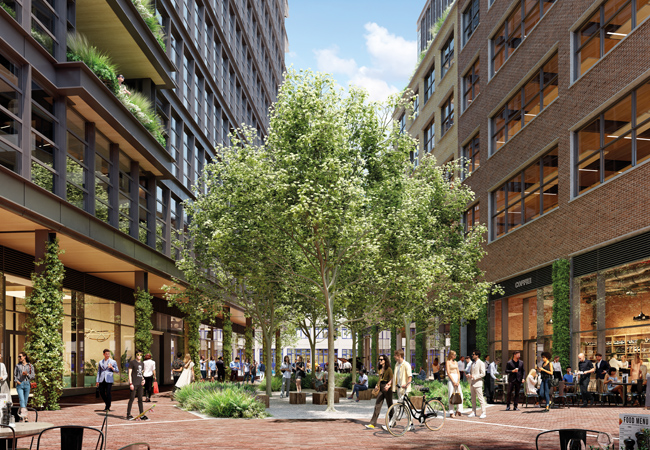
Timber Square is a landmark net zero carbon development in Southwark, London
London mayor Sir Sadiq Khan has proposed minimum energy standards that major new developments in the capital must meet. His Draft London Plan, published for consultation in July, sets out proposed baseline standards for space heating and energy use.
Space heating demand for all major schemes should not exceed 20kWh.m-2 per year, while the minimum energy use intensity baseline is set at varying levels for six types of new-build development: residential, office, primary school, industrial, hotel and student accommodation. These range from 40kWh.m-2 per year (residential) to 120kWh.m-2 per year (hotels).
Any development falling outside of these categories must establish performance using recognised industry benchmarks, such as the UK Net Zero Carbon Buildings Standard (UK NZCBS), as noted in the policy guidelines.
The plan’s GRH1 policy on energy efficiency also stipulates that major developments should produce, store and use renewable energy on site, while annual in-use energy demand should be monitored and reported for at least five years post-construction.
The plan strongly opposes air conditioning, which it says should be an absolute last resort, in a bid to thwart the growth of urban heat islands. It supports data centres in clusters of such developments where opportunities for heat recovery exist and both electricity and water are available.
In a blog on the Draft London Plan, Cundall sustainability associate Cyril Knabe-Nicol, writes that the proposed changes signal a ‘decisive shift’ in the capital’s sustainability strategy: ‘This is more than a policy update. It marks a transition from demonstrating compliance to proving performance.’