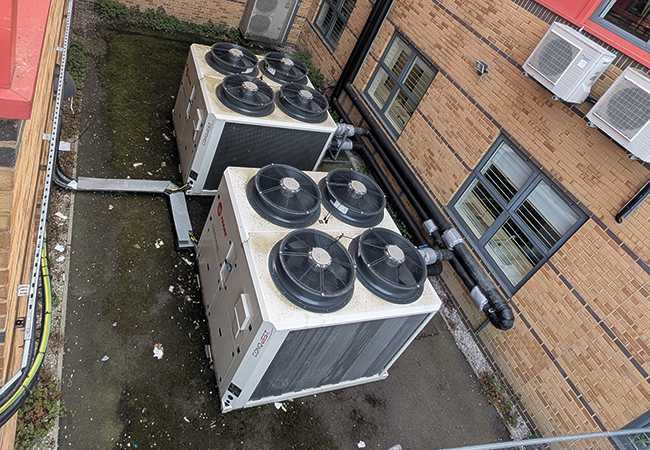
The two ASHPs in the school courtyard
Air source heat pumps (ASHPs) are increasingly being chosen by schools to replace fossil-fuel heating. Although this supports UK net zero commitments, there have been cases when ASHP noise has become disruptive in classrooms.
A good acoustic environment is essential for children’s learning. Chronic high noise levels are linked to lower results and higher reported noise annoyance by pupils and teachers.
This case study of an ASHP installation at a secondary school in Manchester1 shows how careful ASHP siting can reduce noise emissions to classrooms.
Two pumps were installed in a courtyard, between two and five metres from classroom windows that often need to be open for cooling and ventilation while other parts of the school require heating. Providing effective screening for large ASHPs is difficult because of the physical size, directivity and low-frequency content of sound emissions.
Microphone positions. UW: Upper window. LW: Lower window. U/LWB: Upper/Lower window back.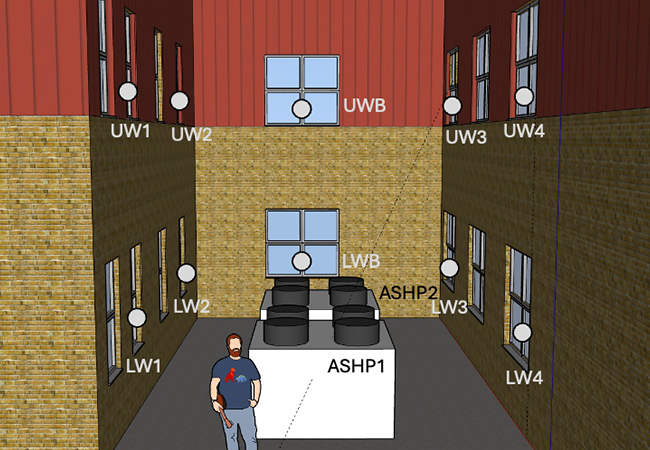
Furthermore, the placement of the ASHPs, enclosed by reflective surfaces on three sides (and the ground), could create low-frequency resonances and mid- to higher-frequency flutter echoes and reverberation.
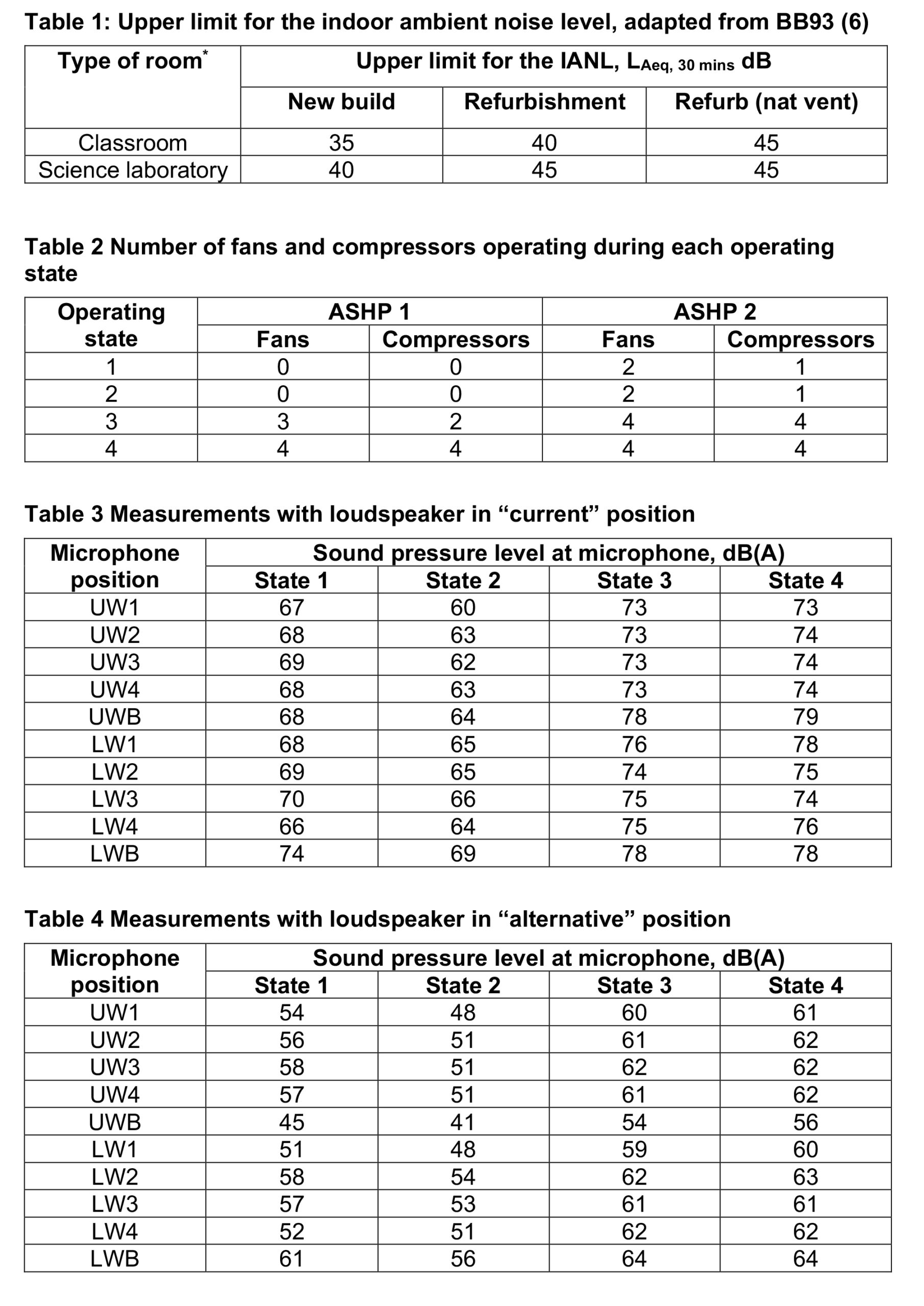
In the UK, schools must comply with the maximum indoor ambient noise levels (IANLs) set out in Building Bulletin 93 (BB93) (6); see Table 1. Noise from ASHPs is included in the IANLs.
Sound pressure levels (SPLs) at approximately 10cm from the five ground-floor and five first-floor classroom windows were measured with the ASHPs in four operational states – from only two fans and one compressor working in one ASHP, to all four fans and compressors operating in both ASHPs. (see Table 2).
The second part of the study played pink noise (a rainfall-like sound with balanced energy across octaves) through a loudspeaker to simulate the ASHP SPL at the classrooms in the current and an alternative location.
Loudspeaker position used to represent alternative ASHP placement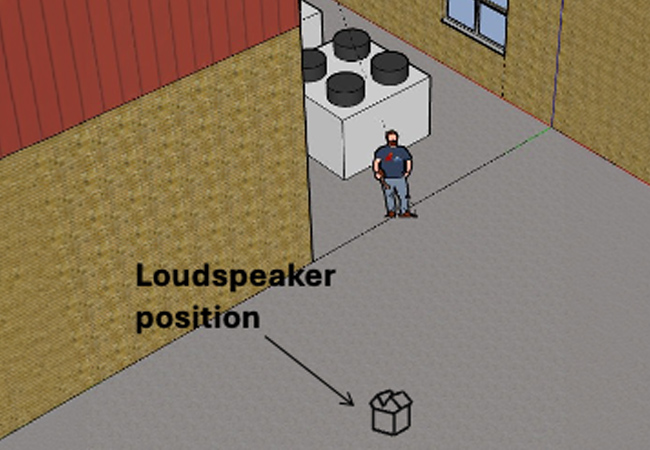
In the current ASHP location, the SPLs measured at the windows ranged between 60 and 69dB(A) in the quietest operating mode, and 73 and 79dB(A) in the loudest mode. Even assuming a best-case 15dB reduction across the open window, the SPLs inside the rooms do not meet the BB93 criteria (see Table 3).
In the alternative ASHP location, the calculated SPLs range from 41 to 56dB(A) in the quietest operating mode and 56 to 64dB(A) in the loudest mode. In the quieter modes, at least eight of the 10 classrooms are likely to meet the BB93 criteria (see Table 4).
In the higher operating modes, most classrooms still exceed the criteria, but by a smaller margin.
This provides scope for other mitigation options to become more effective, such as allowing ASHPs to operate at a lower capacity during teaching hours.
In the current location, even restricted ASHP operation during teaching hours would not meet the BB93 criteria if windows are open.
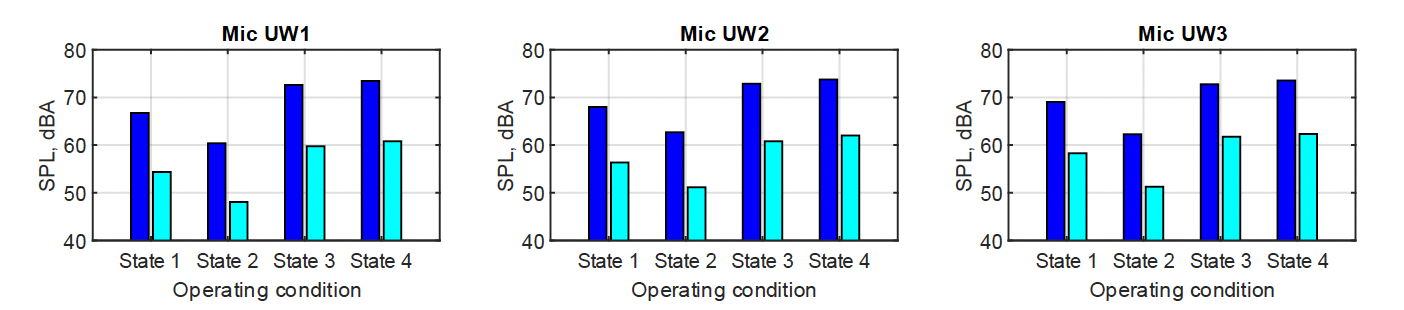
Measurements from three microphone positions for the four operating conditions. (Current position is dark blue; alternative position is light blue). Note that even with a heat pump in the alternative position the BB93 criteria is not met (BB93 upper limit is 45 dB(A) for refurbished classrooms with natural ventilation.)
The study demonstrates the importance of placement for minimising noise issues, highlighting that this should be assessed at an early stage, including reviewing the criteria for noise in schools given in BB93 (6) and local authority requirements.
The usage requirements and context should be reviewed in detail, including: understanding the heating, cooling and ventilation requirements throughout the school, and the implications of this for ASHP operation and scheduling; the required hours of operation of the ASHPs; and the use requirements of rooms close to the heat pumps.
ASHPs should be located as far as possible from classrooms. Use should be made of natural screening by school buildings, with less sensitive spaces on the side close to ASHPs.
ABOUT THE AUTHOR
Katie Salter is a PhD student at the Acoustics Innovation Institute, University of Salford. Read a longer summary of her paper, with references, at cibsejournal.com
References:
1 Salter, K et al. (2026) Heat pump noise in schools: influence of heat pump placement on noise exposure. CIBSE Technical Symposium 2026, Loughborough University, 26-27 March