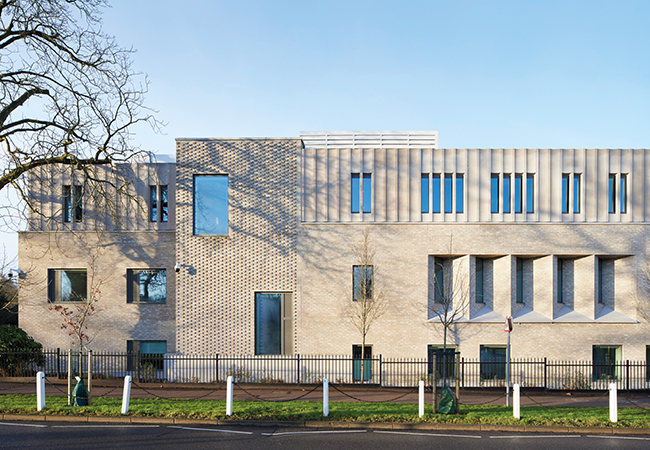
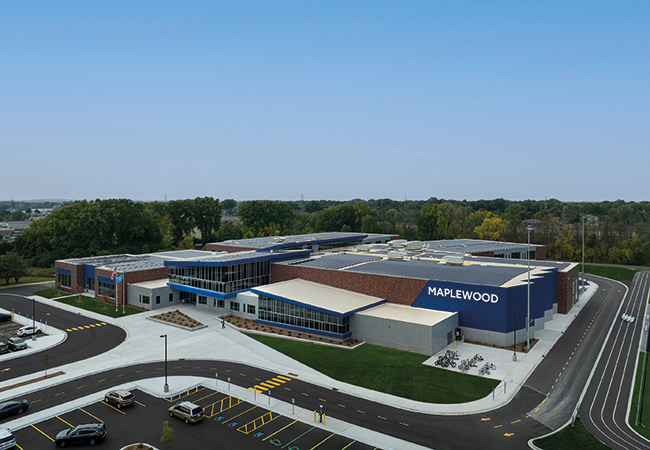
A visualisation of Menasha Maplewood Middle School in Wisconsin. Source: C+N photography candnphoto.com
A case study presented at the ASHRAE Annual Conference demonstrated that achieving net zero-ready performance depends as much on commissioning, controls integration and operational optimisation as on the selection of low carbon technologies.
This was the central message of a presentation by HGA building performance specialist Drew Dillmann, at the 2026 ASHRAE Annual Conference.
Referring to the recently completed Menasha Maplewood Middle School, in Wisconsin, USA, he described how geothermal heating, distributed heat pumps, dedicated outdoor air systems, photovoltaics (PVs) and battery storage were used to create a ‘net zero ready’ building.
The 20,700m² school opened in autumn 2025 and accommodates around 1,000 pupils. Although it incorporates a comprehensive range of renewable technologies, the project did not begin with a net zero target.
Instead, the design team first concentrated on minimising energy demand through an efficient building envelope and integrated building services. Only after tenders were returned below budget, and additional funding incentives became available, was the opportunity taken to enhance the project to become net zero ready.
This illustrates an important engineering principle. The most cost-effective route towards net zero begins with reducing demand before considering renewables.
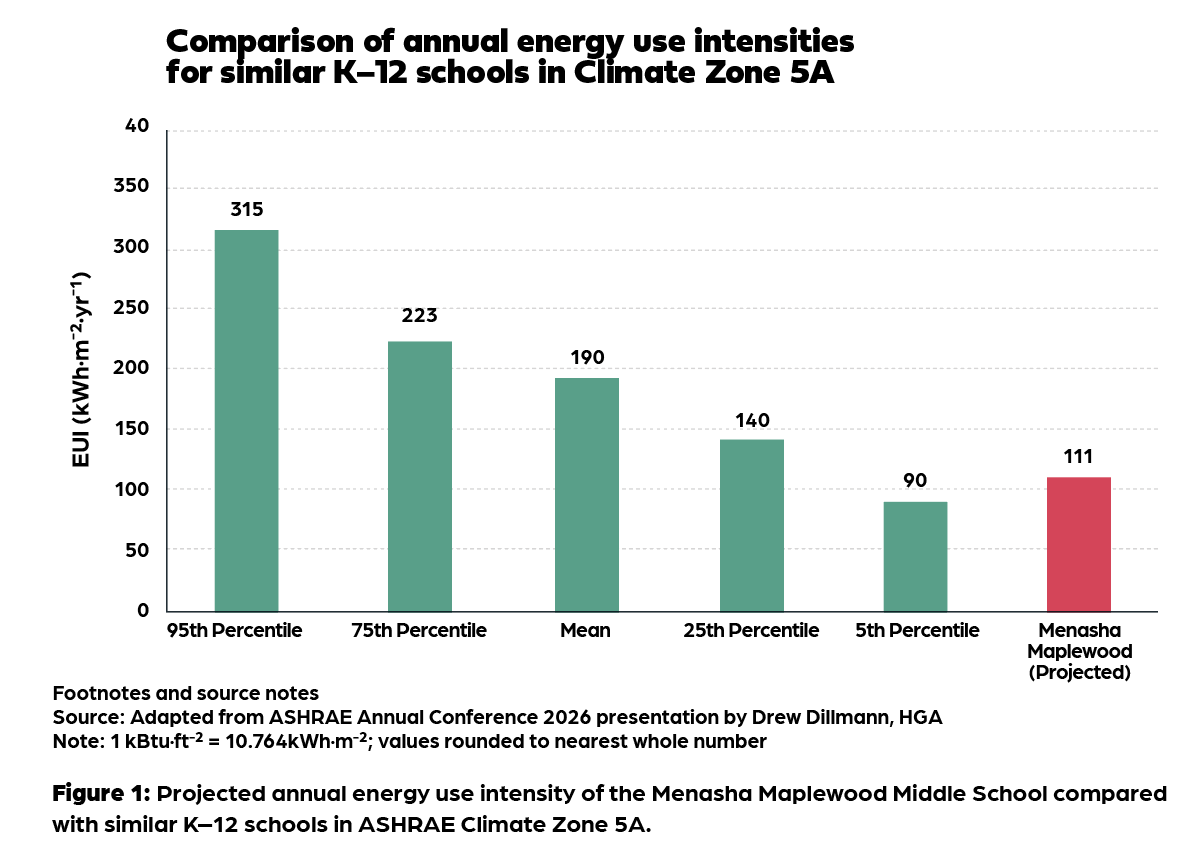
Rather than relying on large renewables to compensate for inefficient buildings, the project demonstrates the value of optimising the building before addressing the remaining energy requirement. The effectiveness of this demand-first approach is reflected in the projected annual energy use intensity (Figure 1), which is significantly lower than the average for comparable schools.
What does ‘net zero ready’ mean?
Although the term ‘net zero ready’ is being used increasingly, its meaning is not always clear. Rather than describing a building that already achieves net zero operational carbon, it refers to one that has been designed so that net zero operation can be achieved without major changes to the building fabric or engineering systems.
Typically, a net zero-ready building minimises energy demand, incorporates efficient low carbon heating and ventilation, provides the infrastructure needed for future renewable generation and energy storage, and retains sufficient flexibility to accommodate future technologies without extensive retrofit.
The approach allows projects to respond to changing funding opportunities and technology costs while maintaining a clear pathway towards net zero operation.
The school building combines a number of complementary technologies. Around 160 geothermal boreholes provide the primary heat source for 156 distributed water source heat pumps. Ventilation is provided by nine dedicated outdoor air systems, while there is a 1.15MW rooftop PV array, of around 2,750 panels. Battery storage and standby generation complete the integrated energy system.
However, Dillmann repeatedly emphasised that building performance depends as much on system integration as on selecting efficient technologies. The building management system (BMS) coordinates geothermal operation, heat pumps, ventilation, photovoltaic generation and battery storage as a single integrated energy system.
The photovoltaic array generates renewable electricity to help meet building demand, while the battery energy storage system is controlled independently to reduce peak electrical demand, improve resilience and optimise energy costs by charging from surplus solar generation or off-peak grid electricity and discharging when demand is highest. Achieving this level of integration requires sophisticated control strategies that continue to evolve with operational experience.
Perhaps the strongest message of the presentation was that commissioning should not be regarded as an activity that begins once construction is complete. Energy modelling informed decisions on envelope performance, waste energy recovery and sizing from the outset; control sequences were reviewed during design; owner’s project requirements were continually refined; and commissioning activities were planned from the earliest project stages. Rather than seeing commissioning as a final activity, it was embedded in design, procurement and construction.
This philosophy continued through construction. Equipment start-up, balancing and controls integration were coordinated carefully, while manufacturers’ commissioning documentation was reviewed well before systems were energised. Dillmann noted that issues not resolved during design inevitably surfaced during construction, where they became more difficult and costly to rectify.
The project also highlighted the relationship between prefabrication and commissioning. Factory-assembled plant and packaged systems can improve manufacturing quality, reduce site installation time, and allow hydraulic and electrical testing before delivery. They also provide documented factory test records that contribute to the project’s digital quality information.
However, prefabrication is no substitute for commissioning. Factory-tested assemblies must still be integrated with the BMS, commissioned alongside other building services and optimised under real operating conditions.
Functional performance testing remains essential to verify that the complete building operates as intended. Care is also needed when specifying packaged systems with proprietary controls, to ensure they remain compatible with the overall control strategy and allow sufficient flexibility for commissioning and future optimisation.
Performance in use
Dillmann told delegates that practical completion represents the beginning, not the end, of the optimisation process.
The first year of operation is described as a period of continuous learning. Control settings are adjusted as occupancy patterns become established, weather conditions vary and operational data become available. Rather than viewing these adjustments as defects, they are treated as valuable information that helps improve system performance.
Battery operation provides a particularly good example. While batteries contribute to resilience during Grid outages, their greatest value often lies in reducing peak electrical demand and maximising the use of onsite renewable generation.
Determining the optimum charging and discharge strategy requires operational experience, rather than design calculations alone.
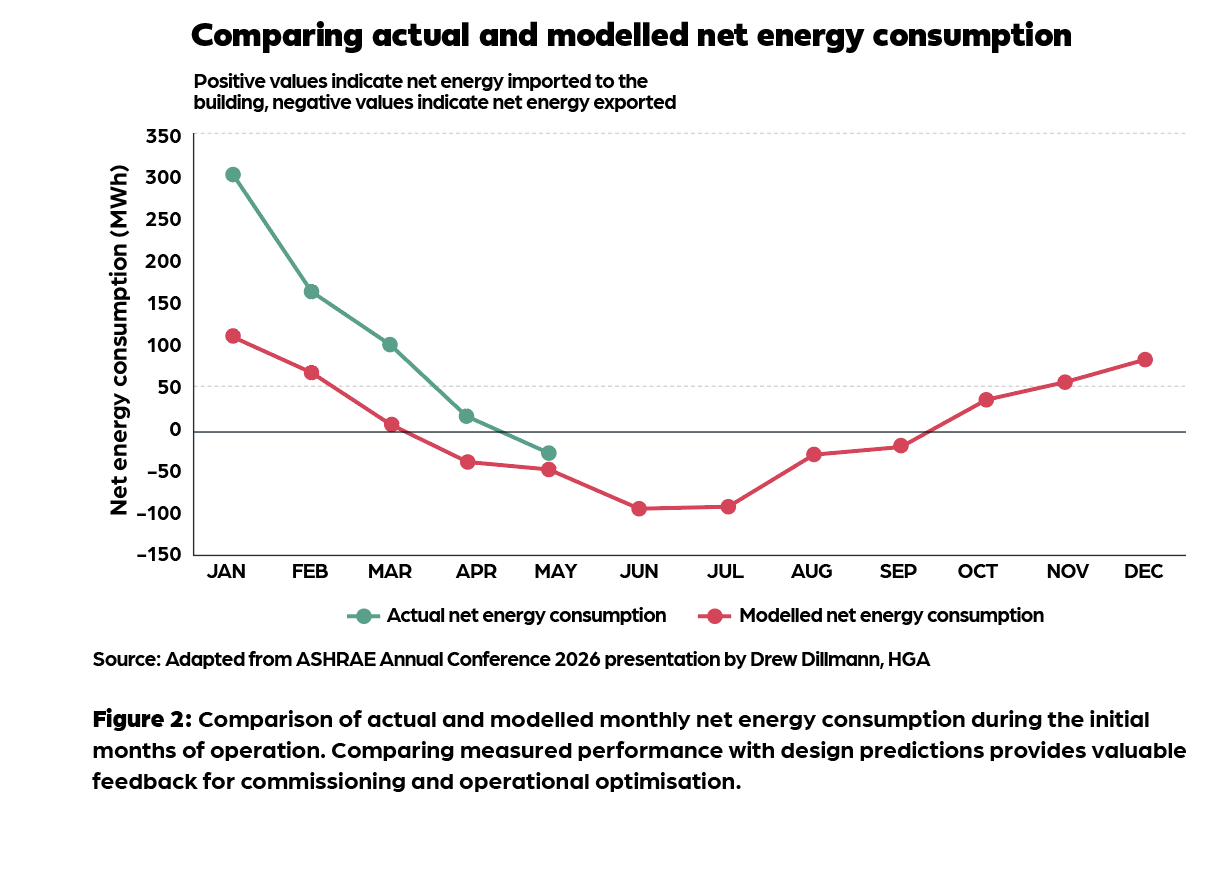
Measurement and verification therefore become central elements of the project. Continuous monitoring allows actual energy performance to be compared with design predictions, identifying opportunities for further optimisation while providing valuable feedback for future projects.
Figure 2 compares the measured net energy consumption during the first five months of operation with the values predicted by the design model.
Although only partial-year data were available, the comparison illustrates how operational monitoring can be used to verify performance, identify trends and support the ongoing refinement of control strategies.
The need for integrated design, effective commissioning, measurement and ongoing optimisation remains fundamental to achieving reliable building performance.
Issues not resolved during design inevitably surfaced during construction
CIBSE Commissioning Code M emphasises that commissioning is a managed process extending from design through installation, testing, handover and post-occupancy evaluation, rather than simply a
final construction activity.
Similarly, the Soft Landings framework promotes continued involvement of the design and construction teams after occupation to help ensure buildings achieve their intended operational performance.
The emphasis on comparing predicted and measured energy performance closely aligns with the principles of CIBSE TM54, which seeks to reduce the well-documented performance gap between design intent and operational performance.
Dillmann concluded by stressing that achieving net zero-ready performance depends on continuous collaboration throughout design, construction and operation. Independent commissioning, measurement and verification were presented not as optional project enhancements, but as essential tools for ensuring that buildings continue to perform as intended throughout their operational life.
Delivering high-performance buildings is no longer simply about specifying innovative technologies; it is about creating an engineering process that connects design, construction, commissioning and operation into a continuous cycle of improvement.
That lesson applies equally to schools, commercial buildings and many other projects seeking to deliver reliable, low carbon performance.