
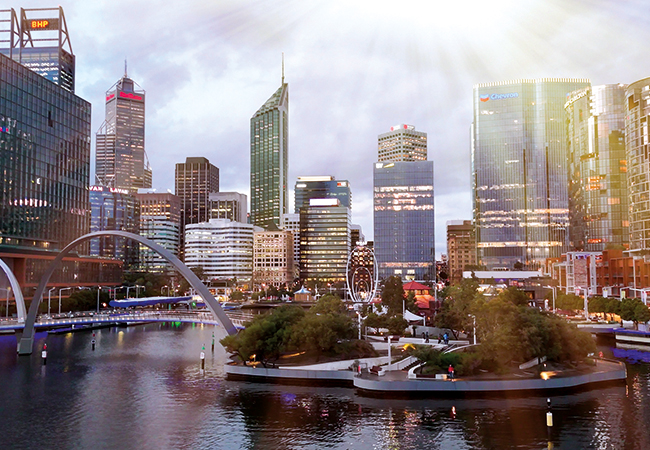
Perth is an emerging data centre hotspot driven by a mining and tech base and proximity to Asian subsea cable landing points
Building services engineers in Australia and New Zealand face the dual challenge of meeting extreme cooling demands while hitting ambitious decarbonisation targets in a booming data centre sector.
In addition, volatile climate-related issues – from bushfire smoke and extreme storms to drought and seismic risks – require continual innovation, as the regions see growth around retrofits, electrification and embodied carbon.
To bridge critical skills gaps, CIBSE ANZ is upskilling the workforce, backing early-career professionals through its Young Engineers Network and fostering the expertise needed for resilient infrastructure.
Emerging sectors
Data centres are currently the standout building sector in ANZ. Australia’s deployable capacity is on track to more than double this decade, and we’re seeing that demand in every state. Not just in Sydney and Melbourne, but in emerging markets such as Perth, driven by its mining and tech base and proximity to Asian subsea cable landing points. This is translating into sustained work for our mechanical and electrical engineers.
Energy infrastructure and defence-related construction are the other strong performers, supported by public investment in health, education and utilities.
New Zealand’s market has been through a rougher patch, but rate cuts and easing inflation are starting to stabilise conditions.
Across both countries, we’re seeing more concentrated growth in fewer, larger, more technically complex projects.
The data centre challenge
Balancing the extreme cooling and power demands of data centres with the region’s carbon- and water-reduction targets is one of the more difficult issues with which CIBSE ANZ members are grappling.
The shift in the direction of AI workloads has pushed up rack densities sharply, driving a move towards liquid cooling. This helps on the water side compared with older, evaporative systems, but adds complexity in electrical infrastructure and heat-rejection design.
Top-performing engineers address power and water efficiency as an integrated design problem, linking data centre precincts directly to renewable energy zone upgrades instead of simply increasing load on the existing grid.
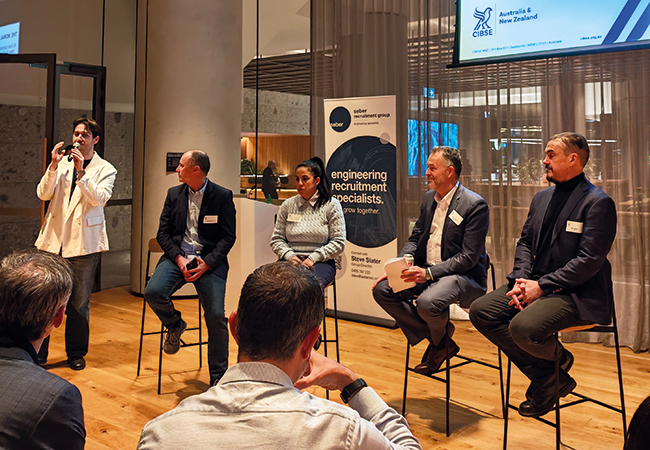
CIBSE ANZ’s ‘Moral grey zone’ panel event series on professional ethics
Closing the skills gap
M&E engineers with genuine data centre design experience are in short supply.
We need more engineers who are comfortable working across decarbonisation, embodied carbon assessment and life-cycle analysis – a skill that is now becoming central to how buildings are procured.
CIBSE ANZ’s role here is to keep the pipeline of technical knowledge flowing to members through six regional chapters.
Environmental challenges
Australia’s climate range is enormous, so no one design solution travels well across the region when it comes to environmental challenges.
Layer on top of everything else exposure to bushfire smoke events, increasingly intense storms and, in New Zealand, seismic design requirements, and engineers in the region are designing for a wider envelope of extremes than most of our counterparts overseas.
The other constant challenge is water. Both countries have had serious drought periods in recent years, so any services strategy that leans hard on evaporative cooling or heavy potable water use draws real scrutiny.
Decarbonising existing stock
Retrofit is arguably the harder decarbonisation problem for local engineers compared with new build, because you’re constrained by existing plant and floor-to-ceiling heights, and a building that has to stay operational throughout.
Focus has shifted to heating electrification, alongside the staged replacement of ageing chillers and air handling units with higher-efficiency equipment, timed to coincide with end-of-life replacement rather than wholesale strip-outs.
Reusing structures and services can be the most carbon-efficient option, as initial embodied carbon is fixed early and difficult to mitigate later.
Dealing with toxic smoke from bushfires
Fire seasons have shifted the tension between ventilation and outdoor air toxicity into a standard design priority. Commercial buildings typically increase outdoor intake filtration, recirculate air when feasible, and use positive pressurisation in advanced facilities to limit envelope infiltration.
Well-sealed commercial buildings with good mechanical ventilation and high-Merv or Hepa filtration genuinely protect occupants. But the research is also clear that leakier buildings and homes offer far less protection, so building envelope quality matters just as much as the mechanical response.
Engineers must balance heavy filtration and air recirculation with the resulting energy penalty during extreme conditions, proving that resilience and energy efficiency must be designed together.
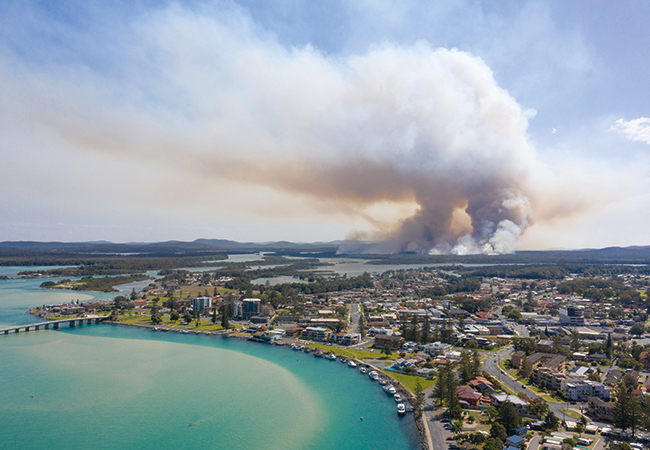
Heavy filtration is key to addressing threats from bushfire smoke
NABERS and embodied carbon
NABERS remains the benchmark that drives operational performance improvement across the commercial sector and it’s now extending its influence into embodied carbon.
Australia awarded its first NABERS Embodied Carbon rating in December 2025 and the tool is already being referenced in policy, including the NSW Sustainable Buildings SEPP and the Australian government’s sustainable procurement policy.
The National Construction Code’s 2025 update also points to the NABERS methodology as the preferred framework for embodied carbon assessment – though, at this stage, it sits as guidance rather than a mandatory requirement.
Supporting ANZ young engineers
CIBSE ANZ is supporting younger professionals in securing their chartered engineer credentials. The Young Engineers Network is the backbone of this – it’s free to join, open to those who are in the first 10 years of their career, and gives members a structured peer network and access to CIBSE mentoring.
Graduates are connected with mentors who have been through chartership themselves, host events specifically aimed at demystifying the process, and make sure our chapter technical events count towards the CPD evidence members need for their application.
The Young Engineers Awards celebrate emerging talent driving innovation in building services across the region. This public recognition is, in itself, a strong motivator for graduates to stay the course towards chartership.