Credit: iStock.com/Teamjackson
An On the wire story
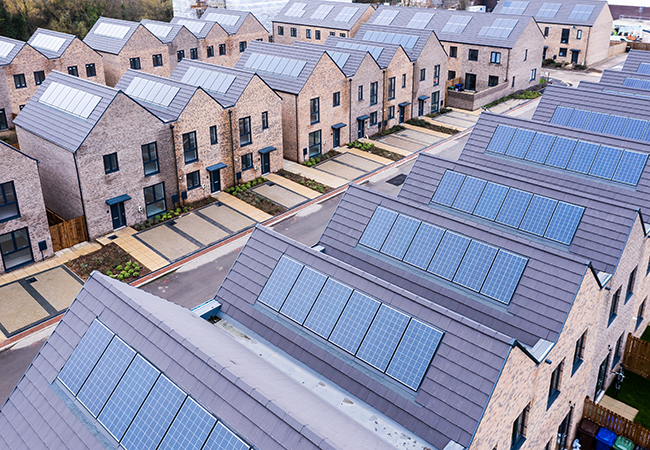
Solar panel fires in the UK are rising at a pace that now appears to be outstripping the sector’s expansion, according to new analysis from insurer QBE.
Based on freedom of information requests to fire services, the company says incidents involving solar panels climbed to 212 in 2025, up from 91 in 2022, while installations rose from 1,268,795 to 1,933,148 over the same period. QBE says the mismatch suggests that safety, installation quality and maintenance are not keeping up with the speed of adoption.
The figures come as Britain’s solar rollout continues to accelerate. Government statistics show installations passed the two million mark in March 2026 and reached 2,047,225 by May, underlining how quickly rooftop and other systems are spreading across homes and businesses. But QBE’s analysis suggests the surge is bringing fresh operational risks, especially where cabling, connectors and battery storage are involved.
Residential buildings accounted for most of the fires QBE identified in 2025, with 102 incidents. Commercial premises saw fires rise from 33 in 2024 to 48 in 2025, while industrial sites recorded a sharper jump from six to 14.
The insurer says this is particularly relevant as the government’s solar strategy places commercial and industrial rooftop systems at the centre of its clean power plans, with large sheds, retail sites and warehouses expected to take on more panels.
QBE said the leading cause of the fires it examined was DC cabling and connectors, with 49 incidents in 2025, followed by the solar panel itself, battery banks and inverters. Adrian Simmonds, risk manager at QBE Insurance, said the trend pointed to weaknesses in installation practice and maintenance, adding that systems should be fitted by accredited installers and checked regularly. He also warned that battery storage can make fires faster-moving and harder to control, particularly when units are placed in confined or inaccessible spaces.
The insurer is urging homeowners and businesses to treat solar systems as active electrical infrastructure rather than fit-and-forget equipment. Its guidance includes annual inspections, attention to ventilation and access, and extra checks after severe weather. For a technology that remains central to the UK’s energy transition, the message from QBE is clear: rapid deployment without adequate fire precautions could leave both insurers and property owners exposed.
Source Reference Map
Inspired by headline at: Installer Online [1]
Sources by paragraph:
– Paragraph 1: [2], [4]
– Paragraph 2: [1]
– Paragraph 3: [1], [5]
– Paragraph 4: [1], [3], [7]
– Paragraph 5: [1], [6], [7]
• This On the wire article was created using Noahwire AI and reviewed by CIBSE Journal’s editorial team