An On the wire story
Researchers at Loughborough University have found that internal temperatures of homes can be reduced by up to 6°C with the use of external shading.
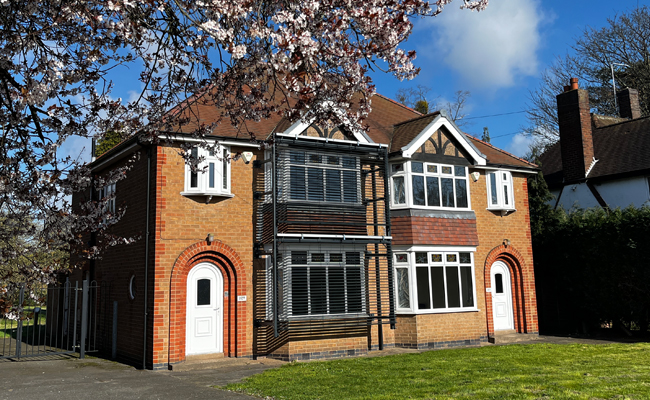
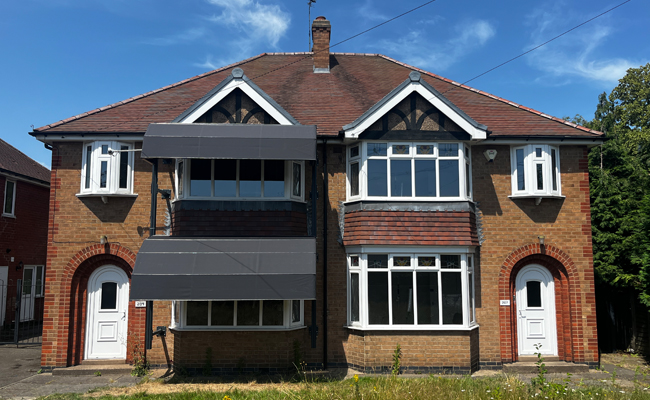
Work by researchers at Loughborough University centres on two identical semi-detached houses, one left untreated and the other fitted with external shading, heat sensors and so-called heat boxes that mimic the warmth produced by people living inside.
According to the university, the aim is to find low-cost, practical ways to stop homes from overheating as temperatures rise.
Dr Ben Roberts, a senior lecturer in healthy buildings, said the findings so far suggest that outside shading can make a meaningful difference. He believes housing developers may need to build this kind of protection into new homes, particularly as heatwaves become more frequent.
The university says around one in five UK homes is already prone to overheating, underlining the scale of the problem.
Lights replicate internal heat gains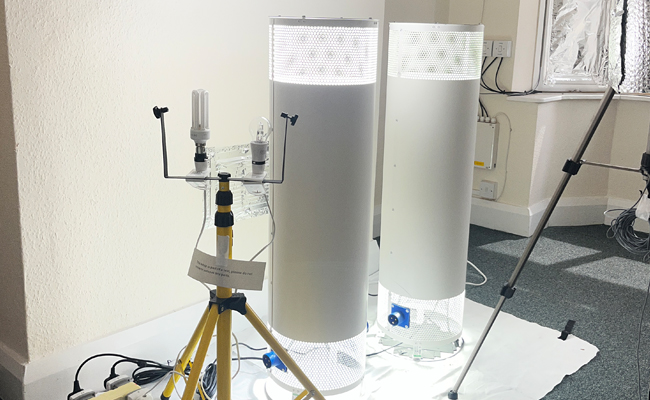
The results from the test houses have been striking. Roberts told the BBC that the shaded property has stayed up to six degrees cooler than the unshaded one. On the day the BBC visited temperatures in the untreated house climbing above 33°C while the shaded home remained nearer 29°C.
The research has also shown that, during heatwaves, keeping windows closed in the daytime can help prevent hot air from entering the home.
External shading such as louvres, canopies and other outside-mounted screens work by stopping solar heat before it reaches the glass. In practice, that can be especially useful in homes with large windows, glazed extensions or other features that admit strong sunlight.
Roberts warned that widespread reliance on air conditioning would place fresh strain on the electricity grid, which he said is not currently equipped to handle a major jump in demand.
Loughborough University PhD student Niloo Todeh Kharman MCIBSE is leading the investigation, and she presented a paper on the initial findings and methodology at the 2025 CIBSE Symposium.1
Todeh Kharman also recently published her first journal paper, which is focused on the effectiveness of shading devices in European homes.3
In addition she is looking at how external blinds impact natural ventilation rates when deployed, which will help inform future developments in CIBSE TM59/TM52. This projected is supported by CIBSE (see panel below).
Evaluation of external shading devices to mitigate overheating in naturally ventilated UK dwellings
2025 – 2029, Loughborough University and the British Blind and Shutter Association
The project carries out testing in two twin domestic houses and makes use of modelling tools to better understand and evaluate the impact differing external shading systems have on UK homes and the occupants within them. The project aims to inform overheating risk assessments and support the development of practical, occupant-centred design guidance for residential buildings.
The next step in the research is to develop a predictive model to estimate internal operative temperatures – with and without shading – under future climate scenarios. To support this CIBSE 2025 weather files are being used.
REFERENCES
1 Todeh-Kharman, N., et al, 2025. The impact of shading on overheating adaptation in a matched pair of houses: Initial findings and methodology. In: CIBSE-IBPSA Technical Symposium 2025: Fit for 2050. London, UK, 24–25 April 2025. London: CIBSE https://bit.ly/4aF8qqQ
2 Todel Kharman, N et al, 2026. Overheating adaptation in temperate European dwellings: a systematic review of evidence on shading devices. [online] Loughborough University Repository. Available at: https://doi.org/10.17028/rd.lboro.32172555.
Source Reference Map
Inspired by headline at: BBC News[1]
Sources by paragraph:
– Paragraph 1: [2], [6]
– Paragraph 2: [2], [3]
– Paragraph 3: [1], [3]
– Paragraph 4: [4], [5], [7], [2]
• This On the wire article was created using Noahwire AI and reviewed by CIBSE Journal’s editorial team