
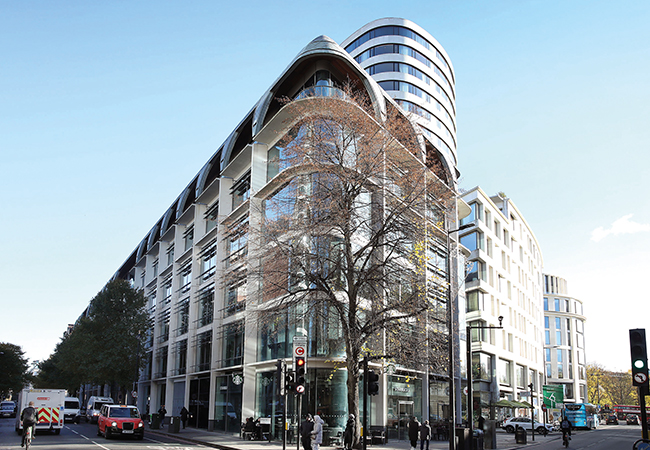
York House won Workplace of the Year – Retrofit at the 2026 CIBSE Building Performance Awards
Expectations for the operational performance of commercial office buildings are set to be redefined by 2 Finsbury Avenue (2FA), in London. When completed in 2027, the scheme – developed by British Land and engineered by Ramboll – aims to achieve Breeam Outstanding, Well Platinum, an Energy Performance Certificate A rating and a NABERS UK Design for Performance scheme 5-star rating.
This established a total building energy target of 90kWh.m–² per year, with landlord energy use targeting 55kWh.m–² and tenant energy 35kWh.m–² per year.
To achieve these goals, Ramboll has taken a holistic approach to the building services design by shifting away from a peak-load approach. Instead, it has engineered and optimised systems for part-load, part-occupancy operation to reflect a post-pandemic world of hybrid working in amenity-rich spaces, with increased focus on health, wellbeing and sustainability.
Ramboll’s route to meeting the low operational energy targets began with the building’s form and façade design. 2FA, in the City of London’s Broadgate campus, is unusual in that it comprises two towers – 37-storey East Tower and 23-storey West Tower – combined at the base by a 13-storey podium.
Early modelling identified peak solar gains would occur during the afternoon. Working with the project architects, 3XN, Ramboll analysed multiple façade geometries and orientations, simultaneously modelling variables such as glazing ratio, daylight availability, solar heat gain, glare risk and the thermal performance of glazing systems.
Its detailed analysis informed the final, optimised façade design, which incorporates saw-tooth modules orientated to maximise daylight while avoiding excessive cooling loads.
The design team adopted what Danny Coleman, technical director at Ramboll UK, describes as a ‘pragmatic approach’ to the challenge of high-end commercial offices typically generating significant internal gains from occupants, equipment and lighting. ‘Over-insulating the envelope would risk increasing cooling demand,’ he says, ‘so the façade uses double glazing with a low solar G-value of around 0.25, combined with U-values that satisfied Part L energy modelling requirements for planning while avoiding over-insulating.’
The development was designed to operate without fossil fuels, but with a combination of electric heat pumps, boilers and high-efficiency chillers interconnected with sophisticated control algorithms. ‘The system can dynamically select the most efficient combination of plant for any given load and weather condition, to maximise operational efficiency,’ says Coleman.
The system is designed to provide heat primarily using air source heat pumps (ASHPs), with electric boilers providing additional capacity. Heat pumps are sized to meet the bulk of the heat load. In the West Tower, heating is provided by two ASHPs: one 4-pipe unit and one 2-pipe reversible unit. In the East Tower, heating is provided by three units: two 4-pipe heat pumps and one 2-pipe reversible unit.
Rather than sizing the ASHP system to supply heat for extreme winter design conditions that will occur only rarely, the system incorporates three 750kW electric boilers. These provide top-up heat and additional resilience while minimising the embodied carbon, cost and space associated with redundant heat pumps.
The ASHPs also supply cooling in the West and East Towers. For this system, additional cooling capacity is provided by two water-cooled chillers in the West Tower and three in the East Tower.
A major benefit of this approach is making use of heat recovered from comfort cooling loads, tenant IT cooling, lift motor rooms and electrical switch rooms – which, says Coleman, can meet approximately 40% of the building’s demand for space heating and domestic hot water.
The system can dynamically select the most efficient combination of plant for any given load and weather condition
Optimising part-load performance
Ramboll’s engineering design used occupancy and performance data from British Land’s existing office portfolio to understand how buildings perform in practice, especially when operating at partial load for most of the year.
Part-load is common in spring and autumn, when loads can be relatively low, and for out-of-hours working, when only parts of the building are occupied. The system needed to accommodate these variations to meet indoor design conditions of 20oC heating and 24oC cooling.
Ramboll’s system is so efficient that even under very light loads – potentially as little as 2% of peak capacity – the entire system can, if necessary, operate from a single chiller or heat pump. Or, as Coleman puts it, the building has been ‘designed for 7,000 people, but will operate just as effectively for 70’.
Although each tower has its own chilled water and low-temperature hot-water systems, efficient part-load operation is achieved by the two networks being linked via plate heat exchangers in the basement.
‘Instead of running multiple machines at inefficient conditions, one piece of plant can serve both towers while operating near its optimal efficiency point,’ says Coleman.
The interconnection also enhances system resilience in the event of plant failure in one tower, by providing backup heating and cooling from the other.
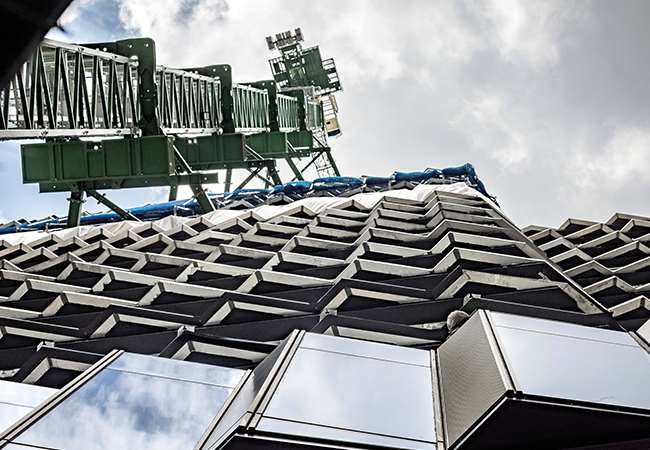
2FA’s saw-tooth façade is designed to maximise daylight and avoid excessive cooling loads
Achieving the 5-star NABERS UK rating requested in British Land’s brief is dependent on controlling and monitoring the engineering systems. The central plant will be operated using a plant optimisation system, which incorporates performance data for each piece of equipment, including efficiency curves for its operation under numerous conditions. This data helps the control system to select which items should operate at any given time, improving plant performance significantly compared with conventional building management system (BMS) sequencing.
A comprehensive metering strategy also underpins the NABERS approach. Energy use is monitored across all systems, including tenant systems.
Tenant spaces are connected to the base-build systems via heating and cooling interface units. To maximise heat-recovery opportunities, tenants are required to prioritise use of the building’s chilled water system for their IT cooling requirements. Heat rejected from these systems is then captured and reused by the central plant. Similarly, all tenants are required to use heat supplied from the central plant.
Energy consumption in tenant spaces will be metered and monitored to support energy management, and to enable NABERS UK performance verification.
The ventilation system is designed to meet energy and wellbeing objectives, supporting the building’s aspiration for Well Platinum certification, and is sized to deliver 16L.s–¹ per person. Rather than delivering fixed air volumes, the system operates using demand control based on maintaining a CO2 concentration of approximately 750ppm in each 200m2 office floor plate control zone.
Ventilation design targets a specific fan power of around 1.2W per litre per second. Oversized duct risers and connections to each of the office floors help achieve this. Duct connections are sized to enable occupancy of one person per 8m2 in a proportion of zones on each floor, with ventilation plant sized based on a diversified occupancy of one person per 10m2.
Four large central air handling units (AHUs) – two in the basement and two on the roof of the East Tower – provide the bulk of the fresh air. These serve office areas in the podium and parts of the tower through ductwork distributed in the building cores. In addition, some areas are served by on-floor AHUs, which intake air and exhaust directly through the façade. This allows flexibility while limiting the scale of duct distribution within the towers.
While the building primarily uses mechanical ventilation, the façade has motorised natural ventilators to support passive ventilation. These enable pre-occupancy purge of the office floors and night-time ventilation, allowing warm internal air to be flushed from the building, helping to reduce cooling demand the following day.
‘During normal occupied hours, the ventilators are not intended to contribute to thermal conditioning of the spaces, as this would reduce the effectiveness of heat recovery within the mechanical ventilation system,’ Coleman explains. The ventilators are operated by the BMS during appropriate weather conditions.
The development also incorporates strategies to reduce water consumption, including low-flow fixtures and fittings, sensor-operated taps, dual-flush WCs, and PIR-controlled washroom systems. A reclaimed water system combines greywater recycling with rainwater harvesting to supply non-potable uses, such as WC flushing. The cooling system also contributes to water efficiency. The water-cooled chillers reject their heat via hybrid coolers, which combine the efficiency of cooling towers during warm conditions with dry operation during cooler periods. Coleman says this approach ‘reduces water consumption while maintaining high cooling efficiency’.
At completion of 2FA, scheduled for June 2027, the brief calls for the building services solution to deliver a landlord energy use target of 55kWh.m-2. Ramboll’s modelling is currently showing it to be 36.4kWh.m-2 – well below the NABERs target. Coleman says the independent design review required under NABERS has confirmed that the hybrid system design for 2FA should enable it to target the 5-star rating.
The building is 33% pre-let, and once it is 75% occupied, British Land will pursue a formal NABERS In-Use rating. This will verify whether Ramboll’s building services solution has delivered real operational performance and set a new benchmark for high-performance commercial offices in the UK.
With 2FA set to redefine expectations for the energy performance of office buildings, its developer, British Land, is showing that it is serious about building energy performance. Its head office is in York House, an existing building that it owns and that has already achieved NABERs 4*. The scheme won the Workplace of the Year – Retrofit at this year’s CIBSE Building Performance Awards, with the judges saying: ‘This project will bring about wider change by providing a blueprint for the developer’s wider commercial portfolio and other, similar, buildings.’ 2FA is proof that this, indeed, is the case. Building