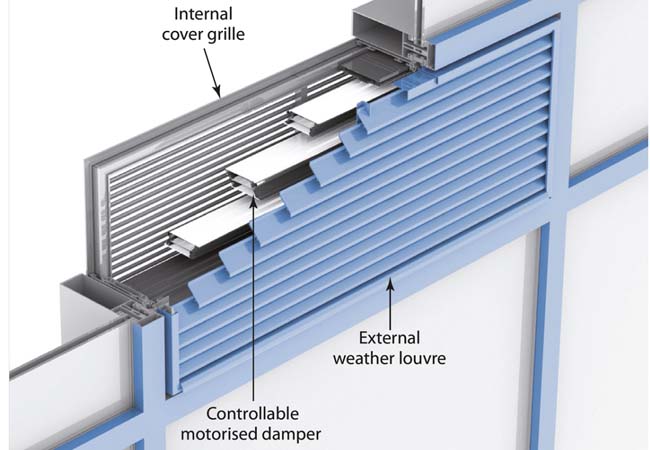
Drawing from AM10 showing example of an insulated mechanical damper for a façade
Natural ventilation remains one of the most appealing ways to deliver low-energy, comfortable buildings. It is simple in principle, but often difficult to deliver in practice. Designs that look convincing at concept stage can fail once built, leading to overheating, poor air quality, or systems that are difficult to control.
The 2026 edition responds to these problems. It provides updated guidance on how natural ventilation systems should be designed, assessed and integrated into modern buildings. It does not introduce a new standard or set of targets. Instead, it focuses on helping designers make better decisions, earlier in the process.
AM10 is a CIBSE Applications Manual. Its role is to support design rather than to prescribe compliance. It provides practical design methods, explains physical behaviour and links research to everyday practice.
Importantly, it does not attempt to duplicate material covered elsewhere, which has allowed some streamlining. Detailed approaches to indoor air quality and thermal comfort are addressed in other CIBSE guidance, such as TM57 and TM59, while CIBSE Guides A and B provide information on airflow rates required and how to calculate them. AM10 focuses on what is specific to natural ventilation: how air moves through buildings, how systems are configured and sized, and how they perform in real conditions.
This distinction is a deliberate attempt to make AM10 flexible guidance, rather than a de facto standard, and allows it to sit clearly alongside Building Regulations and other CIBSE documents.
Start with feasibility
A central theme of the new edition is that natural ventilation design must begin with feasibility.
Too often, natural ventilation is assumed to be appropriate, and the design process moves directly to sizing openings or selecting components. When problems arise, they are addressed through increasingly complex solutions. In many cases, the underlying issue is that natural ventilation was never a good fit for the building in the first place.
AM10 addresses this with a structured approach to early decision-making. Key questions include:
- Are the spaces suitable in terms of depth and height?
- Is there a clear path for airflow through the building?
- Are there constraints from cold draughts, noise or outside air pollution?
- Can overheating be managed under future summer conditions?
These factors determine whether a building can rely on natural ventilation alone or whether some form of assistance is required. The outcome may be a fully naturally ventilated design, a mixed-mode system or a predominantly mechanical solution.
The key point is that this decision should be made early, when it can still influence the architectural design.
From strategy to system
Once feasibility has been established, the focus shifts to developing a ventilation strategy and translating it into a working system.
AM10 describes common strategies, such as cross-ventilation and stack-driven flow, and how these relate to building form. It then considers the components that deliver these strategies in practice, including windows, louvres, trickle vents and roof ventilators.
A significant addition in the new edition is the treatment of system integration and control.
Natural ventilation systems increasingly rely on automation, with actuators, sensors and control algorithms determining how openings respond to internal/external conditions. In practice, this is where many systems fail. Issues often arise from poor coordination between disciplines, unclear performance requirements or control strategies that lead to nuisance behaviour, such as unexpected opening and closing.
The guidance emphasises clear definition of ventilation requirements, coordination of components and control systems, and the importance of occupant override.
Occupants need to retain some control over their environment. Systems that remove this are unlikely to perform well in practice, regardless of how well they perform in theory.
Design tools and workflow
AM10 also sets out how different design tools can be used throughout a project.
Rather than promoting a single method, it presents a hierarchy of tools, from simple airflow models through to dynamic thermal simulation, computational fluid dynamics and physical testing. The emphasis is on selecting an appropriate level of complexity for the design stage. This is supported by a structured workflow:
- Feasibility: determine whether natural ventilation is appropriate
- Strategy: define the intended airflow patterns and integration with heating and cooling
- Envelope design: size and position openings
- Internal environment: assess performance and refine the design
- Commissioning: ensure the system performs as intended in practice.
This reinforces the idea that natural ventilation design is not a single calculation, but an iterative process that evolves alongside building design.
Updating the physics
The 2026 edition also revisits some of the underlying physics used in design.
A long-standing issue in natural ventilation calculations is the definition of opening area. The free area of an opening does not represent the area through which air actually flows. In practice, flow contracts as it passes through an opening, and is influenced by geometry, edges and obstructions, such as insect meshes or louvres.
Traditionally, this has been addressed through discharge coefficients. These can be difficult to apply correctly, however, particularly when opening geometry becomes more complex.
AM10 therefore advocates the effective area as a more direct representation of airflow performance. This is supported by the statistical effective area model, which offers a practical way to estimate effective areas of windows based on opening characteristics.
The aim is not to increase complexity, but to improve consistency. By working with parameters that better reflect real openings, designers can have greater confidence in predicted airflow rates and system performance.
A more structured approach to natural ventilation
The 2026 edition of AM10 reflects how buildings and expectations have changed since the previous update. It recognises that natural ventilation must be considered in the context of overheating risk, urban constraints and increasingly complex systems.
Its contribution is a clearer structure for decision-making, from early feasibility through to detailed design and operation. It does not replace professional judgement, but supports it with more consistent methods and better representation of real systems.
For practitioners, the message is straightforward. Natural ventilation can still deliver robust, low-energy solutions, but only if it is applied appropriately. AM10 offers the framework to make those decisions with greater clarity and confidence.
CIBSE AM10 is available at www.cibse.org/knowledge
ABOUT THE AUTHORS
Chris Iddon is chair of the CIBSE Natural Ventilation Group
Dr Benjamin Jones is associate professor at the Department of Architecture and Built Environment,
University of Nottingham