
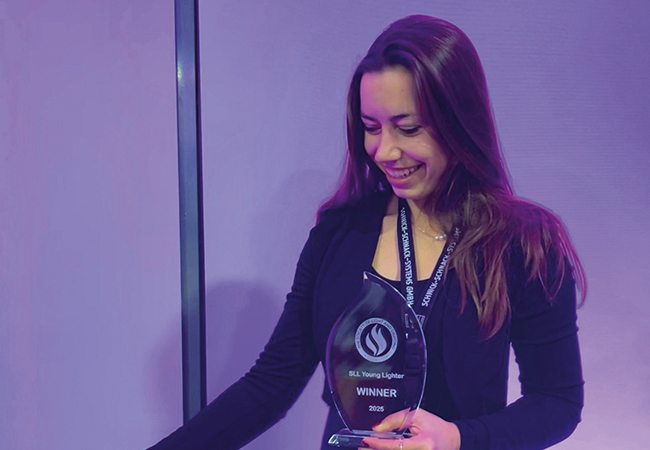
Lucie Koháková was named SLL Young Lighter 2025 for her Luna project on the impact of light on human circadian rhythms – especially in early childhood – and how design can support healthier sleep through biologically appropriate lighting.
What first sparked your interest in lighting design?
My route into lighting design stems from a long-standing interest in how light influences human experience, behaviour and overall wellbeing. I began to focus on light during my studies in industrial design at the Czech Technical University in Prague. There, I started to see design not only as a visual or functional discipline, but as a tool that can actively influence health.
While working on my Bachelor’s project, which later developed into Luna, my attention increasingly centred on light as a medium that operates on both physiological and emotional levels.
How did your studies shape your approach to lighting?
During my studies, I began to connect design with broader scientific perspectives, particularly biology and behavioural science. This shift happened while developing the Luna project, when I explored the relationship between light and circadian rhythms in early childhood.
Lighting design quickly became a natural intersection between my design background and my growing interest in wellbeing and the biological effects of light on the human body.
What inspired the creation of your winning project, Luna?
Luna emerged from a very personal experience. The initial impulse came from the sleep difficulties of my niece, Luna, and from observing how profoundly a child’s sleep quality affects the life of my older sister and those around her.
When a child wakes frequently during the night, parents often experience chronic sleep deprivation and the night-time routine becomes fragmented and stressful. It quickly became clear to me that this was not an isolated case, but a common reality for many families.
What problem does Luna aim to solve?
Luna is a portable light designed specifically for infant care during the night. It is not a conventional lamp, but an object conceived as a biological tool that respects the natural rhythms of the human body. The goal is to provide enough light for parents to care for their child while minimising disruption to sleep for the infant and caregiver.
The core principle of Luna lies in its spectral composition. It emits a narrow spectrum of orange light that is entirely free from blue and green wavelengths, which are known to suppress melatonin production. Research shows that even very low levels of short-wavelength light can significantly impair the body’s ability to fall back asleep.
By eliminating these disruptive wavelengths, Luna supports the body’s natural ability to maintain sleep and return to rest.
Why is circadian rhythm so important in early childhood?
During the prenatal period, an infant’s circadian rhythm is regulated through maternal hormones. After birth, however, the child must gradually develop their own biological clock, a process that usually stabilises around the third to fourth month of life.
During this sensitive phase, environmental cues – particularly the alternation of light and darkness – play a crucial role. If the night-time environment is too bright or biologically inappropriate, the development of a healthy circadian rhythm may be delayed or disrupted.
What did you learn from user research with parents?
Many parents rely on their mobile phones as a light source during night-time care, even though they are aware of the negative impact of screens on sleep. This contradiction between knowledge and behaviour became a key insight. It showed that education alone is not enough – design must embed the solution directly into the object itself.
With Luna, users do not need to remember rules about healthy lighting, as those principles are already built into the design.
What did winning the Young Lighter Award mean for you?
Taking part in the Young Lighter competition was an exceptionally valuable experience. Beyond the award itself, having Luna recognised by the Society of Light and Lighting (SLL) was a pivotal moment for me.
It showed me that it was time to fully commit to the project and take it all the way to market. Engaging with the SLL community was deeply motivating, and reinforced my desire to continue working in lighting design and be part of this inspiring global network of designers and architects.
How has the project changed the way you think about light?
For me, Luna represents a shift in perspective. Light is no longer only about how much illumination we add to a space, but about understanding when and how light should step back. By respecting the body’s rhythms and letting darkness remain an important part of the environment, lighting design can support rest, health and wellbeing in a more meaningful way.