
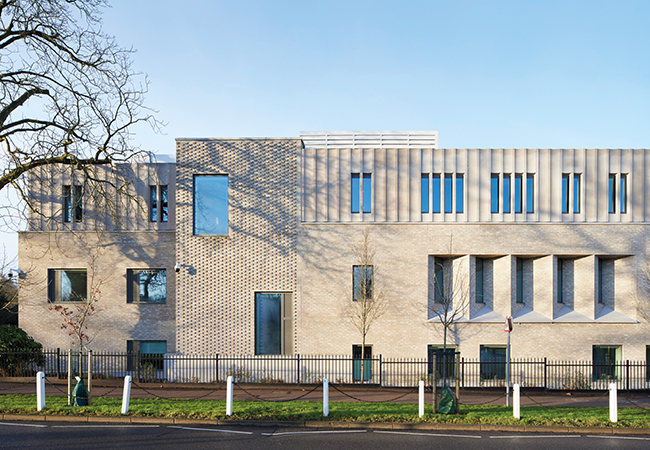
Dulwich College’s new Raymond Chandler Library (completed in July 2024) is an oasis of quiet concentration for the school’s pupils aged 11-13. Generous levels of natural light and views over sports fields provide an ideal backdrop for reading and studying.
Designed by architect alma-nac, the library is a striking three-storey building featuring a sand-coloured brick façade with deep-set, angled windows and a distinctive top floor clad in scalloped, glass-reinforced concrete panels.
A double-height atrium connects the ground floor, housing the main book collection and digital facilities, to a mezzanine level via an oak-topped concrete spiral staircase. The design features warm timber-slatted ceilings, reading nooks, and a top-floor ICT and robotics suite with glulam beams.
Measured operational energy breakdown 2025 (kWh.m-² per year)
Heating 9.6
Hot water 0.6
Heating and cooling 11.5
Comms room cooling 0.6
Fans and pumps 8.3
Other plant 11.9
Lighting 5.6
Small power 16.4
Comms room ICT 4.8
Lift 0.7
Total 70.1
The elegant form of the library belies the level of engineering consideration in designing a net zero carbon building that is also resilient and comfortable.
Max Fordham was appointed by the client at concept design stage and worked with the design team to develop a brief for the net zero strategy. Initially aligning targets with the Paris Climate Agreement, Max Fordham switched to RIBA 2030 Climate Challenge (RIBA CC) and LETI targets, and then the UKGBC Net Zero Carbon Buildings Framework.
‘We had to develop our own methods to determine the limits of operational energy and embodied carbon. It was before the RIBA CC or LETI targets were published,’ says Max Fordham principal engineer Hareth Pochee. ‘It was encouraging to see that, while we used different methods, we came to similar conclusions.’
Max Fordham didn’t just set carbon standards for the building. It also used RIBA CC to set limits for a range of other environmental factors, including potable water use and indoor air quality. It ran a 12-month evaluation of the building in 2025 to ascertain how successful it had been in meeting its objectives.
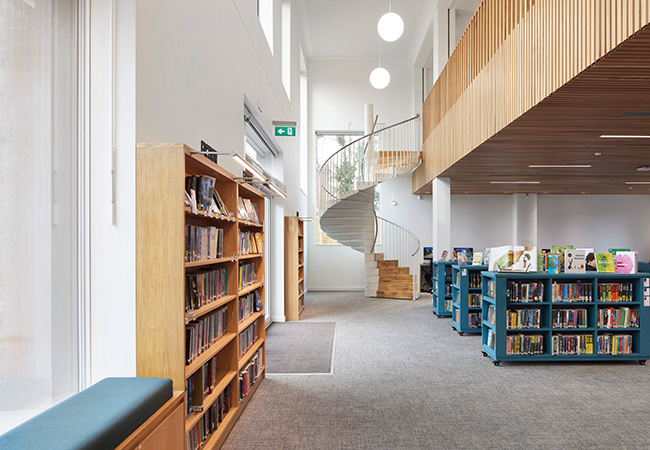
The library’s elegant form belies the engineering needed to design a comfortable, resilient net zero building
Net zero strategy
To meet their design targets, the project team undertook thermal comfort, embodied carbon and operational energy/carbon analysis, while assessing structural systems, façade performance and building services options.
The resulting hybrid lightweight steel frame with composite decks provided the optimal balance of low embodied carbon, buildability on a constrained school site, long-term adaptability and cost.
Targeting embodied carbon
The materials strategy for the new library was driven by circular economy principles, long-term durability, and a strict target to minimise upfront embodied carbon.
A major carbon-saving success was the procurement of electric arc furnace steel for approximately 75% of the structural frame; this high-recycled-content steel was partly produced using renewable hydropower.
Where concrete was required, it was specified with a very high proportion (around 65%) of GGBS, a low-carbon cement replacement.
Timber also played a significant role in reducing both the building’s overall mass and its carbon footprint, with glulam, plywood, and cross-laminated timber (CLT) used extensively for the top floor and roof structure.
During the value engineering process, the team made further low-carbon material substitutions. They replaced heavy solid concrete facade panels with lightweight glass reinforced concrete, opted for anhydrite floor screeds instead of traditional sand-cement, and selected mineral wool insulation over fossil-fuel-based foams.
Finally, this strategy was backed by rigorous supply-chain tracking, with the contractor implementing enhanced quality assurance procedures to verify the embodied carbon properties of materials prior to installation.
Passivhaus design shaped the environmental strategy as the team pursued a low heat-loss form factor, optimised glazing ratios, high airtightness and thermally efficient façades. The heat-loss form factor – the ratio of external envelope area to floor area – was just 1.8, which is very efficient for this type of building. Less surface area also means fewer materials, minimising embodied carbon.
To avoid the aesthetic monotony often associated with high-performance form factors, the team used façade articulation to add visual depth. ‘It’s not a shoe box,’ says Pochee. ‘It proves it’s possible to have an efficient shape that’s not trivial and boring.’
Services strategy
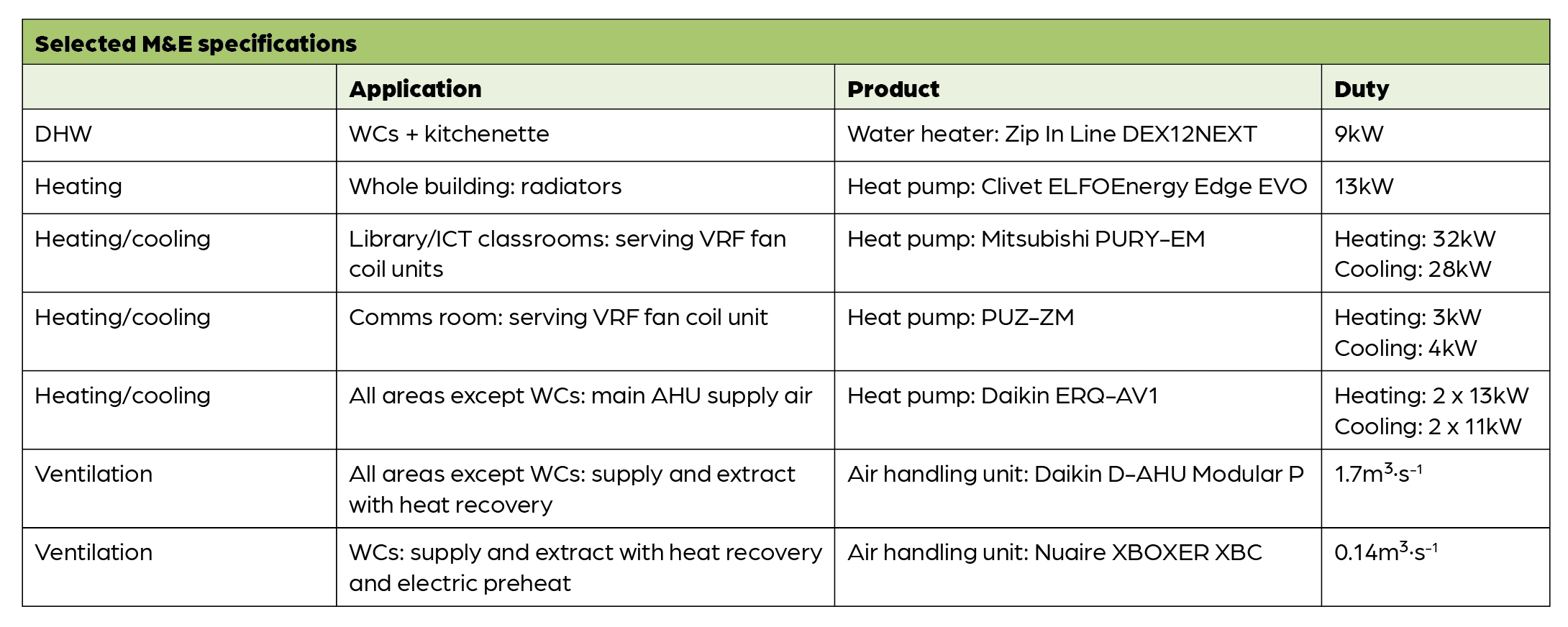
Although the school has an existing heat network, it is gas-fired, so the design team specified heat pumps for heating and cooling needs.
Thermal modelling against future CIBSE weather files revealed it was not possible to cool the building using natural ventilation alone. Overheating in an adjacent building, due for upgrade and reconfiguration in another phase of the project, highlighted the issue.
‘We paid close attention to the potential for overheating, and found passive ventilation and cooling was just not feasible,’ says David Montgomery, senior engineer at Max Fordham.
Relying on openable windows for cooling and ventilation would have been problematic because of noise. ‘An acoustic survey showed that, at certain times, road noise was significant and there was also noise from the playground,’ Pochee adds.
The building has MVHR throughout. The main air handling unit (AHU), serving all areas except WCs, provides around 8 L·s-1 per person of fresh air with a (clean filter) design peak flow specific fan power (SFP) of 1.4 W.L-1.s-1. The AHU incorporates a plate heat exchanger with heat-recovery efficiency of around 80%, having two direct expansion (DX) heating and cooling coils to pre-heat and pre-cool supply air as needed. The coils are used in series to improve turn-down capacity, with a much lower output than maximum design capacity.
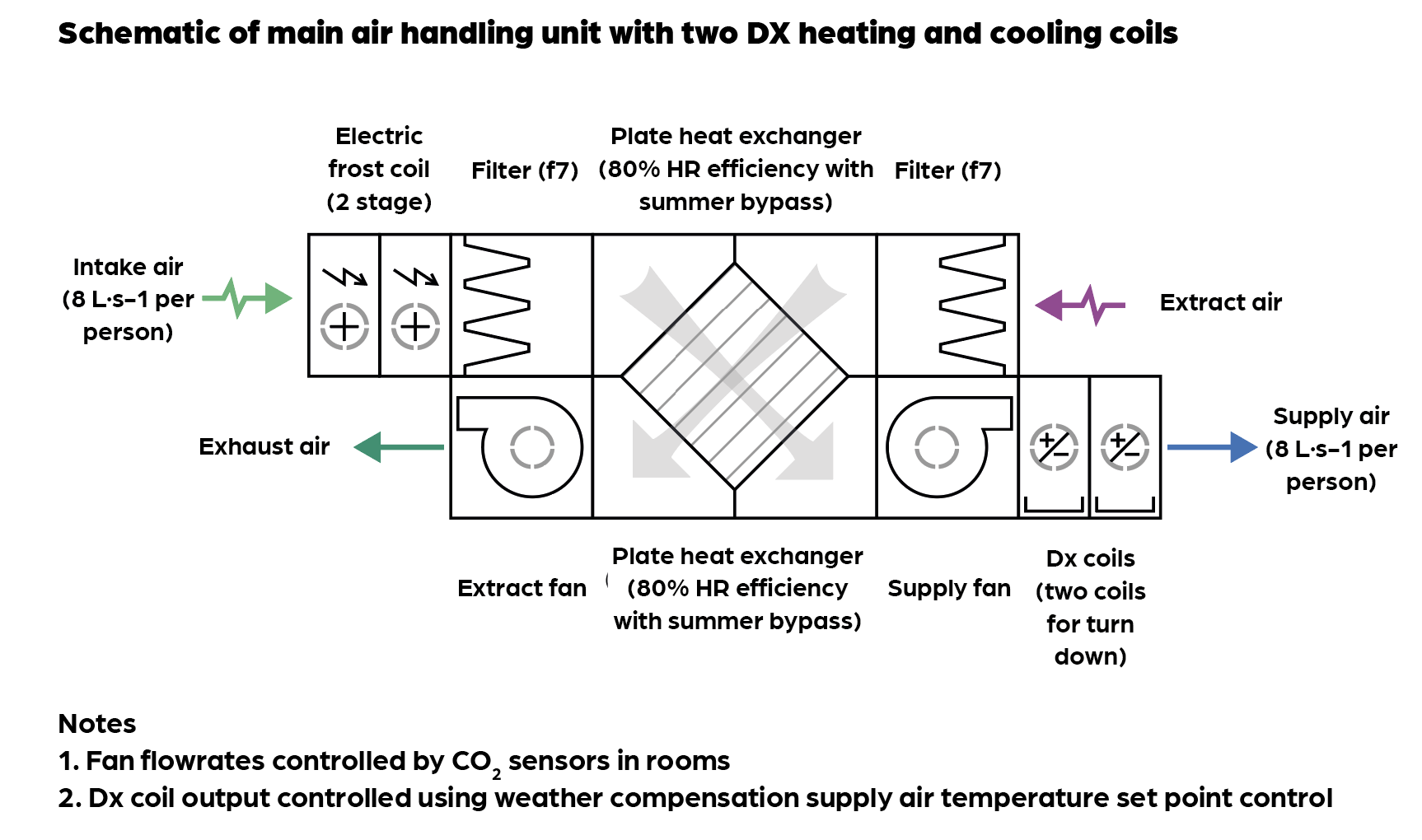
The coils are served by two DX air source heat pumps (ASHPs). These use R410A refrigerant, which Max Fordham says was all that was available when the project was specified. Now a lower global warming potential refrigerant option would be selected, says Pochee.
All the main spaces have CO2 parts per million (ppm) sensors, and AHU flowrate is modulated on the worst-case sensor reading, with a minimum value of about 40% maximum flowrate.
General-purpose classrooms, staff rooms and circulation areas are heated with radiators served by a 12kW roof-mounted R32 ASHP. Radiators are sized to meet peak loads with a water flow temperature of 55°C. The ICT classrooms and library spaces are heated and cooled with an R32 variable refrigerant flow (VRF) reversible heat pump serving ceiling-concealed fan coil units.
Careful detailing of the controls hardware and (cause and effect) logic was developed with the client’s estates and sustainability teams, which required some areas to have local user control and others to have central control.
Hot water is provided by point-of-use electric heaters with no storage.
Lighting is high-efficiency LED throughout, with a centralised automatic controls system that implements daylight dimming along with absence and presence switching.
Around 30 electricity meters are used with other BMS data, such as internal temperature, CO2 ppm, plant operating data and time schedules, to implement an energy (and health and wellbeing) optimisation plan during commissioning, de-snagging and seasonal commissioning. ‘The metering requires a great deal of attention to be commissioned properly,’ says Pochee.
Results of building evaluation
- Overheating: The RIBA CC health metric for avoiding overheating suggests limiting internal temperature so that 28°C is not exceeded for more than 1% of occupied hours. BMS data (from 2025) shows this criterion is met in 10 out of 11 occupied spaces. For one classroom, the data shows the criterion is exceeded in 2% of hours.
- Potable water: The metered potable water use is 1.7 m³ per pupil per year, 63% less than business-as-usual and close to the RIBA CC target of 1.5 m³ per pupil per year.
- Indoor air quality: For CO2 concentration in schools, CIBSE TM40 recommends that daily average CO2 levels should be less than 1,000ppm during occupied hours. For the one-year monitored period, nine of 11 occupied spaces met this criterion 100% of the time. The other two rooms exceeded it for only 0.5% of occupied hours.
- Formaldehyde:The RIBA 2030 CC air quality health metric for formaldehyde is to limit concentration to less than 100µg–m–³. Post fit-out testing confirms the building achieved 28µg–m–³.
- VOCs: The RIBA CC air quality health metric for (the eight-hour average) total VOCs is to limit concentration to less than 300µg–m–³. The testing during fit-out did not meet this, but the relevant Breeam credit was achieved by implementing a post-testing VOC dilution (by ventilation) plan.
- Air permeabililty: 2.2 m³·h–¹·m–²@ 50Pa
Energy consumption is 70kWh.m-2 per year, of which 80% is based on metered data and the rest on assumption, as some data is missing. This meets the RIBA CC new-build schools target. Energy consumption slightly exceeds the LETI-based net zero carbon (NZC) target of 65kWh.m-2 per year. However, energy optimisation is to be implemented via seasonal commissioning in the next year.
The calculated as-built upfront embodied carbon is 570 kgCO2e.m-2 (A1-A5), 5% less than the LETI NZC-compatible target of 600 kgCO2e.m-2.
One finding from monitoring was the difference in the designed peak flow SFP of 1.4W.L-1.s-1 for the AHU versus the actual peak flow SFP of 2. This means fans are working harder than they should be for the same amount of air.
‘It is thought this discrepancy has been caused by underestimating the system pressure drop at design stage, combined with sub-optimal ductwork layouts in the installation,’ says Pochee. ‘We expect this type of performance gap is common and goes unseen, because SFPs are not normally tested.’
Max Fordham suggests including as-built SFP tests as standard and says industry guidance is needed in this area.
The SFP was one of many valuable insights gained from the performance evaluation. Dulwich College will now benefit from an energy use optimisation plan, and it employs the BMS specialist on an ongoing basis for the whole campus, giving it the ‘tools and knowledge to make adjustments if it wishes’, says Pochee.
Max Fordham is applying lessons learned on subsequent projects, but, as Pochee points out, ‘there are loads of challenges and problems that never come up again’.