
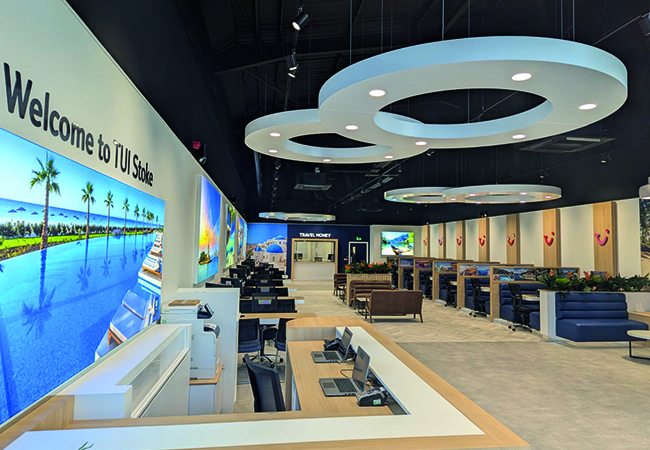
3D-printed luminaires have been installed in travel company TUI’s UK stores
Resource extraction, manufacturing and disposal of products accounts for half of the world’s greenhouse gas emissions and more than 90% of its biodiversity loss.1 In response, firms are turning to circular manufacturing models, with a focus on reuse, repair, refurbishment and recycling.
Lighting giant Signify is exploring how circularity can be achieved using 3D printing. Traditional lighting manufacture uses virgin materials, has long supply chains and produces waste at every stage. Signify’s myCreation concept, however, prints luminaires close to the customer using recycled polycarbonates, which can be recovered and reprinted repeatedly.
Rethinking plastics and circularity
Plastics are often positioned as the villain, but Bart Maeyens, leader for 3D printing at Signify, says the issue is not always the material, but how it is used and discarded. ‘We need to harness plastics so they serve us sustainably, not harmfully,’ he adds.
Every Signify 3D-printed luminaire contains at least 65% recycled polycarbonate, sourced from industrial scrap and everyday waste, such as used water jugs. Polycarbonate was chosen because it is ultraviolet and fire resistant, durable for up to 20 years, and retains its structural integrity after recycling.
There are trade-offs, however; 100% recycled material can cut lifespan. ‘Is it better to have a longer-lasting fitting with 65% recycled content, or a shorter-lived one with 100%?’ Maeyens asks. ‘Achieving circularity means minimising waste and maximising lifespan.’
Signify is piloting reverse-logistics programmes through which eight-year-old 3D-printed luminaires are returned, disassembled and granulated into feedstock for printing new products
for the same customer. Its Environmental Product Declaration states that a carbon reduction of up to 76% is achievable compared with traditional luminaires.
3D printing aligns with the EU Right to Repair Directive, which must be applied by member states by July 2026. This obliges manufacturers to make spare parts available for in-scope products and, rather than holding physical stock, firms can print parts.
Decentralised production is a key benefit of 3D printing. Signify operates five industrial printing hubs worldwide, reducing delivery distances and the embodied carbon of transportation. Luminaires can also be printed to exact sizes, enabling replacement of older, obsolete fittings without waste.
Speed is another advantage. From concept to final product typically takes 14 weeks and digital modelling can happen in days. This agility makes bespoke lighting practical, says Maeyens, who reveals that Signify aims to double printing capacity within three to four years. ‘I hope more companies embrace the concept. Circularity only works if everyone does it,’ he adds.
Intelligent by design
Artificial intelligence (AI) is being used by Signify in the 3D printing process in a number of ways.
It assists in polymer science, rapidly calculating chemical compositions that once required years of testing. In printing, AI optimises the creation of G-code – the instructions a printer follows – continuously learning how to achieve the best strength-to-material ratio with minimal waste.
‘AI can print, test, recycle and iterate,’ Maeyens explains. ‘Within only a few cycles, it figures out how to build using less material while achieving better strength.’
The next wave of innovation looks at detailed virtual replicas of printers that can be tested and improved before any physical hardware is built.
‘We can build printers digitally, explore what they can do, and then manufacture the best version,’ says Maeyens. ‘It saves time, money and a lot of resources.’
References:
1United Nations, facts and Figures, bit.ly/UNfactsandfigures