
Air source heat pumps (ASHPs) are no longer an emerging technology. Their thermodynamic performance is well understood, product ranges are mature, and they sit at the centre of UK and international decarbonisation strategies.
Yet adoption remains uneven and outcomes variable, particularly in retrofit. This persistent gap between technical capability and real-world delivery raises an uncomfortable question: if heat pumps work, why do they still struggle to scale smoothly or perform consistently in practice?
Research from the University of California Davis (UC Davis), presented at the ASHRAE Winter Conference in Las Vegas, examines non-cost barriers that shape whether heat pumps are discovered, specified, installed, operated and, ultimately, trusted by occupants.
While the underlying studies are largely US-based, the patterns they identify resonate strongly with issues familiar to UK building services engineers and across global heating markets. As the lead author, Sarah Outcault, explained during her presentation, the work focuses on ‘the gap between technical potential and sociotechnical potential’ – the space where well-designed systems can still fail to be adopted or trusted in practice.
The research synthesises findings from multiple studies, including reviews of heat pump promotion initiatives, analysis of consumer questions raised in public forums, and market studies examining policy, workforce and delivery conditions. These findings are interpreted using an ‘energy technology adoptability’ framework, adapted from diffusion of innovation theory, which considers how characteristics such as complexity, compatibility, observability and user experience influence whether a technology is adopted in practice.
For engineers, the value of this work lies in what it reveals about the space between design intent and lived performance. Many of the barriers identified sit within areas influenced by engineering decisions, installation practice, commissioning quality and how systems are explained to users.
Installation complexity
One of the most significant challenges is installation complexity, particularly in retrofit. Heat pumps succeed or fail as part of a wider system that includes emitters, distribution, controls, electrical infrastructure and the building envelope. Compatibility issues – such as undersized electrical panels, poorly sealed envelopes or limited external space – are common. None is insurmountable, but each adds risk, cost and uncertainty. If installers lack experience or confidence, uncertainty can translate into conservative design, inflated pricing or discouragement of heat pump options.
From a UK perspective, this reinforces a familiar message: heat pumps are not boiler swaps. Treating them as such risks underperformance and reputational damage. The research strengthens the case for early system appraisal and integrated approaches that address fabric, distribution and controls, alongside heat generation, rather than expecting the heat pump to compensate for systemic weaknesses.
Closely linked to system complexity is workforce capability. In markets where heat pump deployment is still accelerating, relatively few installers have deep experience of system design, sizing and commissioning. This has several consequences: limited competition, inconsistent advice and a tendency towards ‘risk pricing’, where uncertainty is reflected in conservative or inflated quotes. Contractors hedge against unfamiliarity by oversizing equipment or defaulting to hybrid solutions, while others dissuade clients based on outdated perceptions of performance.
Beyond technical design, prospective adopters often struggle to identify qualified installers, receive inconsistent or contradictory advice, and find it difficult to compare quotations where system specifications differ. These challenges are compounded by complex and opaque incentive rules, with eligibility criteria and application processes that are not always clear. Such issues increasingly shape the context in which engineers are asked to advise clients or validate proposals, particularly in retrofit programmes, where trust and confidence are fragile.

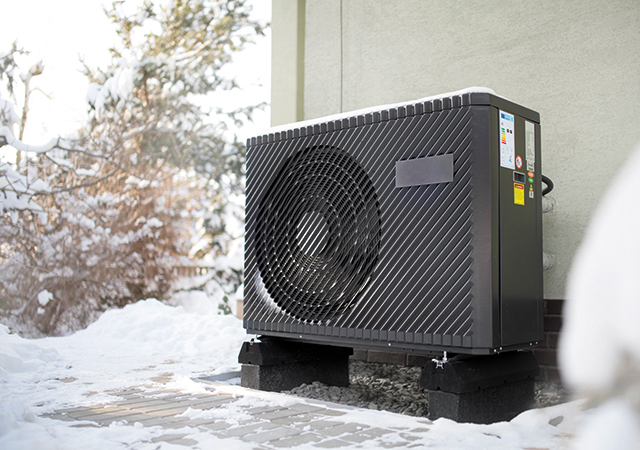
Light under a bushel: The invisibility of heat pumps means they are in danger of being overlooked
In response, some programmes have begun to restructure delivery rather than refine individual steps. ‘One-stop shop’ or concierge-style models have emerged to guide householders through contractor selection, system choice, incentive applications and financing. These reflect recognition that coherent delivery matters and that fragmented processes can undermine technically sound designs.
Another recurring theme is the challenge of predicting and achieving energy savings. In gas-dominated markets such as the UK, switching to a heat pump does not guarantee lower running costs. Relative fuel prices, system design and operational behaviour all influence whether efficiency gains translate into savings. Poor sizing, inadequate insulation and inappropriate control strategies persist in practice, particularly in cost-constrained retrofits. User operation also plays a role: heat pumps generally perform best with stable setpoints, rather than aggressive setbacks, and systems may operate inefficiently where this is not clearly explained at handover.
Two less familiar, but highly relevant, concepts are observability and trialability. As Outcault noted, ‘most residential heat pumps live out of sight, and that low observability means neighbours don’t learn from neighbours and old myths persist long after the technology has improved’. This reinforces misconceptions based on legacy technology. While engineers are not responsible for public awareness campaigns, they influence observability through case studies, monitored performance data and transparent reporting of outcomes.
The research also highlights the importance of non-energy benefits. Outcault observed that these ‘are often the most compelling selling points for customers, yet are not well understood and are under-communicated’.
Specifications and programmes often focus on efficiency and carbon, but occupants tend to value comfort, quiet operation, air quality and perceived safety just as highly. This underlines the importance of treating comfort and usability as legitimate design parameters. Stable temperatures, appropriate emitters, intuitive controls and clear guidance on operation can have a greater impact on user satisfaction than marginal gains in nominal efficiency.
The central message of this research is that heat pumps reward good engineering and expose weak practice. As deployment accelerates, the challenge is to move from demonstrating that heat pumps can work to ensuring that they work reliably, predictably and comfortably at scale.
By paying closer attention to system integration, workforce capability, delivery structures and the lived experience of occupants, building services engineers can help close the gap between technical potential and real-world performance. l
This article is based on a pre-print paper presented at the 2026 ASHRAE Winter Conference by Sarah Outcault, Eli Alston and Angela Sanguinetti, of UC Davis. The final paper will be appear in ASHRAE Transactions, vol 132, part 1 (2026).