
As the UK intensifies its efforts to decarbonise heating in buildings, the spotlight is increasingly turning towards heat pumps – not only in homes, but across the vast and complex landscape of commercial and public buildings.
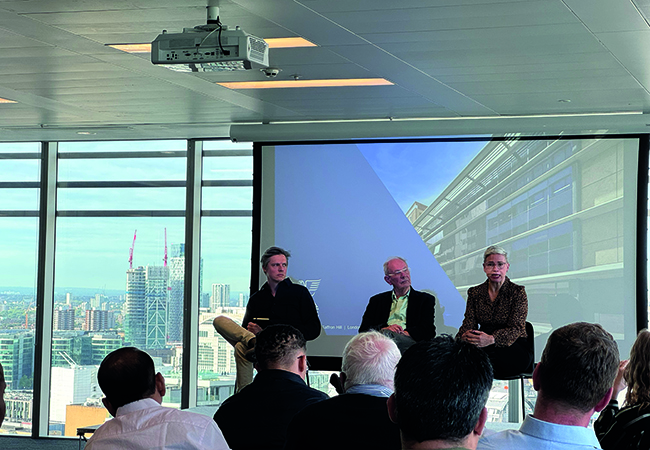
The latest CIBSE breakfast briefing, held at Aecom’s London office on 24 September, explored this rapidly evolving field, focusing on the application of heat pumps in non-domestic buildings. It brought together three leading voices from the sector: Roger Hitchin, independent consultant and long-time contributor to the International Energy Agency’s (IEA’s) heat pump programme; Laura Bishop, director and co-founder of Hillside-Infinitas; and Josh Bird, director at Rethink Buildings.
Understanding the market
Opening the session, Hitchin provided an overview of the UK’s non-domestic heating landscape. ‘About one-third of heat use in the UK is in the non-domestic sector,’ he explained. ‘New build represents a comparatively small portion of that. The real opportunity lies in the existing building stock.’
He noted that the majority of non-domestic boiler sales are replacements, rather than new installations, adding: ‘That tells us where the market is and where we need to be headed.’
To help practitioners navigate this evolving space, Hitchin highlighted a range of CIBSE guidance. ‘AM17, published in 2022, remains a key resource for large non-domestic heat pump installations,’ he said, ‘and a new supplement focused on retrofit is just starting. TM51, on ground source heat pumps, is being revised and so is TM39, on building energy metering.’
Every building can support a heat pump… but we need to understand what makes it tricky and plan accordingly
He also pointed to new IEA and Department for Energy Security and Net Zero initiatives, including Annex 60, which focuses on retrofitting heat pumps in large buildings. ‘Next year, we’ll have a new web tool providing guidance for building owners. It will link to real case studies, something the market needs.’
The road ahead, however, is not straightforward. ‘Costs remain a major constraint,’ Hitchin cautioned. ‘The Public Sector Decarbonisation Scheme showed that financial incentives can be effective, but the complexity of choice and the performance risks are still high. Installer experience varies widely and systems are often poorly designed.’
He underlined that retrofitting a heat pump is not the same as replacing a boiler. ‘Compatibility is key, particularly emitter capacity. Many businesses offering heat pump installations simply don’t have the expertise. It’s key we improve this if we are to progress.’
Design matters
Bishop’s advice to designers was practical and direct: ‘Don’t size your heat pump based on the old boiler. Reduce your flow temperatures to maximise COP [coefficient of performance] and always look at the building holistically – understand how it’s operated, where the problems are and how users interact with the system.
‘The heat pump gets blamed far too often for poor performance, when it’s really a design or installation issue.’
She urged practitioners to embrace a wider range of technologies. ‘There are so many resources available; don’t just default to what you know.’
When asked why retrofit uptake in commercial buildings remains slow, Bishop was frank: ‘It’s money. We’ve worked on projects where local authorities receive grant funding for heat pumps, but once the building is occupied, only one system is actually running, and that’s down to cost. Until we crack this, the market will stay limited.’
She highlighted the ongoing issue of energy pricing and the ‘spark gap’ between gas and electricity: ‘Gas is still far cheaper than electricity and that’s driving some people back to fossil fuel boilers.’
Bishop urged project teams to plan for electrical impacts early. ‘Upgrading an electricity supply can trigger unexpected costs,’ she warned. ‘Bring the client on that journey from the start, so there are no surprises. Understand the DNO [distribution network operator] upgrade implications, include all costs in your financial model and shop around for tariffs. Thermal storage and time-of-use pricing can also make a difference.’
Tackling tricky buildings
Bird explored the challenge of heat pumps in ‘tricky’ commercial buildings, which often have high temperature demands, limited electrical capacity, or space and noise constraints. He described the pitfalls of ‘sledgehammer’ sizing: ‘Too often, we see systems sized to match the original boiler output. You need granular data to understand the building’s true heating demand – only then can you size the system correctly.’
Despite these challenges, he remains optimistic: ‘Every building can support a heat pump if properly assessed. We just need to understand what makes it tricky and plan accordingly.’
Many existing systems are vastly oversized, Bird added: ‘Historically, when you were installing a boiler it was easy to oversize; there was little penalty. Now, with heat pumps, oversizing can be expensive and inefficient.’
On practical solutions, Bird shared examples of creative retrofits that can be easy and low intervention. ‘If you are looking at offices with undersized fan coil units, you don’t have to rip everything out and replace it, and displace the occupants while you do so. You can “hack” the building, optimise controls, use different operational strategies, and work within constraints.’
When the debate turned to controls, Bird and Bishop were aligned. ‘Performance specs don’t cut it,’ said Bird. ‘Designers should specify down to every nut and bolt, otherwise you’ll have kit that doesn’t work well together.’
Bishop agreed: ‘When you write a control philosophy document, it forces you to question and understand how the system operates. That’s what leads to good, functional design.’
The briefing ended on a note of cautious optimism. Retrofitting commercial heat pumps is not simple, but with better data, training and design, it’s achievable.
As Hitchin concluded: ‘We’re learning fast. The tools and guidance are coming, and the market will mature. The key is getting the fundamentals right – design, performance and understanding how buildings really work.’