
Credit: iStock.com/John_Lamb
Designing a building that complies with today’s UK Building Regulations is no guarantee that it will be fit to withstand future climate extremes.
In the UK, new buildings are designed to comply with energy efficiency standards and overheating requirements. However, compliance checks evaluate a building against normal summer conditions, not climate extremes, so meeting the requirements of Building Regulations doesn’t necessarily mean buildings are future-proofed against a changing climate.
Regulations also assume that building systems run continuously, without interruption. They do not account for Grid failures or power outages during severe heatwaves.
Increasingly extreme weather, ageing Grid infrastructure and more frequent peak-demand spikes are putting unprecedented pressure on distribution networks.
The instability of the Grid means air conditioning (AC) cannot be regarded as a silver bullet; widespread AC use risks overloading electricity networks during extreme heat.
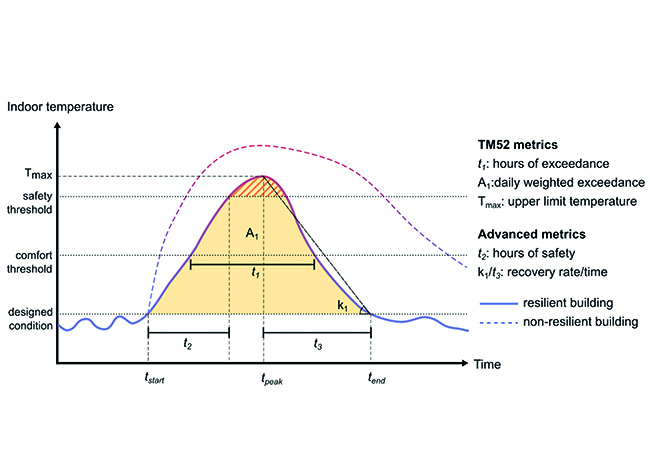
Figure 1: Conceptual resilience curve of indoor temperature during heatwave and/or power outage
A recently published critical review1 on thermal resilience says services should be stress-tested against worst-case scenarios – such as a heatwave occurring at the same time as a power outage – to ensure occupants remain safe when mechanical cooling fails.
Assessing thermal resilience requires looking at how indoor environments respond when a disruptive event is combined with a power outage. By adapting the CIBSE TM52 framework (Figure 1), an internal temperature profile can be mapped against the duration of overheating (hours of exceedance), severity (daily weighted exceedance) and upper temperature limits.
When facing a compound scenario – heatwave and outage – safety-based thresholds may be more appropriate than comfort-based ones. The concept can be applied in summer and winter under disruptive events: in summer, it indicates how long safe indoor conditions can be maintained without active cooling, while, in winter, it reflects how long a building can remain habitable when heating is unavailable.
This challenges the simplistic design approach of relying solely on active systems and additional cooling capacity to address overheating. Instead, it reinforces a passive-first strategy, such as better-performing building fabric, including improved insulation to reduce heat loss in winter and greater thermal mass to buffer indoor temperature fluctuations during extreme conditions.
This metric could also serve as a proxy energy flexibility indicator that reflects a building’s passive capacity to reduce energy demand when the Grid is under stress or when tariffs are high.
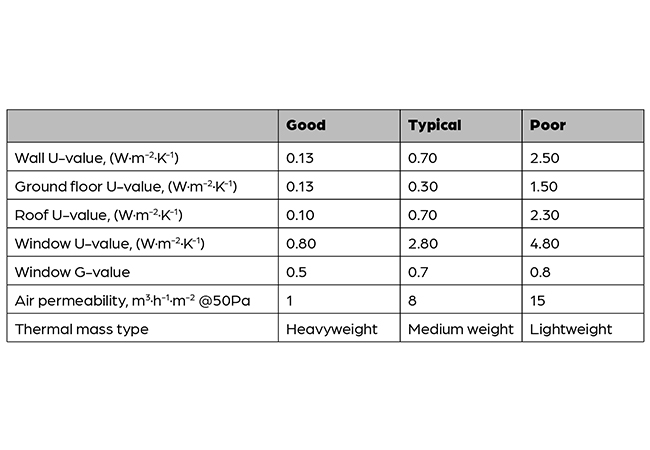
Table 1: Fabric properties of the three building cases (dwelling)
The recovery time or recovery rate can provide another perspective on a building’s ability to respond to extreme events, by indicating how quickly conditions can return to a safe or acceptable range.
Figure 1 also shows that resilient and non-resilient buildings perform differently during disruptive events: a resilient building has a greater capacity to absorb shocks, recovers more quickly and has a shorter window of danger.
This distinction can be further illustrated through modelling results for a typical dwelling, with three different envelope types, under extreme summer and winter conditions during a 24-hour power outage (Table 2).
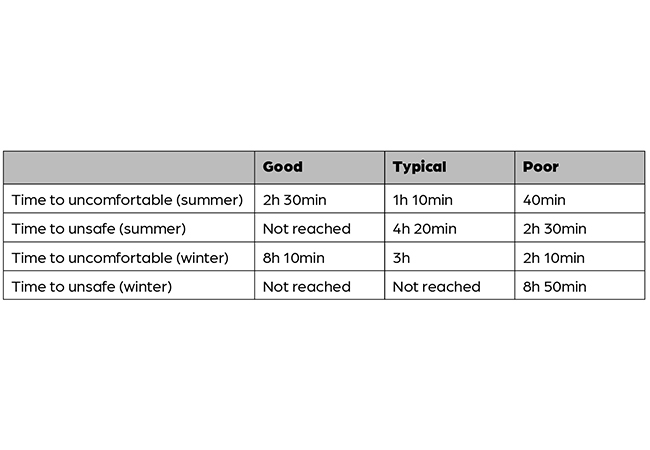
Table 2: Performance of typical dwelling under extreme conditions with 24-hour power outage
The ‘good’ case represents a well-insulated dwelling designed in line with the LETI net zero recommendations and incorporating high thermal mass; the ‘typical’ case reflects the predominant characteristics of English housing stock; and the ‘poor’ case represents a lightweight, uninsulated envelope. The fabric property inputs are shown in Table 1, with a maximum ventilation rate of 5 ACH applied to all cases.
Under future extreme summer conditions, free-running dwellings will be at risk of severe overheating, and active cooling measures may need to be considered. When a power outage occurs, however, substantial differences emerge between the three design cases: the poor-performing dwelling quickly enters unsafe conditions, while the good-performing dwelling is able to buffer indoor temperature rise and avoid unsafe conditions.
A similar pattern is observed during a winter cold snap with power outage, when the good-performing dwelling is able to maintain comfortable conditions for a much longer period (Table 2).
Extreme weather is part of a broader, unpredictable trend that requires a robust risk assessment framework. Current weather datasets are often too conservative – recent weather has already hit levels predicted for 2050. With the release of new CIBSE weather files, designers can test building performance under future conditions.
Resilience assessment can move beyond a simple pass/fail indicator of overheating towards an approach that translates complex risk scenarios into a clearer indication of how buildings perform in extreme conditions. Such an approach could show whether a building is able to remain safe and functional in 2080, or withstand heatwaves and power outages of varying severity.
Resilience can be communicated through comparable evidence, helping to reduce uncertainty around climate risk and, potentially, informing insurance, financing and investment decisions. There is potential for a rating framework, which could indicate the level of building resilience in an accessible way.
About the author
Yingyue Li is a paper co-author and PhD student in energy resilience and the built environment at UCL
References:
1 Li Y, Tsouknida E, Collins T, Bateson A, Tang R, Burman E. (2026) Thermal resilience in the built environment: A critical review. Sustainable Cities and Society.