
Sustainability in the built environment has evolved beyond energy efficiency. Today, professionals must consider a broader set of key performance indicators (KPIs) from the earliest stages of design. Yet early-stage decisions are often made with limited definition, making it challenging to balance ambition with feasibility.
To address this, Aecom has developed a suite of digital toolsets, including Aecomzero, a parametric optimisation platform that enables project teams to test multiple design strategies simultaneously across a range of KPIs. Rather than treating sustainability as a downstream check, the tool helps embed performance decisions from the outset.
In a recent project in Spain, it guided design decisions that delivered a 36% reduction in embodied carbon and up to an 11% reduction in energy use at concept-stage.
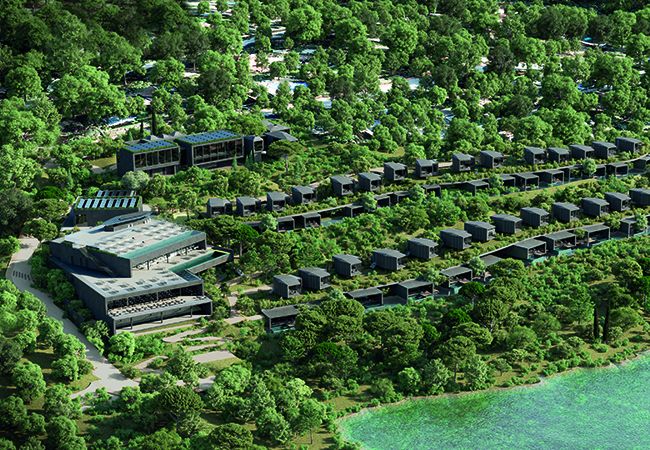
Vivood Landscape Hotels is a hospitality operator whose hotels are designed for those seeking nature and disconnection, typically located in scenic areas near urban centres. The project involved a new hotel in mountains northwest of Madrid, adjacent to a reservoir and within a protected natural area. The west-facing orientation, seasonal climate variation and unreliable water infrastructure presented unique design challenges.
The hotel team, who trained as architects, approached us with a concept aligned with their values – landscape integration, privacy and unobstructed views. While they had no formal sustainability standard or certification goals, they were open to strategies that delivered measurable impact within budget constraints.
The optimisation tool
Aecomzero is built on Ladybug Tools and Grasshopper for Rhino, with EnergyPlus for energy modelling, Excel for cost and carbon calculations, and Human UI for the dashboard interface. The tool enables real-time feedback across multiple KPIs, and is structured as a series of modular analysis packs, adaptable to each project.
For Vivood, we focused on four core priorities in collaboration with the client: energy, water, embodied carbon and cost. Other indicators, such as daylight and biodiversity, were considered, but were excluded to maintain analytical clarity and relevance at concept stage.
The process began by establishing a baseline reflecting the client’s concept, typical materials and compliance with national building regulations. From there, the project was divided into optimisation packages, primarily by geometry, but also by material and system definition, enabling targeted evaluation.
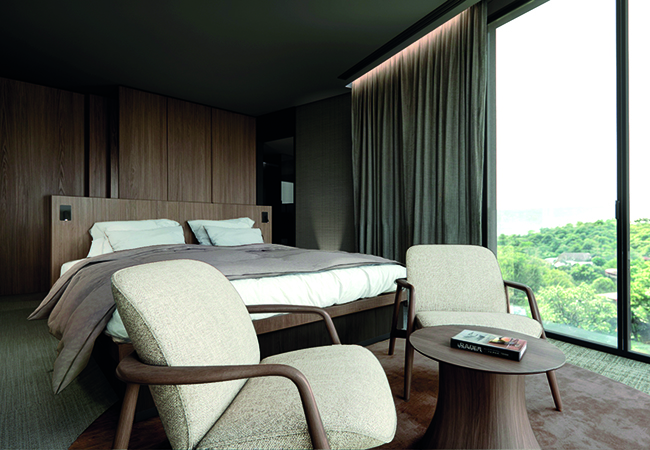
The team behind Vivood Landscape Hotels all trained as architects
Unlike traditional linear workflows, where sustainability assessments follow design iterations, the tool supports a circular process. Design options are explored directly within the tool, with live feedback on environmental performance. This integrative approach required front-loaded collaboration with architects and MEP and structural engineers, and data collection to support cost and carbon analysis.
Each design parameter – geometry, materials and systems – was interconnected, allowing us to assess trade-offs and synergies across KPIs. The tool’s dashboard visualises the impact of design decisions in real time. Parameters are grouped into categories, such as glazing ratios, shading elements, material selections, HVAC and PV options, and water strategies. Strategies are tiered (base, good, better, best), enabling combinations based on discipline recommendations and client input.
This visualisation fostered cross-disciplinary awareness of environmental impacts and engaged the client in sustainability decisions. While the tool prioritises speed and conceptual clarity over detailed accuracy, it supports informed choices effectively without delaying design progress.
Performance outcomes
At the end of concept design, the tool helped guide several key decisions, driving a balance between optimised performance and cost. Options such as low carbon concrete and high recycled-content reinforcement proved to deliver significant embodied carbon savings at marginal cost uplift, which the client accepted.
A debate over timber or Tapialblock for façades concluded that, while both performed similarly, environmentally, timber carried higher cost, and Tapialblock raised durability concerns. Timber was selected, which resulted in a significant carbon reduction compared with the baseline glass-reinforced concrete panel.
The proposed size reduction of the pools offered carbon and cost benefits, but was rejected to preserve brand identity. Similarly, a reduction of the underground car park was found to be unfeasible from the hotel’s operational perspective. However, changing the landscape retaining walls from concrete to gabions proved cost and carbon efficient.
Overall, a 36% reduction in embodied carbon was achieved at concept stage, along with a modest cost reduction of 1% – and, crucially, the decisions taken avoided any capital expenditure (capex) increase.
Internal finishes were found to have limited overall carbon impact, with most alternatives carrying a cost penalty, so the baseline specification was retained.
Glazing ratios and specifications were decisive. Reducing west-facing glazing and upgrading glass performance cut energy demand, while respecting the client’s preference for uncluttered façades and uninterrupted views.
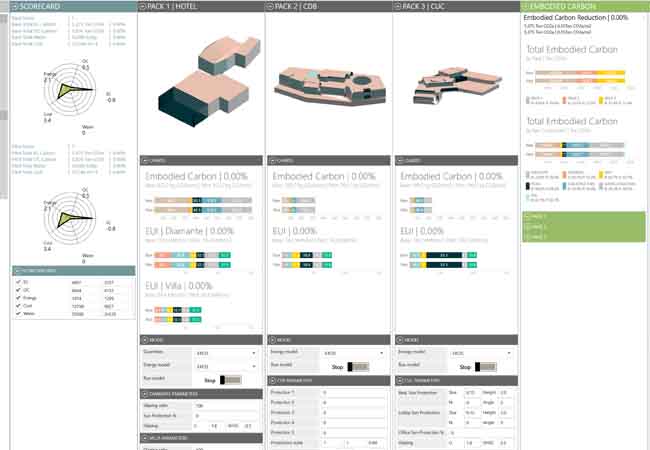
A section of the Aecomzero optimisation platform, where design decisions are visualised in real time
Air source heat pumps serving multiple rooms, combined with photovoltaic arrays on larger roofs, further reduced energy use and operational carbon (the project is all-electric).
Overall, the design achieved up to 11% energy-use reduction for the worst-performing Diamond units, compared with a baseline that followed the already stringent Spanish Nearly Zero Energy Building regulations.
Given the already over-capacity local network, water strategies were prioritised despite the added upfront cost. Measures included low-flow fixtures, greywater reuse for irrigation, and a greywater circuit for toilet flushing. These achieved a 28% reduction in potable demand and a 39% reduction in wastewater generation, with an increase in capex, but reduction in operating expenditure.
Conclusion
The project has planning permission and is nearing construction. A majority of strategies identified through the optimisation tool at concept stage have been developed into detail design, to align with Breeam Excellent accreditation. . While the tool’s accuracy is limited to the elements modelled and relies on early-stage assumptions, its value is in embedding sustainability from the start. It enabled meaningful engagement with the client and design disciplines, reduced the need for costly redesigns, and delivered measurable environmental benefits.
About the author
Inés Idzikowski Pérez is a senior sustainability consultant at Aecom
This paper was presented at the 2025 CIBSE IBPSA-England Technical Symposium. Visit www.cibse.org/symposium to download past papers and see details of the 2026 event.