

Building services professionals today operate under significant and increasing pressure. The drive towards net zero, more frequent extreme weather events, and evolving safety regulations all demand new approaches to the design, management and operation of complex buildings. A presentation delivered at the 2025 CIBSE Technical Symposium explored how an AI-driven platform is being used to address critical information challenges in managing healthcare facilities across the NHS.
Engineers and facilities teams are often expected to navigate multiple overlapping regulatory systems, manage detailed compliance documentation and interpret sector-specific guidance – all while responding to operational issues and delivering on sustainability goals. Accessing the right technical information at the right time is becoming a critical challenge.
Personal experience during the pandemic
During the early stages of the Covid-19 pandemic, I volunteered at Addenbrooke’s Hospital, Cambridge. Estates and facilities teams were working under intense pressure, adapting hospital spaces and services to meet unprecedented clinical demands. I saw first-hand the difficulty of working from decades-old drawings and scattered paper documentation – especially when trying to locate live infrastructure details for critical systems such as oxygen supply lines delivering up to 60 litres per minute to Covid wards.
This experience informed my subsequent PhD research at the University of Cambridge, which focused on how NHS Estates and Facilities Management (EFM) teams access and share technical knowledge. A survey of 324 NHS EFM professionals found they spend more than nine hours a week simply searching for information (as illustrated in Figure 1). A further 12.4 hours are spent writing or reviewing policies, specifications and reports. That leaves just 16 hours per week – less than half a standard working week – for activities like planning, innovation or project delivery.
While my research focused on healthcare, the same issues are present across the building services sector. The information professionals need is often fragmented across file systems, organisational silos, proprietary standards and ever-expanding regulations.
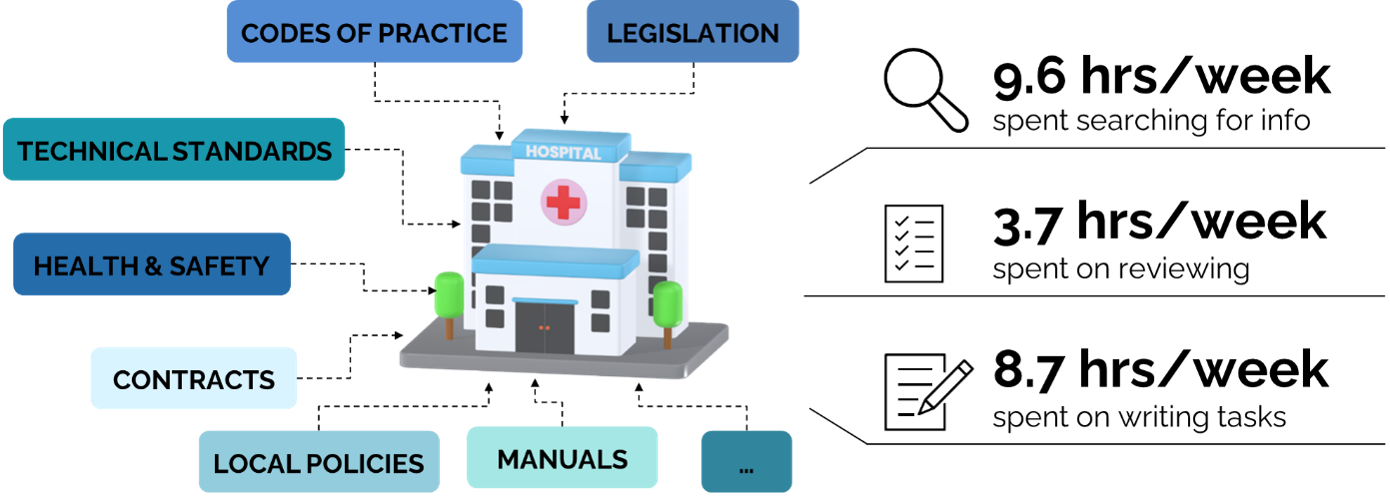
Figure 1: Weekly time allocation by NHS Estates and Facilities Management staff (n=324) for information search, document review, and writing tasks, illustrating the significant administrative burden impacting innovation and collaboration
The promise – and limitations – of AI
Since the emergence of tools such as ChatGPT in late 2022, interest has grown in the potential of large language models (LLMs) to support technical work. These tools use natural language processing to answer questions, summarise documents and generate new text, offering an alternative to traditional keyword searches or manual document trawls.
[pullquote] AI models can answer in seconds what once took hours to search [/pullquote]
For engineers and facilities staff facing information overload, the attraction is clear. LLMs can answer queries such as ‘What are the ventilation requirements for a Category 1 operating theatre?’ in seconds – offering a starting point for further review or decision-making.
However, generic AI tools also present challenges. Most do not have access to the latest technical standards or guidance. They often struggle with domain-specific terminology and acronyms. And they are prone to ‘hallucinations’ – confidently delivering incorrect or misleading information. In a safety-critical context, that risk is unacceptable.
For AI to become genuinely useful in building services, three key requirements must be met:
- Access to trusted guidance
- Sector-specific language understanding
- Integration with real workflows
Building a sector-specific AI platform
To address these challenges, we developed a specialist AI platform – INNEX – designed specifically for compliance-intensive environments such as healthcare estates. Built around verified UK legislation and guidance, and designed in consultation with estates professionals, the system provides fast, natural-language search, writing support, and document review functions – all underpinned by verifiable sources and tuned to reflect the structure, terminology and workflows common in estates and facilities operations.
Following successful pilots at Cambridge University Hospitals NHS Foundation Trust in 2024, the platform has now been adopted by several other trusts. Staff use it to locate relevant internal policies and national standards, generate or review compliance documentation, and check draft material against current requirements.
It has proven particularly valuable for junior staff and neurodiverse professionals, supporting confidence with written tasks and enabling more consistent documentation outputs. This review capability is illustrated in Figure 2, which shows how a ventilation policy can be assessed against relevant guidance using the AI Review Assistant.
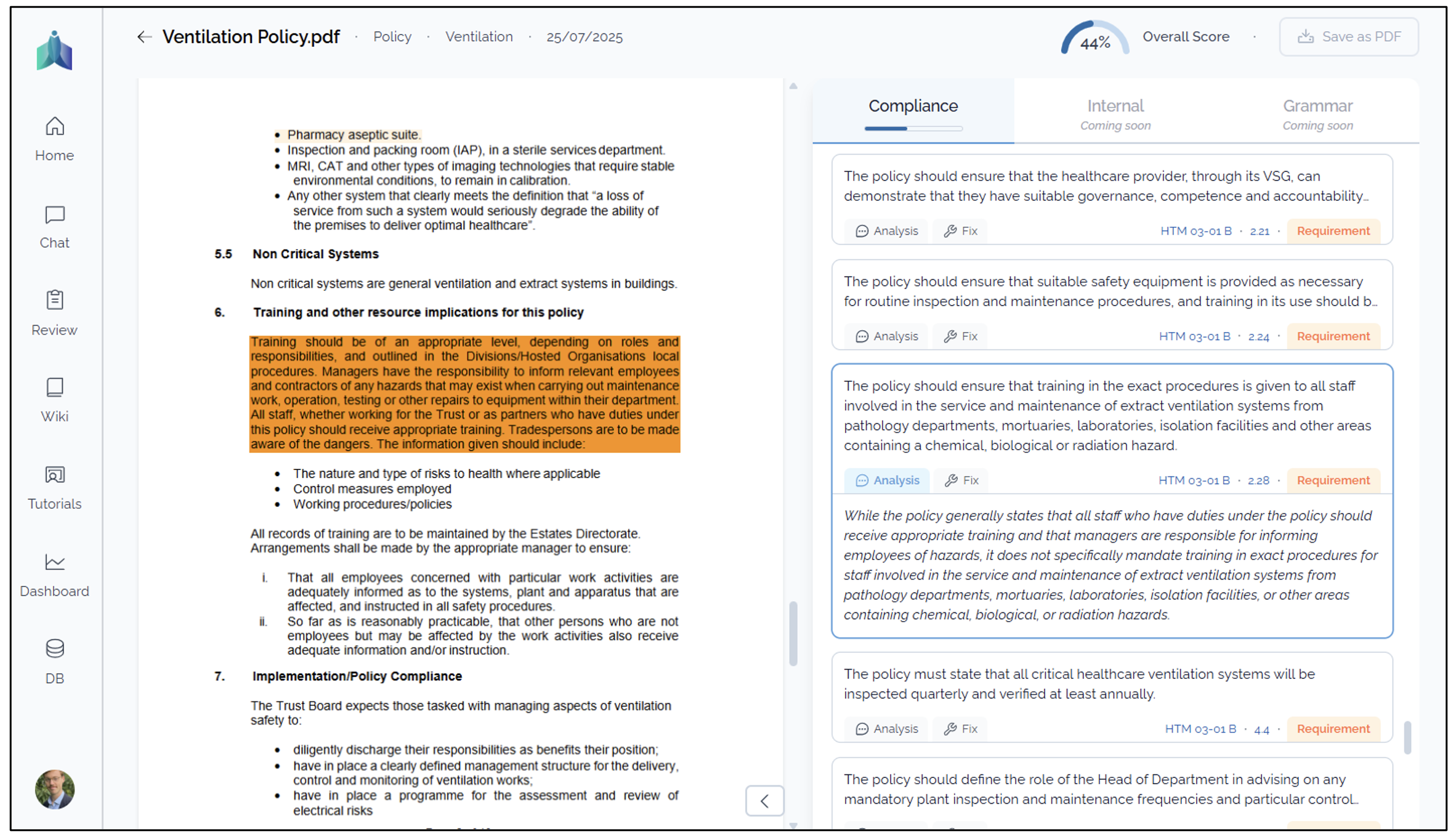
Figure 2: Screenshot of the INNEX AI Review Assistant in action with an example Ventilation Policy.
Applications beyond healthcare
Although initially developed for NHS estates, the platform has broader potential across the built environment. Many other sectors – such as higher education, commercial real estate and transport infrastructure – face similar documentation and compliance burdens.
The introduction of the Building Safety Act and the Building Safety Regulator is already generating new expectations for digital record-keeping, resident engagement and accountable duty-holders in the residential sector.
Beyond day-to-day support, the tool also enables data-led insights. Analysing thousands of anonymous user queries discloses areas where technical guidance may be unclear or frequently misinterpreted – creating opportunities for professional institutions and regulators to improve clarity and consistency.
AI-assisted platforms can create feedback loops to develop guidance and standards.
There’s also scope to support cross-sector learning. For example, ventilation strategies that are proven in hospitals may also benefit schools.
Supporting professionals, not replacing them
AI will not replace professional judgement. But when developed responsibly – using trusted data and designed for real workflows – it can support better decisions, faster compliance checking and reduced administrative overhead.
The building services sector is not short of regulation, but it is short of time. AI, used wisely, can help restore that balance.
To read the paper and presentation slides, visit bit.ly/CJTSCVB25
Details of the 2026 CIBSE Technical Symposium can be found by visiting www.cibse.org/symposium
About the author:
Dr Carl-Magnus von Behr is co-founder at Innex