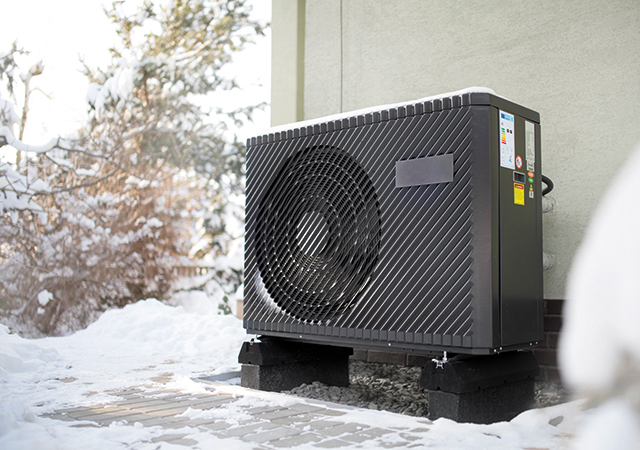
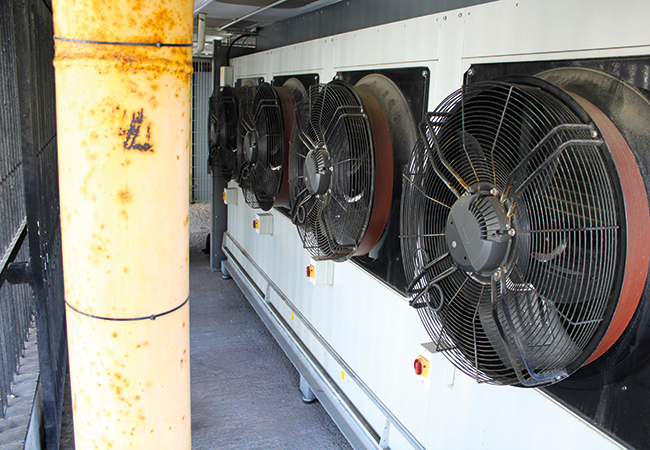
One of four sets of ASHP evaporators next to a gas pipe at the university college case study
A new report commissioned by Historic England has found that air source heat pumps (ASHPs) are a viable and effective solution for decarbonising historic buildings, challenging the common misconception that older structures are unsuitable for modern heating technology.
It features case studies of five ASHPs at four UK sites, ranging from a small café and museum in a historic barn, to a major retrofit of a Grade II-listed university college.
The study, carried out by Max Fordham, found that when performance issues did arise, they were typically rooted in the design of the heating distribution or delivery – such as convectively heating areas open to the outdoors – rather than a failure of the heat pump itself. Notably, the aesthetic and acoustic presence of the units did not cause concern for users, mirroring findings from previous research.
To achieve peak efficiency, carbon dioxide refrigerant systems are highlighted as a major advantage. These allow for the reuse of existing pipework – significantly lowering embodied carbon – and mitigate the environmental impact of potential refrigerant leaks.
The report said the technical success of ASHP installations relies heavily on the ‘human factor’; building users must be educated on how to operate the system controls to ensure the heating is effective and sustainable.
Feature sites
Site 1
Visitor centre and workshop
Split ASHPs
Installed capacity: 16kW and 11kW
Site 2
Visitor centre and restaurant
Monobloc ASHP
Installed capacity: 2 x 11kW units
Site 3
University college: residential/education/hospitality
Split CO2 and multiple
monobloc R-32
Heat pump capacity: 700kW and 75kW
Site 4a
Commercial
Monobloc R410-A, R-32
Heat pump capacity: 28kW (2x 14kW)
Site 4b
Residential
Monobloc R-407
Heat pump capacity: 9kW
Site 1: Visitor centre and workshop
Case study one was the installation of two air-to-water ASHPs in a visitor centre and workshops sited in 19th-century, Grade II-listed agricultural buildings. Additional insulation and a new radiator system were also installed in the visitor centre.
The ASHPs are used to heat the building and to provide domestic hot water to sinks in the bathroom and the office next to the plantroom. Other sinks in the building have hot water provided by point-of-use heaters.
The research engineers uncovered numerous issues and gave the installation no stars for technology choice, thermal comfort or system design/installation quality. (Each project was ranked 0 to 2 stars for each of these criteria). They found that the convection-based radiators do not match the use of the building. The doors of the visitor centre and toilet were propped open, causing heated air to leave the building. There was also limited insulation.
The report states that typical heat output for an old building that has had some fabric improvements is around 120W/m2, but, in this system, the capacity for the building is 54W/m2. During the visit, one of the ASHPs was out of use, reducing the capacity to 32W/m2.
A lack of insulation on pipework in the plantroom was increasing thermal losses, while a lack of mechanical protection meant one ASHP had been decommissioned because of damage caused by vermin. The research engineers said the ASHP’s secluded position behind a hedge made it more vulnerable to attack.
A 260L hot-water cylinder was also found to be oversized for the four sinks that the ASHPs serviced. The other 10 sinks in the building used direct electric heaters.
In user interviews, occupants said they wore coats and used electric heaters to keep warm. They were unhappy with the installer’s aftercare and were having difficulty securing a maintenance contractor trained in ASHPs. This lack of call-out support led to extended periods when the ASHPs were unable to provide space heating.
The report concludes that the ASHP technology was not at fault, but questioned whether such a draughty space should be heated by a heat pump. It suggested using radiant panels near reception staff and in the toilets as a replacement for the radiators. Facilities manager and site staff also had limited knowledge of how to use the heating controls.
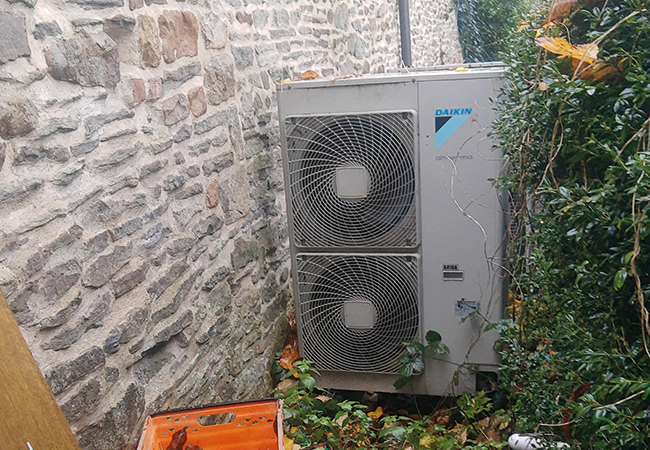
ASHP hidden by the workshop at Site 1
Site 2: Visitor centre and restaurant
There was a much more successful installation of two 11kW air-to-water monobloc ASHPs at Site 2, a modified 15th-century barn that has been converted into a visitor centre, retail space and restaurant. The ASHPs connect to an underfloor heating system and trench and electric heat emitters, and the system has a 200L buffer vessel and an 80L direct electric hot-water cylinder providing hot water.
The research engineers said the system was installed to a high standard, with all external and plantroom pipework insulated. They gave the site 2 stars for technology choice, stating that the heating schedule for the underfloor heating allowed time for the visitor centre and restaurant to warm up before opening. Thermal comfort in the restaurant is low, however, despite the space having additional electric heaters. The report says draughts in the restaurant are the result of the barn’s full-height ceiling, lack of modern insulation, gaps in the fabric and high-speed airflows between open doors. It notes that the restaurant has a wooden floor, which is less suited to underfloor heating, producing 70W/m2 compared with 100W/m2 for a stone floor, according to the BSRIA underfloor heating guide.
The performance of the ASHPs was found to be compromised by an enclosure comprising stone walls and an acoustic louvre screen that aimed to reduce noise pollution.
Acoustic enclosures can impact ASHP performance if they block or inhibit flow from the ASHP exhaust, says the report, as this flow is likely to be diverted back into the inlet. This reduces the temperature of the intake air and forces the ASHP to use more energy to extract heat from air.
Data from sensors showed that the intake air was 3°C lower than the ambient air temperature, which the researchers attributed to the recirculation of air within the enclosure. As a result, it was calculated that the coefficient of performance (COP) of the ASHP was reduced from 3.98 to 3.66 – an 8% reduction, meaning an 8% increase in running costs and CO2 emissions.
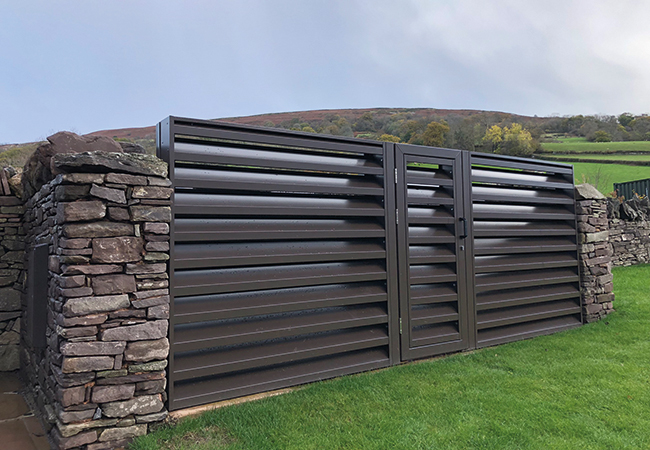
The acoustic enclosure that impacted ASHP COP at Site 2
Site 3: University college
The third case study, at a university college building, featured a large, bespoke air-to-water ASHP using a CO2 refrigerant, and five R32 ASHPs to ensure domestic hot water is always at the target temperature.
The CO2 high-temperature heat pump allowed the existing distribution system, including fan coils, radiators and pipework, to be reused. The report awarded 2 stars for technical choice, thermal comfort and system design/installation quality.
The system is designed to work at 70°C flow/30°C return, as the transcritical CO2 refrigeration cycle means COP is optimised when the return temperature is kept very low (above a certain temperature a CO2 system can’t operate and will switch off). Limiting valves are fitted to radiators to control the return temperature. These are costly, says the report, and must be judged against savings made using a high-temperature system.
As CO₂ ASHPs require a low return temperature to operate efficiently, they are not well suited to providing the slight rise in temperature required to maintain domestic hot water at the target temperature. Instead, a bank of five domestic Samsung R-32 ASHPs is used to raise the hot-water temperature. One of these R-32 units is located in the plantroom, making use of waste heat from the CO₂ ASHP and mitigating plantroom overheating. Three of the units cover the full hot-water demand of the site in the summer.
The large external evaporators of the ASHPs are sited in a car park undercroft. They are custom designed to discharge air horizontally, rather than vertically, which would have limited the airflow rate.
Site 4: Museum, tearoom and shop
The research engineers reported a successful installation of two heat pumps at Site 4, which comprises three main buildings – currently used as a museum, tearoom and staff offices – and a stable yard, which has a small, seasonal cafe, shop and staff accommodation. The heat pumps represent an excellent renewable transition away from oil heating, the report says.
One of the installations was penalised a star because the hot-water cylinder was oversized significantly. It transpired the engineer had mistakenly believed that hot water was to be provided to two baths exhibited in the museum. The misunderstanding emphasises the importance of clear client briefs, the report adds.
The installers decided to exclude the reception area at Site 4b from the heat pump system (unlike Site 1), as it had automatic opening doors and high footfall, meaning high heat loss. It is inefficient to warm such spaces by heating the air, the report says, and the radiant heating provided by the wood-burning stove was more appropriate.
The report notes, however, that stoves emit high levels of CO2 and other harmful emissions, so need regular cleaning, and they run at high surface temperatures that require extra safety measures.
These case studies demonstrate that the ‘heritage’ label is not a barrier to electrification, but rather a call for more rigorous, site-specific engineering. The report says success hinges on a holistic approach that bridges the gap between high-tech plantrooms and the practical realities of historic building fabric.
Other Historic England guides to heat pumps and heating decarbonisation
- Air source heat pump case studies – large buildings bit.ly/CJHEHPla
- Air source heat pumps case studies – small-scale buildings bit.ly/CJHEHPsm
- The viability of ground source heat pumps in historic buildings bit.ly/CJGSHPEH
- Viability of water source heat pumps in historic buildings bit.ly/CJHEWSHP
- Carbon reduction options for churches using oil for heating bit.ly/CJEHchoil