
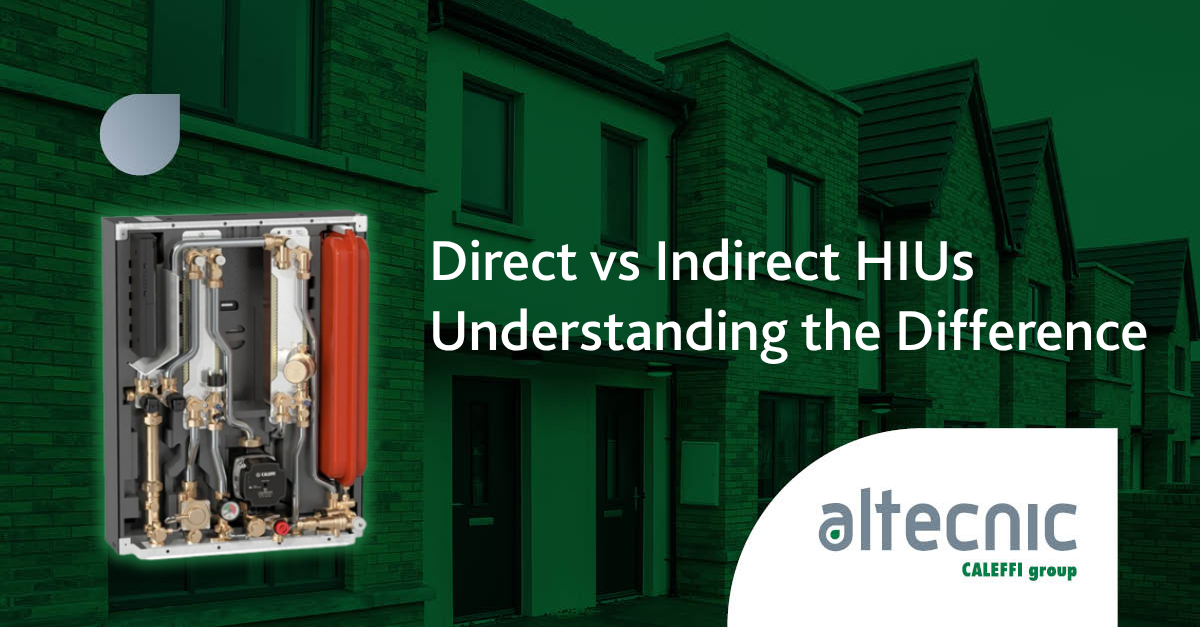
Heat Interface Units, or HIUs, are used in communal and district heating systems to transfer heat from a central plant or heat network into individual dwellings. They typically provide instantaneous domestic hot water and control space heating for the apartment or property.
The main technical difference between a direct and an indirect HIU is how the space heating circuit is connected to the primary heat network.
A direct HIU supplies the dwelling’s space heating circuit directly from the primary heating network. An indirect HIU hydraulically separates the dwelling’s space heating circuit from the primary network using a plate heat exchanger.
This difference affects system design, pressure separation, control strategy, efficiency, maintenance and the level of protection offered to both the apartment and the wider heat network.
What is a direct HIU?
A direct HIU connects the dwelling’s space heating circuit directly to the central primary heating system. In this arrangement, the primary heating water from the communal system is used to supply the radiators or underfloor heating circuit within the apartment.
Domestic hot water is still produced instantaneously through a plate heat exchanger. This means the domestic water remains hydraulically separated from the primary heating water, but the space heating side is not separated in the same way. The Altecnic SATK20 is an example of this type of arrangement. It uses a single-plate design, where the domestic hot water is separated by a heat exchanger, while the space heating circuit is supplied directly from the central primary supply.
In operation, the HIU controls the heating flow temperature using onboard electronic controls and modulating valves. Depending on the model, the heating temperature range can be configured for low-temperature, medium-temperature or high-temperature systems. A support pump can also be included where required, and low-temperature versions for underfloor heating include additional safety and control components.
What is an indirect HIU?
An indirect HIU hydraulically separates both the domestic hot water and the space heating circuit from the primary heat network.
This is normally achieved using two plate heat exchangers: one for domestic hot water and one for space heating. The primary heat network transfers heat into the apartment side through the heat exchangers, but the primary water and secondary apartment water do not mix. The Altecnic SATK32 is an example of an indirect twin-plate HIU. Its design separates both the domestic hot water and space heating circuits from the central primary supply. This gives the apartment its own secondary heating circuit, complete with its own pump, expansion vessel, safety relief valve, pressure gauge and associated protection components.
Because the dwelling circuit is hydraulically separated, the apartment heating system can operate at a different pressure from the primary network. This is useful where the primary network operates at higher pressures or where designers want to protect the central system from issues within individual apartments.
The key technical difference
The simplest way to understand the difference is this:
- In a direct HIU, the central primary heating water flows directly through the dwelling’s space heating emitters.
- In an indirect HIU, the central primary heating water transfers heat through a plate heat exchanger, but it does not flow through the dwelling’s heating emitters.
- Both types can produce instantaneous domestic hot water through a plate heat exchanger. The distinction is mainly about the space heating circuit.
Hydraulic separation
Hydraulic separation is the most important difference between the two designs.
A direct HIU does not hydraulically separate the apartment space heating from the primary network. This means the apartment heating circuit is part of the same hydraulic system as the communal primary heating network. System pressure, water quality and some hydraulic behaviours are therefore shared between the primary network and the dwelling heating circuit.
An indirect HIU provides hydraulic separation between the primary network and the apartment heating circuit. The primary side and secondary side are separated by the heating plate heat exchanger. This helps protect the primary network from problems in individual apartments, such as leaks, poor water quality, air ingress, incorrect filling or contamination.
For buildings with higher primary pressures, complex network hydraulics or a requirement for stronger separation between landlord and tenant systems, an indirect HIU is often preferred.
Pressure and safety considerations
Because a direct HIU connects the space heating circuit directly to the primary network, the dwelling heating system must be suitable for the primary system conditions. The SATK20 data shows maximum working pressures of 10 bar on both primary and secondary sides.
With an indirect HIU, the primary and secondary sides can be designed for different pressures. The SATK32 technical specification lists a maximum static working pressure of 16 bar on the primary side and 3 bar on the secondary side. This reflects the fact that the apartment heating circuit is separated and operates as its own lower-pressure system.
The indirect arrangement therefore gives designers more flexibility and can offer greater protection for apartment-side heating components.
Heat network efficiency
Both direct and indirect HIUs can be designed for efficient operation, but the control strategy becomes especially important on modern heat networks.
The SATK20 uses onboard electronic control and can modulate the heating flow circuit to improve efficiency and respond to changes in external conditions. It also prioritises domestic hot water production over heating demand.
The SATK32 goes further by adding advanced return temperature limitation, or RTL. This allows the maximum primary return temperature to be set independently for both heating and domestic hot water operation. In heating mode, the HIU can automatically adjust the secondary heating flow temperature to keep the primary return temperature below the set value. In domestic hot water mode, the HIU can limit output to maintain a low primary return temperature.
This is important because low return temperatures improve heat network efficiency. High return temperatures reduce delta T, increase distribution losses and can reduce the efficiency of central plant, especially where condensing boilers, heat pumps or low-temperature networks are used.
Domestic hot water production
Both direct and indirect HIUs commonly produce domestic hot water instantaneously. This avoids the need for stored hot water cylinders in individual apartments.
In the SATK20, domestic hot water is produced through a DHW plate heat exchanger, with DHW taking priority over space heating. The data sheet gives a DHW set point range of 42 to 60°C and a heat exchanger capacity of up to 50 kW.
The SATK32 also produces instantaneous domestic hot water through a DHW plate heat exchanger, with models available at 50 kW, 60 kW and 75 kW DHW outputs. The SATK32107 is specifically designed for lower primary flow temperature systems, such as heat pump networks.
In both cases, the HIU only generates domestic hot water when there is demand, reducing the need for stored hot water and helping reduce the risk associated with stored domestic hot water.
Space heating control
In a direct HIU, the space heating circuit is fed directly from the primary heating network. The HIU controls the heating output by regulating flow and temperature into the apartment circuit. Depending on the model, the unit can be configured for different heating temperature ranges, including low-temperature underfloor heating applications.
In an indirect HIU, heat is transferred from the primary network into the secondary apartment circuit through a heating plate heat exchanger. The apartment side has its own pump and sealed system components. This allows the apartment heating circuit to be controlled independently from the primary network.
The SATK32 also includes a room controller, which can act as an HIU controller, time clock and thermostat depending on how it is installed. It can also support programmable preheat functions and, where specified, weather compensation.
Installation and maintenance implications
Direct HIUs are usually simpler because they have fewer components. Since the apartment heating circuit is directly connected to the primary network, there is no separate heating plate heat exchanger, secondary expansion vessel or secondary sealed-system arrangement for the heating side. This can make the unit more compact and reduce component count.
Indirect HIUs are typically more complex because they include additional components for the separated secondary heating circuit. These may include a heating plate heat exchanger, pump, expansion vessel, safety relief valve, pressure gauge, pressure switch and filling arrangement.
However, this additional complexity brings benefits. The primary network is better protected from apartment-side issues, and maintenance responsibilities can be more clearly separated between the landlord’s primary system and the resident’s secondary heating system.
When to use a direct HIU
A direct HIU may be suitable where:
- The primary network pressure is compatible with the apartment heating system.
- The designer wants a compact and relatively simple unit.
- The heating emitters can safely operate as part of the primary hydraulic system.
- The project does not require full hydraulic separation of the apartment heating circuit.
A direct HIU can be an effective solution where simplicity, compactness and cost efficiency are priorities, provided the system design accounts for pressure, water quality and hydraulic control.
When to use an indirect HIU
An indirect HIU may be preferred where:
- Full hydraulic separation is required between the primary network and apartment heating circuit.
- The primary network operates at a higher pressure than the dwelling heating system.
- There is a need to protect the heat network from contamination, leaks or faults within individual apartments.
- Low return temperatures and strong network efficiency control are key design objectives.
- The development uses low-temperature heat networks or heat pump-led systems.
- More advanced monitoring, diagnostics or BMS integration is required.
The SATK32, for example, includes MODbus capability, remote diagnostics, return temperature limitation, programmable keep-warm control and advanced electronic functions designed to protect the wider heat network.
Summary
The difference between direct and indirect HIUs is mainly about how the space heating circuit is connected to the primary heat network.
A direct HIU supplies the apartment heating circuit directly from the primary network, while using a plate heat exchanger for domestic hot water. This can provide a compact and efficient solution where the apartment system is suitable for direct connection to the primary circuit.
An indirect HIU uses plate heat exchangers for both domestic hot water and space heating. This hydraulically separates the apartment heating circuit from the primary network, giving better pressure separation, greater protection for the primary system and more control over network efficiency.
For straightforward applications where direct connection is acceptable, a direct HIU such as the SATK20 can provide an effective solution. For projects requiring hydraulic separation, advanced control, low return temperatures and stronger network protection, an indirect twin-plate HIU such as the SATK32 is generally the more appropriate choice.