An On the wire story
Baxi’s latest survey of UK heating installers points to a widening gap between the skills needed to fit heat pumps and the market opportunities available to use them. While more installers are preparing for low-carbon heating, weak customer demand and uncertainty about the industry’s direction continue to limit the pace of change.
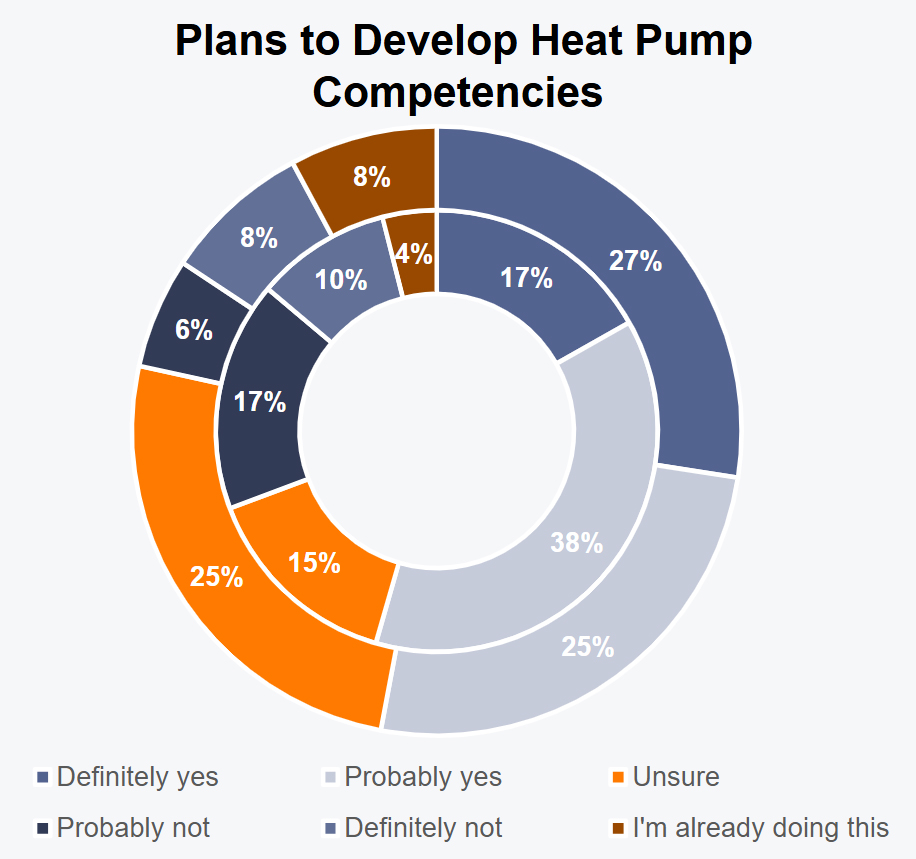
Six in ten of the 207 installers surveyed said they were developing heat pump skills or intended to do so. The proportion already building those capabilities doubled from the previous year to 8%, while 8% said they would not make the transition. A quarter were undecided, up from 15% in 2025, according to the survey, commissioned by Baxi and conducted with JTL.
The share of respondents already installing air source heat pumps rose to 5%, but the survey found that fewer installers were very or fairly likely to move into the work. Respondents were less concerned than in earlier surveys about policy, administration, training and accreditation. Instead, they most often pointed to a lack of customer demand, with households deterred by the cost and disruption involved.

Those already fitting heat pumps described a different picture of demand. In a smaller group of 18 air source heat-pump installers, 60% said customer interest or enquiries had risen over the past year, almost three times the rate among other respondents. These installers identified greater consumer choice, including hybrid systems that combine a heat pump with a boiler, as a way to encourage wider participation.
The contrast echoes findings from Baxi’s 2025 survey, which reported that 59% of installers were developing heat pump skills or expected to do so in the following few years. That earlier study also found that households often favoured replacing a boiler with a similar model, while paperwork and the time required for training could be difficult for sole traders and smaller businesses. The latest results suggest that improved skills have not, by themselves, resolved the obstacles around demand and practical opportunity.
Training is only one part of the route into the market. Government guidance says installers may need to update their competent-person scheme registration when adding heat pumps, while installations supported through schemes such as the Boiler Upgrade Scheme must be carried out by MCS-certified installers. The guidance also points to practical routes for gaining experience, including supervised work in an installer’s own home or subcontracting before seeking independent certification.
The survey included a new set of responses from JTL apprentices. Some 83% said they were very or fairly optimistic about their careers, and half saw opportunities in air source heat pumps. Yet 42% identified both hybrid systems and gas boilers as areas likely to offer work, while two-thirds said political debate over net zero and energy policy made the industry’s future difficult to interpret.
Ian Trott, Baxi’s head of UK training solutions, said the next task was to help trained installers gain practical experience and confidence. He argued that installers could also help shape demand by answering householders’ questions and correcting misconceptions. JTL operations director Clair Bradley said the apprentices’ optimism was encouraging, but called for more investment to bring young people into the trade.
The workforce challenge extends beyond heat pumps. JTL’s projection model estimates that England’s plumbing, heating and ventilation workforce has fallen by 25,700 since 2018, to 137,800, and could contract by a further 30% by 2039 if current trends continue. The organisation warns that a shrinking workforce could constrain housebuilding and the delivery of clean-energy projects, and says stronger support for apprenticeships will be needed.
References
Main reference: PHAM News [1]
• This On the wire article was created using Noahwire AI and reviewed by CIBSE Journal’s editorial team