An On the wire story
Researchers at the University of the West of England are making the case that cemeteries, long treated solely as places of burial and remembrance, could also help to heat nearby public buildings.
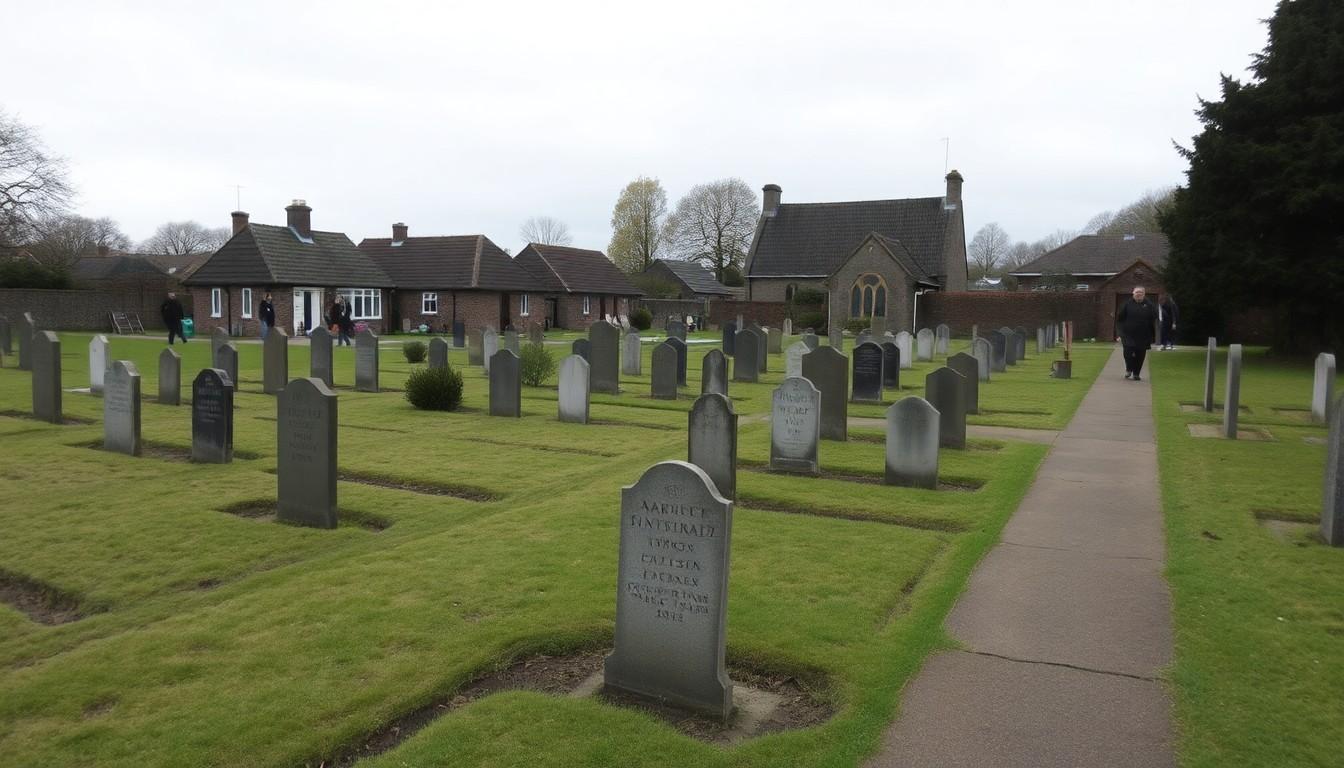
In a pilot study, academics looked at whether ground source heat pumps could be laid along existing cemetery paths and in other non-burial areas at Shirehampton Cemetery in Bristol, with the aim of supplying low-carbon warmth to facilities such as schools, halls and places of worship.
The work is deliberately cautious: the team says the idea raises obvious cultural and ethical questions, but argues that burial grounds may offer a stable surface for underground infrastructure because they are far less likely to be dug up or redeveloped than parks and other open spaces.
The Bristol site was used as a test case for what the researchers describe as a practical, path-based approach. By measuring the cemetery on the ground and mapping it digitally, they estimated that the route network alone could support a substantial amount of pipework without disturbing graves.
On that basis, the team calculated that a system installed there might generate enough heat each year to make a meaningful contribution to a nearby community building, with output comparable to the annual heating demand of a dozen to 18 average UK homes. That estimate is not a final design, but it suggests that the concept could be more than a theoretical curiosity.
The researchers then widened the analysis to England and Wales, identifying 2,255 cemeteries and burial grounds with a combined area of 8,347 hectares. They found that many of these sites sit close to buildings that could plausibly use locally generated heat.
According to the study, 70% of cemeteries are within 250 metres of a place of worship, 42% are within that distance of a school, 28% near a community hall or centre, and 6% close to a library.
The overlap is especially significant for churches, which reflects the long historical relationship between burial grounds and religious buildings, but the broader pattern also points to possible opportunities for schools and civic facilities.
Acceptance, however, is likely to be the hardest part of the proposal. In a survey run mainly through a local community group in Shirehampton, more than 100 people responded and opinion was sharply divided.
Around 60% said some form of cemetery-based heat pump installation would be acceptable, while 29% considered it entirely unsuitable. Support was stronger when the hypothetical project was framed as a new cemetery rather than an existing one, and when the heat was intended for community use.
Residents’ comments ranged from outright rejection to cautious curiosity, with some saying the idea should not be entertained at all and others arguing they would prefer a cemetery equipped in this way, provided the practical consequences were clear.
That social unease reflects the wider regulatory and technical complexity of working in burial grounds. Historic England’s guidance on ground source heat pumps notes that burial sites can require consent or licences, and advises early consultation with local archaeological officers when proposals involve sensitive land.
The UWE team itself acknowledges that conventional geothermal design does not translate neatly to cemetery settings, where paths may be narrow, irregular and bordered by memorials, trees and buried remains.
Yet the researchers also point to other examples of shared ground-loop systems being used successfully in community housing schemes, suggesting that the technology itself is established even if this particular application remains novel. For now, the study is best understood as an opening argument for further, carefully managed research rather than a blueprint for immediate rollout.
References
Main reference: [1]
• This On the wire article was created using Noahwire AI and reviewed by CIBSE Journal’s editorial team