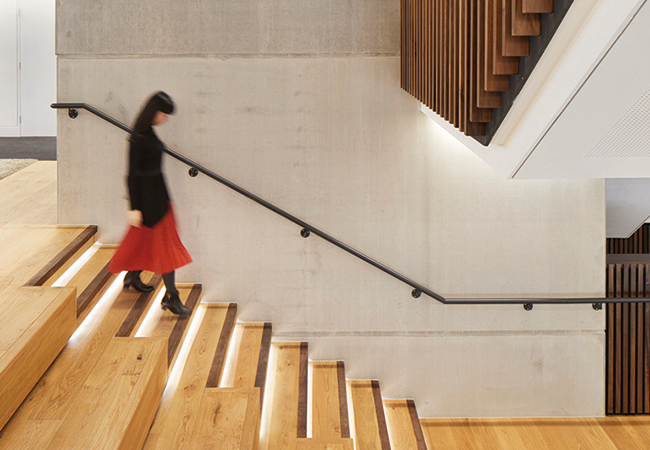
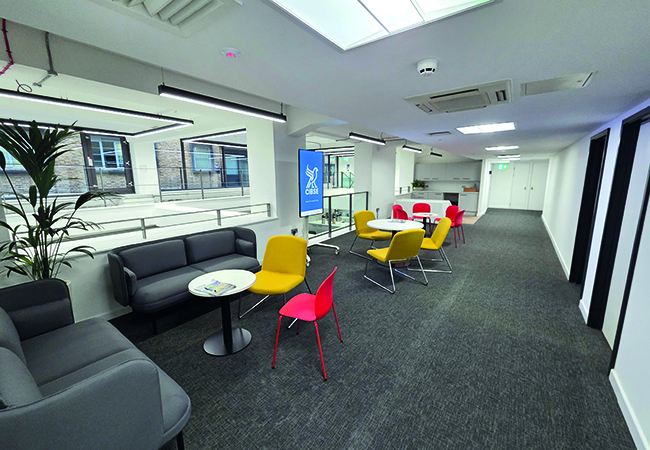
The Members’ Zone on the ground floor
The Manly Trust Skills Hub officially opened last month, comprising training rooms, a conference space and a members’ area at the Institution’s head office in Saffron Hill, London.
The vision is for the hub to be a centre of lifelong learning, collaboration and innovation, and the hosting of the inaugural Heat Pump Summit, in May, embodied CIBSE’s ambition for the space. Delegates in the 120-capacity conference room heard experts from CIBSE, government and industry speak on the guidance, policy and training that is influencing the delivery of heat pumps (page 31).
The skills hub project was an opportunity for CIBSE to accelerate the decarbonisation of its 17,000ft2 head office, which it moved into in December 2024. As well as the ground floor and basement housing the hub, there are three floors of offices, with the upper two occupied by CIBSE and the remaining one tenanted.
Before staff moved in, the interiors were refurbished to provide a clean, contemporary office space.
CIBSE has a long-term plan to decarbonise the building, and the original services strategy for the skills hub was to focus only on the services necessary for the 100-plus people using the lower two floors. Major decarbonisation efforts would be left for later phases. After engineers reviewed the plans, however, they realised there was an opportunity to improve the efficiency and comfort of the whole building, and remove the existing gas boiler with moderate upgrades to existing equipment.
‘We’ve managed to jump ahead in terms of decarbonisation,’ says Phil Draper FCIBSE, chair of the CIBSE HVAC Systems group, who was one of the engineers who reviewed the plans. ‘We’ve increased the scope for roughly the same budget.’
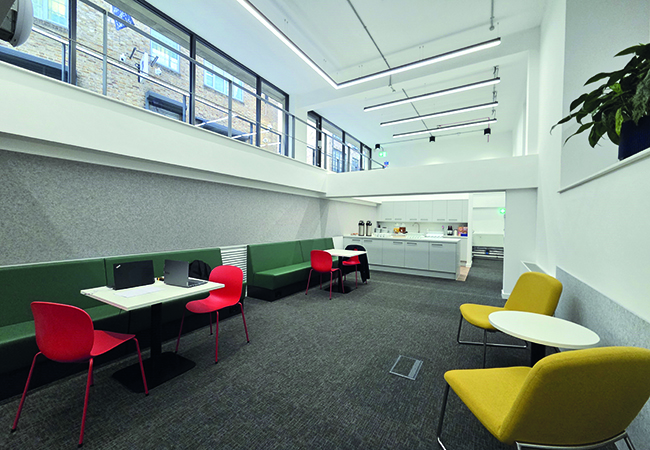
The networking area and Members’ Zone has double-height ceilings
Decarbonisation strategy
The upper three storeys relied on a conventional R410A variable refrigerant flow (VRF) system for comfort cooling and heating.
In the basement, an air handling unit (AHU) supplied outdoor air to the upper floors, which also had openable windows. The AHU had a heating coil supplied by a gas-fired boiler, which also supplied domestic hot water for the building. According to Draper, the system suffered from poor controls, which resulted in the AHU supplying cold air as low as 10-12°C into the upper floors, causing uncomfortable draughts for occupants.
The original plan for the skills hub was to install several mechanical ventilation with heat recovery (MVHR) units. The design left the AHU gas boiler in place.
Having uncovered opportunities to improve efficiency and comfort, Draper developed the new design strategy, which was focused on reusing as much kit as possible. The heating coil was removed from the AHU and replaced with DX coils providing cooling.
For heating, a new VRF heat pump was installed in the basement plantroom and vented to the outside area. AHU duty was increased by 20% by incorporating new EC fans, allowing a greater air volume flow rate, and the MVHRs were removed from the plans, gaining 400mm of headroom in the basement conference room. A floor-displacement system supplies outdoor air at low velocity, eliminating draughts.
The smart hot-water cylinder is a stratified unit, incorporating both a VRF-fed plate heat exchanger and an electric immersion heater. It enables the system to meet hot-water requirements according to occupancy or demand. Its thermal stratification technology allows only a portion of the tank to store hot water, so CIBSE will save energy by not having to heat 100% of the tank when there are few people in the building.
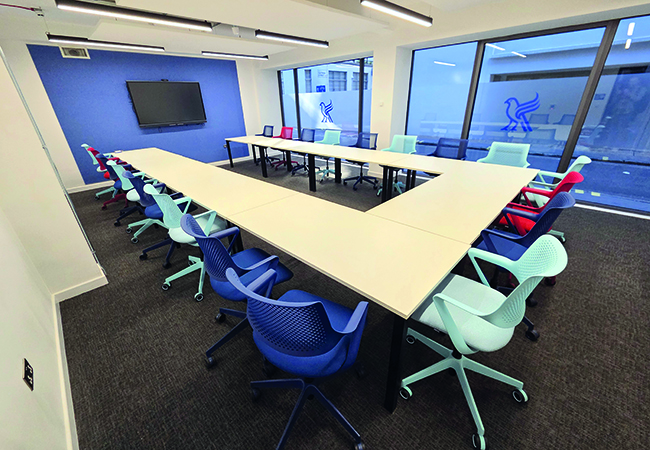
New training room, faces Saffron Hill
It is connected via a coil in the hot-water cylinder, allowing it to ‘recycle’ waste heat from the skills hub’s cooling system to heat the building’s domestic hot water. The tank communicates via ModBus to the new building management system (BMS), which monitors the volume of hot water in the tank and occupancy levels within the building.
‘Our primary heat source for domestic hot water is ideally going to be from the VRF when it recovers heat from event spaces [as a result of cooling],’ says Draper.
The skills hub presented the opportunity to upgrade the controls for the whole building, as the existing systems’ limited control capabilities restricted the ability to manage cooling and heating. By improving the BMS, CIBSE will be able to access data to help it understand what the next decarbonisation phase should be.
The building now features 50 wireless CO2 sensors (10 per floor), which enable the AHU to deliver air to all floors according to occupancy. In scenarios combining full office occupancy with large events in the skills hub, the openable windows provide additional ventilation flexibility.
The facility management (FM) team will be alerted by the BMS via a monitor in the plantroom or a web-enabled dashboard.
A wireless light-management system allows the FM to track driver temperatures, run hours and energy per light, which is integrated into the BMS system. The lighting control system will enable CIBSE to calculate the W.m-2 loads for each room in alignment with requirements in NABERS, says Draper.
‘The new BMS has improved visibility of equipment and environmental conditions across the building,’ he adds. ‘By using CO2 measurements as a proxy for occupancy and ventilation adequacy, we’ve made energy savings from fan energy and we’ve improved comfort by not putting cold air onto people’s necks.’
New dampers connected to the BMS manage demand-controlled ventilation between the AHU and the skills hub and office floors. Modulating to maintain limiting CO2 levels, the dampers direct the flow of outdoor air where it is needed. As the building is rarely 100% occupied in all areas simultaneously, the dampers prevent the AHU from wasting energy by overventilating empty rooms.
During large events in the skills hub, elevated CO2 levels trigger the BMS to modulate the zone dampers, increasing airflow to the basement spaces while reducing ventilation rates to less-occupied office areas. This enables the additional 20% AHU airflow capacity to be directed where it is most needed.
During a normal work day with no events, the dampers can restrict airflow to the basement and prioritise the upper floors, or simply reduce the speed of the AHU fans to save energy.
The air displacement system delivers air at a low velocity through large floor diffusers in the skills hub. Wall-mounted VRF indoor units have been used in the Members’ Zone and training area to free up ceiling space.
As a result of the changes, Draper aims to make a 20% reduction in energy primarily through the CO2 sensors, enabling ventilation-demand control, better lighting control and VRF heat recovery.
The key is knowing how the building is going to be used, says Draper: ‘As CIBSE is the owner, we understand how it will be used over the five to six years. If we know when the spaces are going to be used, we can reduce the opex [operational expenditure] and capex [capital expenditure] by not having everything on 100% of the time.’
Savings have also been made in embodied carbon by reusing equipment and selecting wireless controls. ‘We’ve tried to use as much of what’s already in place,’ he says.
As well as retaining the AHU, some air conditioning units have been reused in the training rooms. The use of wireless lighting and CO2 sensors means fewer controls cables are needed. Having no cables to run through the building has also accelerated delivery, adds Draper.
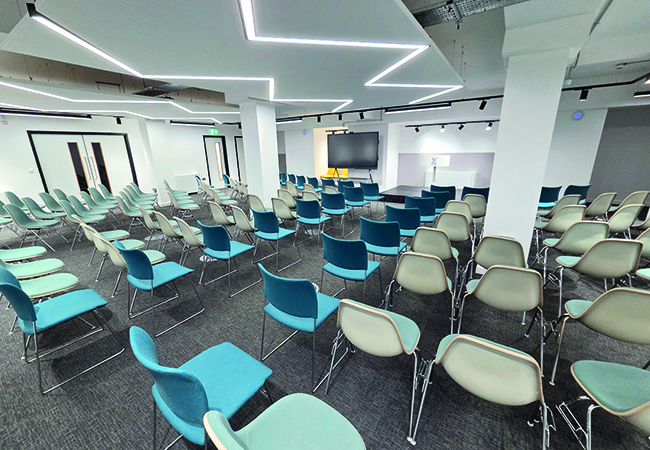
The main conference space
What’s next?
Draper says CIBSE will be looking at the lifespan of existing equipment to see how the system can be improved as units are replaced.
For example, the fan coil units serving the office floors currently use R410A refrigerant, and Draper says CIBSE will have to consider whether to replace them with R32 units or wait until lower-GWP alternatives are more widely available/proven.
There will also be a focus on making the metering as good as it can be and ensuring it aligns with the new CIBSE TM39: Building metering and monitoring guide (see page 20).
Reflecting on one of the first events held in the space, Draper says the environment remained comfortable throughout a Fellows gathering of around 50 people, with good perceived air quality and no sense of stuffiness, despite attendees being seated for more than two hours.
The Manly Trust and the Skills Hub
The Manly Trust was set up more than 30 years ago to assist in the development and education of engineers across different sectors of engineering, particularly building services. Its founder, Graham Manly, was a past CIBSE President and had a great passion for training future generations of engineers, says trustee Ewen Rose. ‘The CIBSE Skills Hub is the type of legacy project we were looking for. We feel it can provide a solid foundation for the long-term development of building services engineers,’ he adds. David Manly, Graham’s son, says the family has a long-standing connection with CIBSE. ‘When we heard about the skills hub, it felt as if the vision was aligned with that of the Manly Trust.’ Rose urges others to invest in the skills hub: ‘If we get this right, and I’m sure we will, it could lay the foundations of something really impressive for the long-term future of an industry in desperate need of more young people.’
CIBSE wishes to thank the Asian Institute of Built Environment for its generous donation to CIBSE’s Building for the Future campaign, helping the development of the skills hub.
The Manly Trust Skills Hub is available for hire, and its adaptable spaces can accommodate workshops, board meetings, presentations and larger gatherings, with breakout and networking areas also available.
For more information, bespoke venue proposals or to arrange a tour of the spaces, visit www.cibse.org/venues or contact venues@cibse.org