
Hospitals present a unique challenge for building services engineers: to deliver safe, healthy internal environments, with clean air that reduces the spread of infection, while meeting the NHS goal of net zero carbon.
At a CIBSE Healthcare Group event in London last month, Frank Mills FCIBSE argued that both aims require a fundamental review of how ventilation in healthcare buildings is designed and operated.
AI overview of this article
Health Technical Memorandum (HTM) 03-011 remains the main UK guidance for healthcare ventilation. It was prepared before the Covid-19 pandemic and makes little reference to airborne transmission. During the early stages of the pandemic, government advice focused on surface transmission and largely ignored ventilation, even though Covid-19 is a respiratory disease. Ventilation was not mentioned in UK government guidance until 2022, Mills noted.
HTM 03-01 sets out minimum standards for air-change rates in clinical areas and assumes the use of 100% outdoor air. Compliance should, in theory, deliver clean air and reduce infection risk. However, the document assumes that outdoor air is sterile and free from dust or pathogens, which is not correct. The Department for Environment, Food and Rural Affairs’ (Defra’s) air-quality review2 confirmed that many UK locations fail to meet international standards for particulates and gases. Even rural air can be contaminated by agricultural activity.
Meeting the HTM air-change requirements demands large air-handling systems, long duct runs and high fan power. This leads to high capital and operating costs, plus significant embodied and operational carbon. Up to a quarter of a typical hospital’s floor area may be dedicated to ventilation plant and risers. The resulting energy use conflicts with the NHS Net Zero Carbon programme3, which targets zero emissions for Scopes 1 and 2 by 2030-32 and Scope 3 by 2050.
HTM 03-01 identifies natural ventilation as the preferred option, followed by mixed-mode and, finally, mechanical systems. Mills described this hierarchy as outdated and impractical. Natural ventilation only works if occupants open windows and, often, they do not. Even in hot weather, sealed or closed windows prevent effective air movement. Mixed-mode systems that combine open windows with mechanical supply can also lead to high energy use, as both indoor and outdoor air must be conditioned.
Mills compared this approach with ASHRAE Standard 1704, which governs healthcare ventilation in the US, where hospitals are generally fully mechanically ventilated and may recirculate up to 80% of air through high-efficiency filters and ultraviolet germicidal irradiation (UVC) air scrubbers. Air-change rates are similar to UK guidance, but the strategy allows large energy and carbon savings, and cleaner interiors.
Mills proposed a hybrid model, using smaller primary systems to provide two air changes per hour of outdoor air, with local air cleaning to achieve the equivalent of six or more clean air changes in ward areas. Such systems could reduce plant size and eliminate the need for boilers – and, consequently, a gas supply. He suggested internal heat gains in hospitals should provide much of the heating load, with recovered heat maintaining supply air temperatures.
Local air cleaning using UVC and air filters gained attention during the pandemic response. NHS-approved standards for these devices are now available online5, covering both portable and ceiling-mounted units. Mills described trials at Maidstone Hospital, where rapid-assessment wards used ceiling-mounted UVC units to deliver sterilised air above each bed. Measured pathogen levels dropped significantly and the scheme eliminated ambulance queuing caused by infection-control delays.
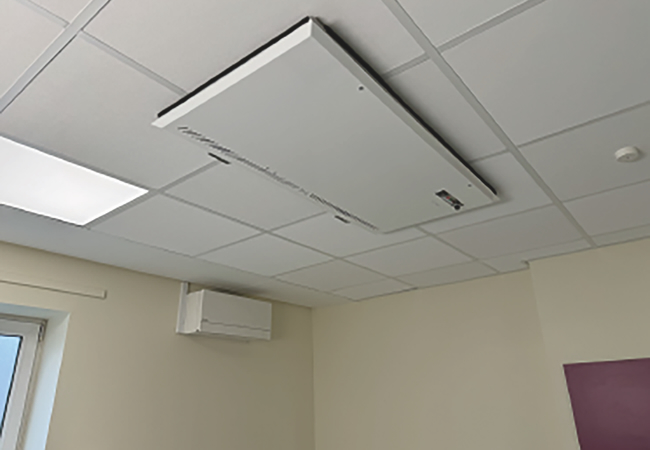
Figure 1: Ceiling-recessed air cleaners use the Coanda effect to distribute air effectively and, at high air-change rates, can achieve very clean room conditions. The units recirculate air after removing viruses, bacteria, mould and any particulates. Recirculating the same air saves energy and reduces carbon impact. This unit has been developed under an NHS-le d work stream
Ceiling-mounted units, as shown in Figure 1, overcome many of the problems of portable devices, such as trailing leads, lack of power sockets and inconsistent placement. They can be installed as part of the building infrastructure with minimal disruption, even within occupied spaces.
Mills drew attention to the fact that HTM 03-01 does not cover non-clinical areas, such as corridors, receptions, cafeterias and offices, which often lack mechanical ventilation. These can make up half of a hospital’s area and may be heavily occupied. Site visits showed that staff workstations, patient trolleys and visitor areas often occupy circulation zones with stagnant air.
Mills warned that these neglected areas contribute significantly to poor indoor air quality and infection spread. In some cases, they are being used for clinical purposes, such as wound dressing, and as holding areas for patients awaiting a ward space. He noted that CIBSE design codes have advice on these other areas, but are not really intended for hospitals.
Mills concluded that all occupied areas of hospitals must have engineered ventilation. Natural ventilation should be replaced by controlled mechanical systems that use energy recovery and partial recirculation. Local UVC and/or Hepa air cleaning should be standard in new and refurbished hospitals. By adopting this approach, future healthcare buildings could be designed with smaller plant spaces, lower embodied carbon and no fossil-fuel boilers. Mills referred to a care-home project where waste heat from a variable refrigerant flow cooling system provides all domestic hot water at 60-65°C without the use of a boiler.
He concluded that intelligent ventilation using filtration, recirculation and heat recovery can deliver clean, safe air while supporting the NHS target for net zero carbon hospitals.
- ‘Developments in IAQ for healthy and low carbon buildings’, held last month, is one of the events organised by the CIBSE Healthcare Group. Visit bit.ly/CJHGSIG
About the author
Frank Mills FCIBSE is an engineering specialist in healthcare ventilation, a member of the NHS Future Standards working group, and a past chair of the CIBSE Healthcare Group, and has contributed to CIBSE and ASHRAE Covid advisory initiatives.
References:
1 Department of Health and Social Care. HTM 03-01: Specialised ventilation for healthcare premises, 2021.
2 Defra. Air quality strategy for England, 2023.
3 NHS England. Delivering a net zero National Health Service, 2020.
4 ASHRAE. Standard 170-2021: Ventilation of health care facilities.
5 NHS. Air cleaning and disinfection devices for healthcare settings – UVC and HEPA Guidance, 2023.