
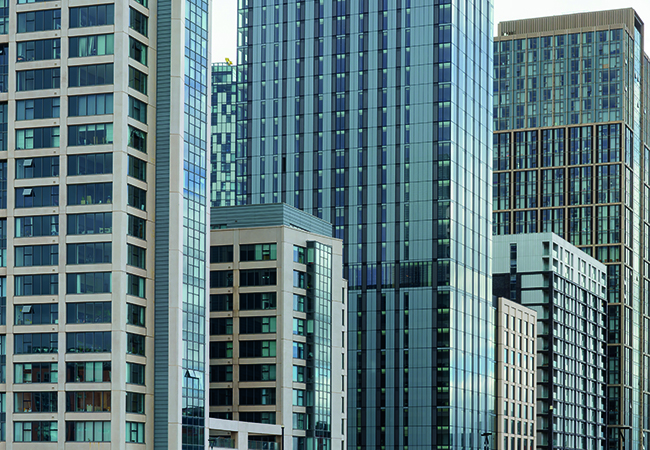
High-rise buildings in Liverpool
The publication of CIBSE’s TM70: Tall building drainage design, in December 2025, marked one of the most significant developments in building drainage design for decades. For the first time, designers had access to a comprehensive, evidence-based framework that addresses the unique hydraulic and airflow behaviours found in tall buildings.
TM70 moves away from purely hydraulic calculations and towards pressure-based system performance, formally integrating key considerations such as effective building height, offset penalties, pressure-fluctuation modelling and advanced ventilation strategies.
In doing so, it helps engineers make informed decisions. As buildings continue to rise in height and complexity, TM70 provides the drainage industry with design guidance based on measured performance rather than convention.
With any new technical guidance, however, comes the risk of misinterpretation. One of the key messages emerging from recent discussions around TM70 is that engineers must understand why certain solutions are required, not simply assume that, because a technology exists, it should become the default specification on every project.
Designing for the building
Pressure transients have always been a consideration in drainage design. As wastewater travels down a stack, it entrains air, generating positive and negative pressure fluctuations that, if uncontrolled, can compromise trap seals and system performance.
In genuinely tall buildings, these transient pressures become increasingly significant. Greater stack heights, larger connected loads and more complex offsets create conditions that simply do not exist in conventional residential or commercial developments.
This is precisely why TM70 places such emphasis on understanding the relationship between building height, airflow, pressure equalisation and ventilation strategy.
It does not, however, suggest every building should now incorporate every available pressure-management technology. Instead, TM70 promotes a risk-based, performance-led approach in which the drainage solution reflects the actual demands placed upon the system.
For buildings of relatively modest height – five or six storeys – the hydraulic conditions are fundamentally different from those experienced in true high-rise developments.
Flow velocities are lower. Pressure fluctuations are reduced significantly. Conventional single-stack systems, when correctly designed and installed in accordance with recognised standards, have delivered reliable performance for many years.
Changing physics
As building height increases, however, the physics changes – so design interventions should increase in proportion to system risk.
In tall buildings, longer discharge paths generate higher airflow velocities and larger pressure transients. Stack offsets become more influential, simultaneous discharge events become more severe and maintaining trap seal integrity becomes increasingly challenging. These are the conditions that TM70 seeks to address through improved design methodology, rather than prescriptive product selection.
One of the most refreshing aspects of TM70 is that it shifts the conversation away from product-led design towards measurable system performance.
For too long, drainage has often relied on historic rules of thumb or assumptions. TM70 instead asks engineers to consider airflow, pressure equalisation, commissioning and validation as part of an integrated drainage strategy. That creates opportunities for innovation, but also responsibility. Manufacturers will naturally seek to demonstrate where their technologies add value, but the challenge for specifiers is ensuring that solutions are selected because they solve an identified engineering problem, rather than simply because they are available.
Additional components increase capital expenditure, introduce further maintenance considerations and add system complexity. It’s important to establish the methodology and determine whether those components are required to achieve compliant, resilient performance.
TM70 also reinforces something many drainage specialists have advocated for years: drainage systems cannot be viewed as isolated products. Stack geometry, offsets, ventilation arrangements, pipework configuration, discharge loading and commissioning all contribute to influencing performance. When these principles are considered from the outset of design, engineers can often achieve simpler, more efficient installations without unnecessary complexity.
Industry next steps
Perhaps TM70’s greatest achievement is not that it introduces new guidance, but that it encourages better engineering conversations, focusing on what the building needs rather than which system to specify.
As the industry becomes more familiar with TM70, confidence will grow. Engineers will become better equipped to distinguish between buildings that genuinely require enhanced pressure-management measures and those for which established drainage principles remain entirely appropriate.
This is not about making every drainage system more complicated. It is about making every drainage system fit for purpose. l
TM70 Tall building drainage design (2025) is available here
About the author
Reuben Colver-Thompson is product manager – drainage at Geberit