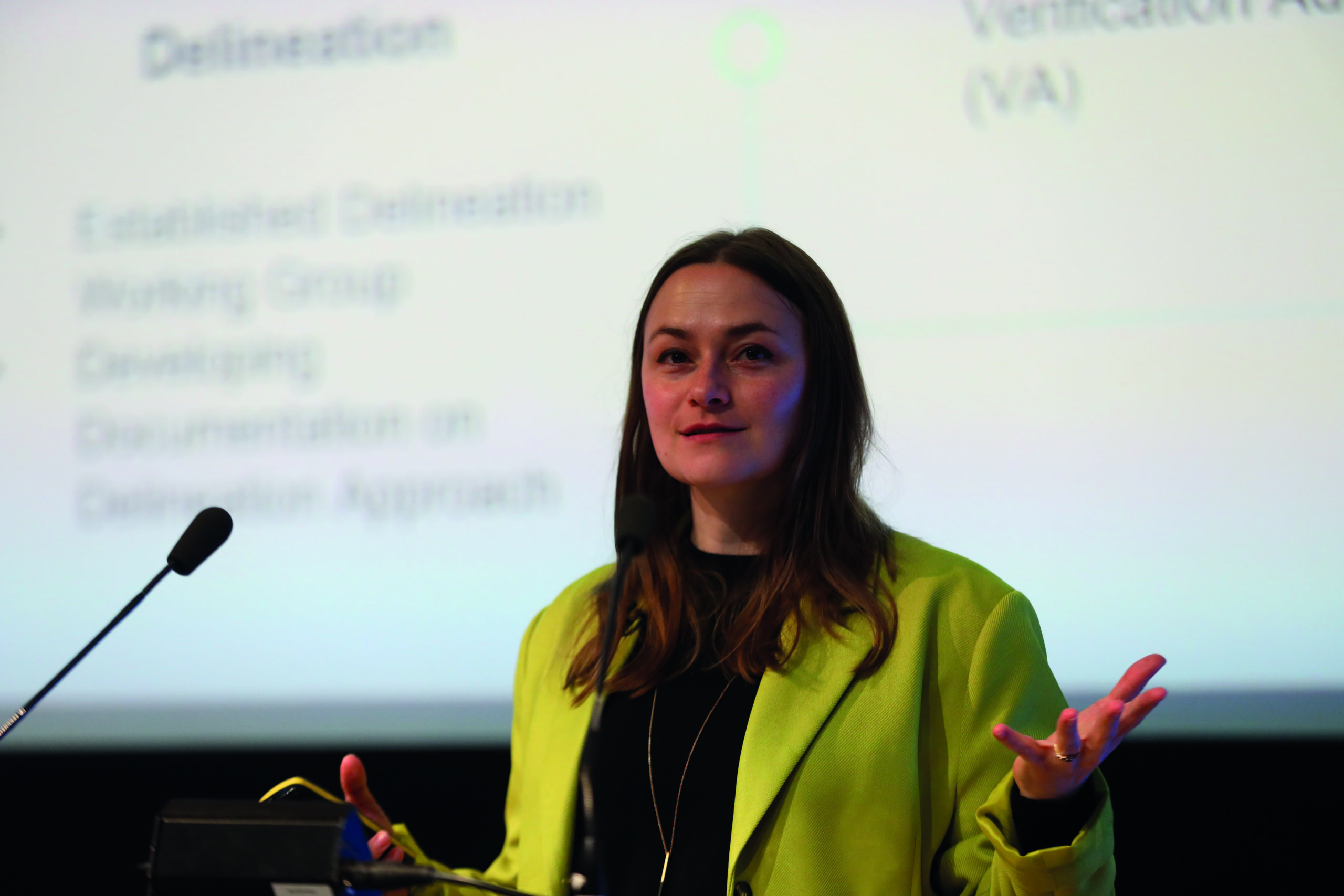
Katie Clemence-Jackson, CEO of UKNZCBS
The UK Net Zero Carbon Buildings Standard (UKNZCBS) is almost ready for launch. In the past year, a large body of evidence has been gathered as more than 130 building owners stress-tested the Standard in 200 real-world projects.
These pilot schemes formed the backdrop to UKNZCBS in Practice, a one-day CIBSE conference held at the Royal College of Physicians last month. With version one of the Standard due in early 2026, industry gathered to hear what the pilots revealed and how the Standard is evolving.
The Standard brings together net zero carbon-aligned requirements for all major building types – existing and new build – across the UK. It sets out metrics by which performance is evaluated, and limits and targets that need to be met. These include operational energy use, embodied carbon, onsite renewable electricity and refrigerants, as well as the need to avoid fossil fuel use on site.
Verification updates
Opening the event, David Partridge, chair of the UKNZCBS governance board, emphasised the unprecedented collaboration driving the Standard’s development. ‘I’ve never seen industry come together in such a way,’ he said.
He also stressed the Standard’s core purpose: closing the performance gap. ‘We need to demonstrate real carbon savings, not theoretical ones. This needs to become business as usual, in the same way that you ensure a building conforms to safety regulations.’
Partridge also announced an important development: the appointment of Bureau Veritas as the Standard’s verification administrator. It will be responsible for establishing the framework and accrediting verifiers, which will involve registration and evidence compilation, a verifier appointment and review, and, finally, the issuing of a certificate. This will be followed by ongoing reverification, usually annually.
Katie Clemence-Jackson, CEO of UKNZCBS, summarised progress since the pilot version was released, saying testing has taken place across 216 projects from 134 building owners. A major area of focus has been the development of equivalence – now termed ‘deeming to satisfy’ – which sets out how existing Standards, such as NABERS UK, Passivhaus and Breeam, can conform to aspects of the Standard. ‘We don’t want people doing extra homework,’ said Clemence-Jackson. ‘If you’re already using a robust scheme, we’re looking at how you can achieve multiple standards without duplicating your efforts’.
Another significant update after feedback from the pilots is the introduction of an ‘on track’ check at practical completion. Because the Standard is outcomes-based, operational performance cannot be proven at handover, Clemence-Jackson explained: ‘[The check] is not a claim that the building meets the Standard; it’s a helpful indication that it’s plausibly aligned and on the right path.’
Across the day, the audience heard from project teams that had trialled the Standard.

Panellists at the UKNZCBS in Practice conference at the Royal College of Physicians
Driving change in offices
Tom Spurrier, sustainability director at Hoare Lea, shared lessons from retrofit and new-build office pilots. He flagged that embodied carbon limits for new builds, particularly façades, are challenging, and said a delineation approach would be crucial, as tenant energy usage and fit-out are not in the landlord’s control.
However, Spurrier also highlighted the refrigerant limits for offices as one of the most effective levers for carbon savings: ‘They’re not glamorous, but publishing a clear limit genuinely drives change. We’ve seen design teams rethink HVAC approaches because of it.’
Passivhaus’s educational advantage
Glyn-coch Primary School in Wales from Wilmott Dixon demonstrated how Passivhaus design naturally creates a buffer for the Standards operational limits. Embodied carbon proved more challenging because of anomalies such as science-lab gas use, a potential exemption under review. Timber construction was a real driver in helping reduce embodied carbon.
Doug Drewniak, principal building performance manager at Willmott Dixon, said a key takeaway was that design efficiency often meant embodied carbon efficiency. ‘The 2030 targets are ambitious. What’s great is the Standard is material-agnostic, which drives innovation in an industry where concrete and steel are essential,’ he said.
The challenge of concrete in hospitals
Velindre Cancer Centre, designed by White Arkitekter, aims to be the greenest hospital in the UK. It demonstrated the challenge of aligning NHS requirements for high-intensity services with the Standard’s goals. Concrete is unavoidable in radiation areas, but the team explored how to reduce embodied carbon through local sourcing and natural materials and transport choices.
Christian Dimbleby, head of sustainability UK at White Arkitekter, said NHS requirements formed a barrier to timber, but added that there was robust evidence that it can be used and meet compliance. ‘We need to be challenging briefs and pushing the boundaries,’ he said.
Raising the bar for housing
ECD Architects’ (ECDA’s) deep-retrofit programme with Cambridge City Council highlighted the difficulty of meeting the Standard limits at scale in social housing. Homes vary significantly, data access is challenging, and deep retrofit is still far from the sector norm.
‘The 98% retrofit prediction by 2050 assumed by the model may be optimistic,’ said Loreana Padron, regional head of sustainability and associate director, ECDA. ‘It will take significant funding to achieve the Standard in this sector.’ However, meeting the targets in retrofit homes is possible, she added, where ambition, fabric-first design and better procurement routes exist.
Ross Boulton, interim sustainability director of developments at Landsec, believes the new-build residential sector is under the most strain, with many projects not meeting the compliance limits for the Standard. Regulatory pressure, insurance trends and fire-safety constraints complicate material selection and low carbon design – but that is exactly why the Standard is needed, he argued. ‘Circularity, retention and reuse is vital for decarbonising. We have to build less and increase retention through existing building stock,’ he said.
Clemence-Jackson urged delegates to support the Standard. ‘Use your collective power, start getting buildings on target and help us drive the transformation the industry needs.’
For more information on the UKNZCBS, visit: www.nzcbuildings.co.uk