
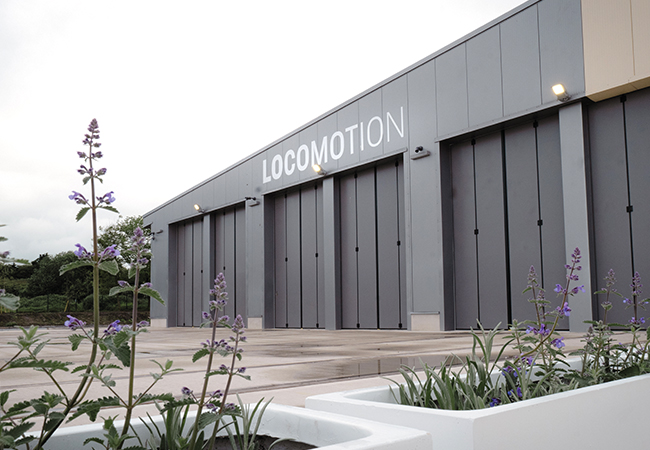
The doors meet airtightness requirements without the need for sealing

The result is New Hall. Designed by Buro Happold working with AOC Architecture, the team has delivered an exceptional, yet simple building that has eschewed complex HVAC systems in favour of a highly insulated envelope, airtight construction and a low-energy heating strategy to maintain the conditions necessary for heritage conservation.
This ambitious approach was recognised at the 2026 CIBSE Building Performance Awards, where the scheme won Public Building of the Year. The judges acknowledged that Buro Happold went above and beyond the brief, describing its solution to balancing the needs of visitors and conservation as ‘simple and robust with low energy demand’.
Locomotion is one of several museums operated by the Science Museum Group, including the National Railway Museum in York and the Science and Industry Museum in Manchester (see ‘Powered by the next industrial revolution’, CIBSE Journal, November 2025, ).
Locomotion is located beside the route of the world’s first public railway, which opened in 1825 with a train hauled by George Stephenson’s Locomotion No 1. The steam engine is on display in the Main Hall at Shildon, part of one of the most significant collections of railway heritage in the world. The museum’s collection is so large that some of the rolling stock at Shildon has to be stored outside.
The New Hall building needed to preserve the precious exhibits while also allowing the public access to view the unique collection. As a result, its architectural design balances the industrial scale of a railway engine shed with a welcoming visitor experience.
It has a wide, mono-pitch roof supported on a steel portal frame enclosed in high-performance cladding panels. On its west elevation, six giant doors provide access for the rolling stock from the concrete apron outside.
Inside, polished concrete platforms allow visitor access between the six sections of track that accommodate the exhibits. Glazing is confined to the north elevation, to prevent sunlight damaging the exhibits and to limit the impact of any solar gains on the environment in the hall.
Museum environmental control is often associated with highly regulated temperature and humidity delivered through complex HVAC systems. New Hall’s engineering team, however, recognised that its function – essentially a large storage building for large exhibits – allowed for a different approach. Instead of tightly controlling temperature, the project focused primarily on maintaining stable humidity levels. Close collaboration with the collection care team helped define appropriate environmental parameters for rolling-stock preservation.
‘Locomotives are made from a mix of materials – steel, wood and other components – and high moisture levels in the air can be problematic,’ says Lawrence Williamson, associate mechanical engineer at Buro Happold. ‘The key requirement was to protect them by controlling humidity.
‘Environmental design criteria were also informed by heritage conservation guidance, including BS 4971, which sets out recommended environmental ranges rather than mandating tight, actively controlled conditions.
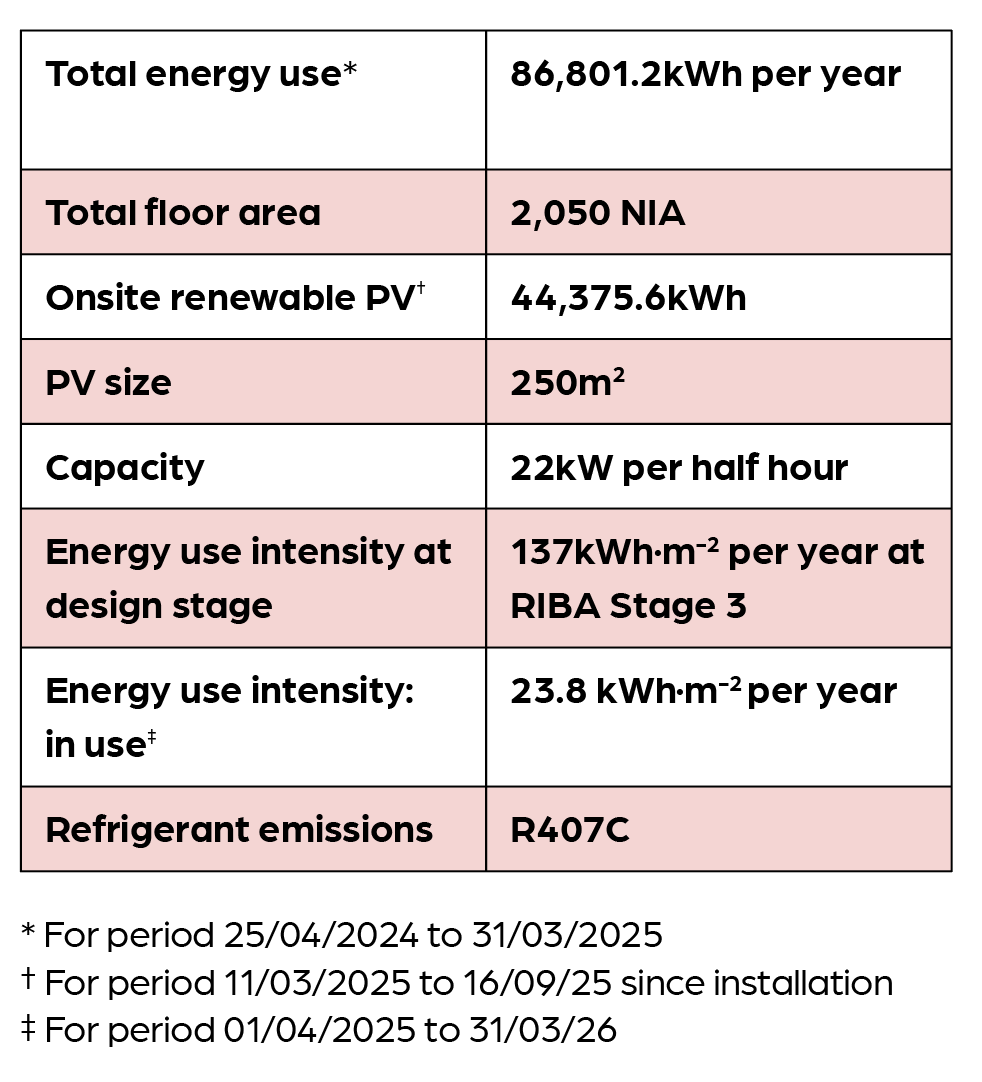
Performance data
‘What matters most is avoiding large temperature fluctuations and keeping humidity within a safe range.’
Environmental targets for the hall were to maintain temperatures ‘broadly between the mid-teens and mid-20s Celsius, and a stable relative humidity between 35% and 60% that allows for seasonal variation’, adds Williamson.
The team focused on ensuring the building itself would stabilise the internal environment. At the heart of the strategy is a relatively high-performance building envelope, designed to minimise heat loss and prevent uncontrolled air infiltration.
‘If you get the fabric right, the internal environment becomes inherently stable,’ says Williamson. ‘Once conditions are established inside the building, they change very slowly.’
Highly insulated panels clad New Hall. Achieving an appropriate level of airtightness required close collaboration between engineers, architects and the contractor, as the manufacturer would only guarantee an air permeability of 3m3·h-1·m-2 @ 50 Pa. Cladding contractor Aspect Facades, working with design and build contractor Nationwide Engineering, set out to improve on this figure for the installation.
The building’s six pairs of enormous access doors posed a particular challenge: Locomotion’s exhibits have to be moved in and out of the building along rail tracks, which require industrial-scale openings that could easily compromise airtightness.
Originally, the intention was to seal around the doors once the rolling stock was in place. However, an initial air-pressure test showed the doors to be surprisingly airtight, so the decision was made to leave them unsealed. This has the benefit of enabling the museum to easily open the doors to facilitate further vehicle moves when required.
The two visitor entrances incorporate lobbies with sequential opening doors to limit air exchange when people enter the building.
Locomotion New Hall BPA winner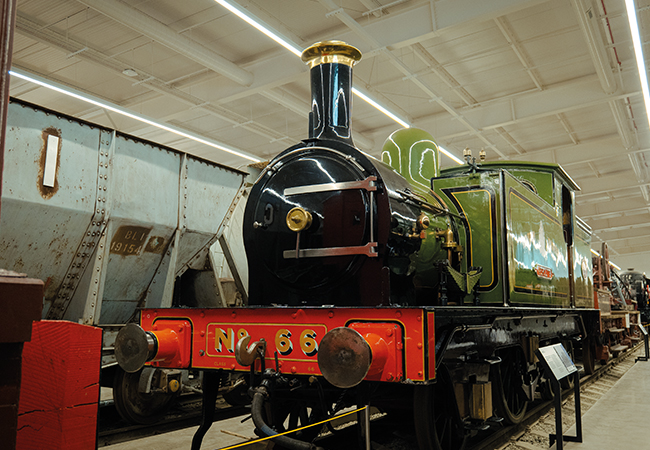
The airtight envelope was key to facilitating Buro Happold’s deliberately simple approach to environmental control. Museum buildings typically use large air handling units with heating, cooling and humidification to maintain tightly controlled conditions., but New Hall avoids this complexity. Instead, humidity is controlled by an underfloor heating system embedded within the polished concrete platforms that provide visitor access between each of the tracks.
‘We essentially removed the middle layer of HVAC,’ Williamson explains. ‘Rather than heating air through big plant systems, we deliver low-grade heat directly into the building fabric.’
The underfloor heating circuits are supplied by air source heat pumps, operating at a relatively low temperature of 45°C flow and 40°C return. Because the building’s heat loss is minimal, the total heating demand is modest, so two small heat pump units are sufficient to serve the entire hall, providing both capacity and redundancy. ‘If one unit is down for maintenance, the other can still keep the building stable,’ Williamson says.
Unusually, the heating system is not designed to keep visitors warm; it is controlled to maintain the humidity conditions necessary to preserve the collection. ‘If humidity rises, gently warming the space lowers the relative humidity,’ Williamson explains. ’So the heating system is effectively controlling moisture levels.’
This solution means the heating system may occasionally operate during warmer humid weather. ‘The museum made it very clear that conservation comes first,’ Williamson says. ‘If humidity rises, we’ll run the heating system to bring it back down, even if it’s a warm day.’ In practice, however, the building has maintained stable conditions without a noticeable impact on visitor comfort.
Instead of tightly regulating temperature, the project focused primarily on maintaining stable humidity levels
Ventilation requirements for visitors are addressed through a small mechanical ventilation with heat recovery (MVHR) system. This has no heating coil, with the temperature of the fresh air supply tempered through a heat exchanger within the unit. The unit is sized to deliver fresh air for 80 visitors, with CO₂ sensors used to modulate the airflow to ensure energy efficient operation. Importantly, the ventilation system plays no role in environmental control. ‘It’s purely there for people,’ says Williamson. ’The building itself is doing the environmental stabilisation.’
The building services installation is minimal. A compact plantroom houses the MVHR unit, heating circulation pumps and associated equipment. The system uses a thermal store to buffer the heating system and assist with heat pump defrost cycles in cold weather.
Elsewhere in the building, services are limited to LED lighting and a small number of ancillary spaces, such as a single toilet, a comms room and storage area – visitor amenities including a café and toilets are all located in neighbouring museum buildings.
New Hall opened in May 2024. Environmental conditions are monitored and controlled through a Honeywell building management system, allowing remote monitoring by the museum’s facilities team. This has shown that Buro Happold’s approach to New Hall has delivered an exceptional energy performance of 49.7kWh·m-2 per year, as shown on the latest Display Energy Certificate. This exceeds the UK Net Zero Carbon Buildings Standard benchmark and surpasses the recommended target for a cultural building holding a collection.
Underfloor heating is supplied by air source heat pumps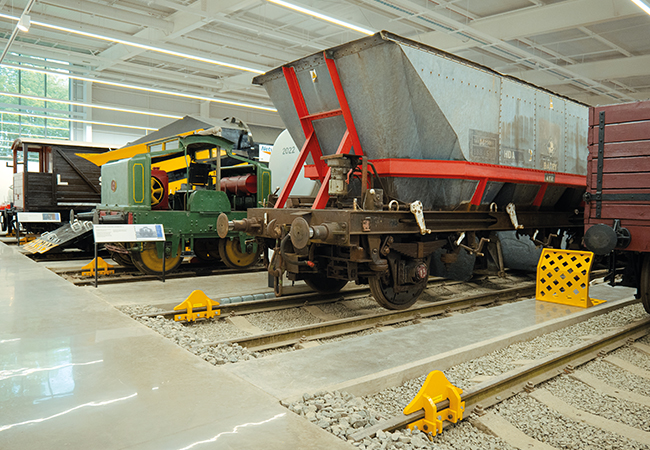
The figure is also a massive improvement on the predicted energy use at RIBA Stage 3 of 137kWh·m-2 per year. Williamson attributes this primarily to the contractor achieving an airtightness of 1.45m3·h-1·m-2 @ 50 Pa, which is a significant improvement on the 3m3·h-1·m-2 manufacturer’s data allowed for in the initial modelling.
The addition, post-completion, of 268m2 of photovoltaics on the building’s roof has resulted in an energy use intensity of 23.8kWh·m-2 per year between April 2025 and March 2026.
By investing in a high-performance envelope and using thermal mass to moderate environmental conditions, the scheme shows it is possible to avoid the energy-intensive HVAC infrastructure often associated with museum buildings.
Its recognition at the CIBSE Building Performance Awards 2026 suggests this approach may offer valuable lessons for other heritage and cultural projects seeking to balance conservation, sustainability and operational simplicity.