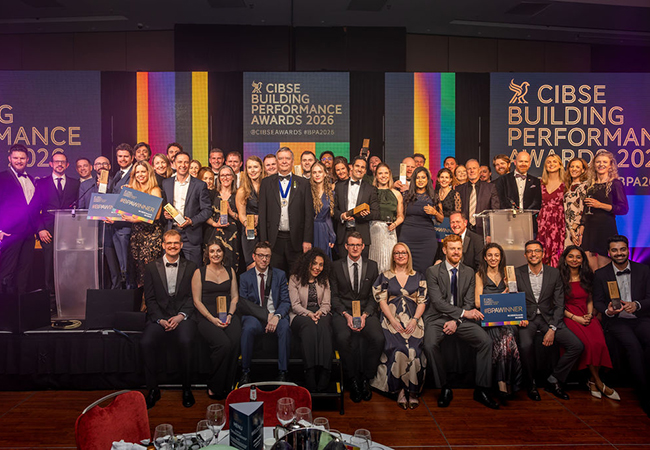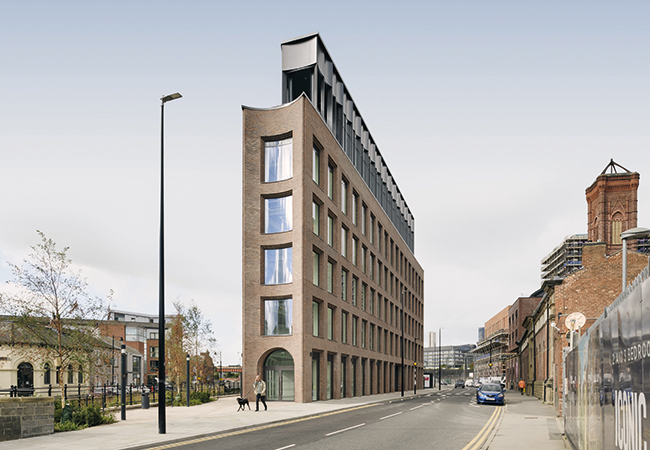

Newly inaugurated CIBSE President Dave Cooper
Dave Cooper’s inauguration as CIBSE President last month represents the pinnacle of a distinguished career in engineering. A prolific figure in vertical transportation across industry and academia, he is recognised globally as a leading forensic accident investigator, who has provided expert witness testimony in more than 2,000 cases.
Championing the theme ‘Future-proofing through resilience’, Cooper wants to use his experience to push the industry to deliver buildings that are both sustainable and meet societal demands for inclusivity and wellbeing.
An honorary visiting professor at the University of East London, Cooper has an MPhil degree, earned after researching escalator accidents. His studies revealed 40% of such accidents involved children under 10 falling over handrails, a finding that led to a change in the height of balustrades.
He is author of, and contributor to, numerous standards and guidance, including CIBSE Guide D: Transportation systems in buildings, and he chairs the British Standards Institution committee on cable cars and cableways.
1993: IET’s Highfield Shield 2012: CIBSE Silver medal 2021: CIBSE President’s Commendation 2023: Awarded an MBE 2026: Lifetime Achievement Award from the British Safety CouncilAwards/honours
Cooper, founder of lift consultant Lecs (UK), has been involved in a string of iconic infrastructure projects, including the Emirates Cable Car in London and the HS2 rail project.
It’s a far cry from his first job, aged 16, as an engineering technical apprentice at Southern Railways. It was an unusual career choice for a boy at Eastbourne Grammar, where the expectation would have been for him to continue his academic studies. ‘My careers master was horrified that I wanted to be an engineer and advised my father that it wasn’t possible as “we have taught him Latin”,’ says Cooper.
While Cooper may have wanted to ‘fix trains’, his supervisor had other ideas, and he was asked to move to the outdoor machinery team, maintaining lifts, escalators and boilers. He was regarded as a ‘naive, trustworthy lad, who could be reliably sent across the south of England to work without supervision’.
With this move, his career path was set. After his apprenticeship, Cooper moved to Marryat & Scott, a lift and escalator company that was swiftly acquired by Kone. He embarked on a Higher National Certificate (HNC) in building services at the City of Westminster College, which is where he first came across CIBSE; course leader Norman Gunter told students to join the Institution if they wanted to complete the HNC. The advice shaped Cooper’s professional trajectory, leading him to hold every CIBSE grade, from Student to Fellow.
He was promoted to run operations at Gatwick Airport and became area safety manager, while – alongside his work – completing a BSc (Hons) and then an MSc in lift engineering.
Cooper believes CIBSE is vital to its members’ ongoing education, offering a ‘broad brush’ of general knowledge through regional talks and a ‘deep dive’ into specific topics via its societies. If an engineer needs to understand a discipline outside their expertise, CIBSE has the network, course or mentor to guide them, he says.
He refers to CIBSE as the ‘head of the valleys road’, connecting disciplines such as lighting, electrical, lifts and heating. These links are essential in modern engineering because professionals must collaborate, adds Cooper: ‘A lift engineer needs a strong working relationship with life-safety specialists and lighting engineers, to ensure a building functions safely and properly.’
He highlights the Institution’s role in raising competence levels in line with the Building Safety Act. The Engineering Council (EC) licenses CIBSE to assess applicants, conduct interviews and provide independent proof of a technician’s competence. By aligning membership tiers with the EC’s professional registrations, CIBSE provides a vital framework to verify skills.
‘It’s really important you get recognised for your skill set, and lift engineers are now registering with a professional body,’ says Cooper, who believes it’s also important to address skills on site. He stresses that designing on a computer is irrelevant if the build quality and competence at installation is lacking.
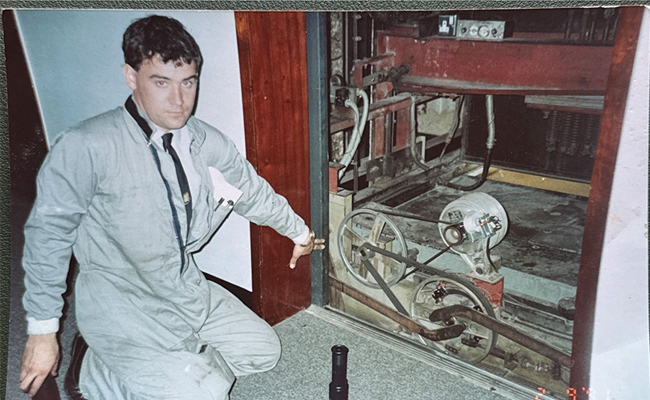
Dave Cooper working on a lift in Carlton House Terrace, London, for Royal Insurance in 1991
Education and training in the industry, he believes, must focus on mastering knowledge, skills and behaviours: knowledge to understand standards; skills to install equipment correctly; and behaviour to conduct yourself properly.
Having a positive attitude is key, Cooper says. If an engineer has a ‘don’t care mentality’, their technical knowledge and skills are rendered useless. He also recalls a talk he gave to apprentices on BS 7255 Safe working on lifts, which none of the learners had heard of. ‘Unless we get the information to where it needs to be, it’s irrelevant.’
Cooper’s presidential theme, ‘Future-proofing through resilience’, is a call for the construction industry to reject short-termism and, instead, design and maintain buildings that can ‘adapt seamlessly to change, whether in technology, occupancy patterns or societal expectations’. Future-proofing means ‘carefully balancing innovation and sustainability, ensuring that our decisions support long-term resilience while minimising environmental impact’, he says.
A primary driver for Cooper is climate change and the need to adapt to extreme weather events. Designers must also account for rising populations and overcrowding, which put a strain on building services. For example, lifts can fail simply because a building’s population has risen beyond its design capacity.
In his inauguration address, Cooper referred to the resilience of Joseph Bazalgette’s design for the London sewer system, which purposefully doubled the diameter of the pipes, beyond what was needed at the time, with Bazalgette stating, ‘there’s always the unforeseen’. The system is still being used more than 150 years later.
Engineers need to address future societal expectations, says Cooper. Buildings are no longer expected to be functional and ‘brutalist’, but inclusive, with living walls, roof gardens and a feeling of space. He is critical of the short-term mentality in construction, whereby companies ‘spin a coin, deliver a building… and walk away’.
He uses hospital private finance initiative contracts as a prime example of poor resilience. Buildings were contracted to run for 50 years, but vital equipment, such as lifts, had only a 25-year life-cycle. Because nobody planned for reinvestment, the infrastructure failed.
Cooper criticises ‘acceptability of failure’, whereby building owners wait for equipment to break rather than replacing it proactively. He recalls fire-related lifts being out of service for more than a year because of missing parts, which fundamentally broke the building’s safety design.
For him, resilience means specifying the appropriate equipment at the design stage, rather than using value engineering to cut costs, which compromises building longevity and safety.
Closing the skills gap
One major barrier to the future resilience of buildings is the skills shortage in building services, says Cooper. ‘We are vastly underskilled and under-resourced. Waiting times to have lifts modernised or installed are huge, for example.’
He believes the industry does a poor job of promoting engineering, but feels there is a broader societal failure to properly recognise and promote vital professions.
‘We must make engineering an attractive career for young people,’ he says, ‘to ensure a continuous pipeline of fresh skills, new ideas and different perspectives.’