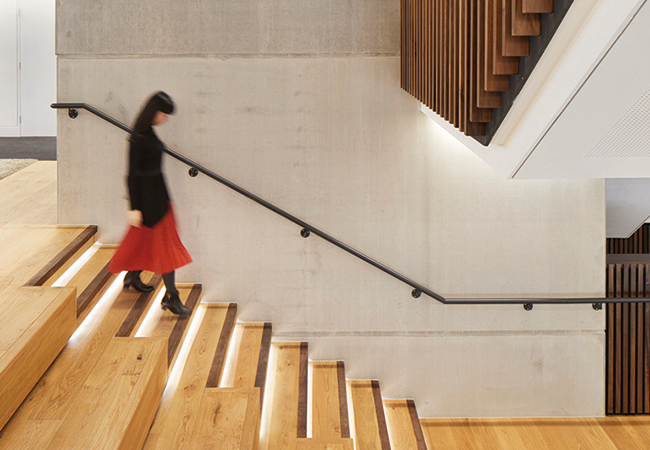
Lighting by Hoare Lea at the Beecroft building, University of Oxford
The Society of Light and Lighting (SLL) launched its latest lighting guide in February – LG23: Design, creativity and compliance.
Lighting is both an art and a science, practised across many disciplines, from contractors and manufacturers to engineers, interior designers and specialist lighting designers. While there is extensive guidance on specific lighting applications, the industry lacked a guide that could support practitioners to make clearer, more confident lighting design decisions. This guide aims to fill that gap.
It arrives at a pivotal moment. The lighting industry has undergone significant change in recent years, and there has been growing recognition of lighting design as a profession and as a critical component of the built environment. Over the past two decades, the rise of LED has transformed what is possible, opening a far broader range of design opportunities than ever before.
The drive for sustainability has also intensified. Designers are expected to minimise energy use and embodied carbon, reduce waste, and promote reuse and recycling, all while considering whole life carbon impacts.
‘Design’ can mean different things at different times and in different contexts. In the case of lighting, it could be about improving the quality of a space, changing its use, or using light to make a new space comfortable, inviting and sustainable, while still supporting its function.
LG23 does not focus on a single application, but addresses the architectural lighting design process as a whole, offering guidance on creative approaches and delivery methods.
Good lighting design draws on a broad mix of skills, experience and judgement, and there is rarely a single solution to a design problem. The designer’s role is to work with the project team to develop a response that meets functional requirements while aligning with stakeholder aspirations.
Good lighting design goes beyond minimising the carbon footprint. An extremely low-energy scheme that is technically compliant may, if not considered holistically, be deemed inadequate or uncomfortable by users. A truly sustainable lighting scheme is ‘energy effective’ – delivering a useful, comfortable space that people will use. This may require a little more energy use, but gives a scheme longevity.
LG23 supports practitioners to balance these sometimes competing demands: meeting functional and energy targets while considering comfort, safety, health, wellbeing, sense of place and orientation. It also addresses wider social impacts, local ecology and dark skies.
The guide promotes a responsible approach that seeks to maximise overall effectiveness. It outlines models for the design process and is structured around these, covering the principles of lighting design, including:
- The human relationship with light, and the intrinsic relationship between light and architecture
- The fundamentals of lighting design, such as visual perception, lighting the task, emphasis, mood, atmosphere, style, suitability, spatial expression and decoration
- The importance of considering all the requirements of the people using the space being designed
- Consideration of the place – a project’s context, materiality and architecture
- Lighting regulations, standards and guidance, how to interpret them, and when it may be right to challenge standards and guidance
- Key lighting design considerations, including: daylight, sustainability, circular economy, safety and security, wellbeing, dark skies, ecology, CDM, maintenance, and lighting control
- Key objectives a lighting designer has and the choices they must make in their approach to a scheme
- The lighting design process, from gathering information through to developing the detailed design
- Fundamentals of project delivery, such as outlining the various roles in the project design team, project design stages (RIBA Plan of Work), BIM, lighting-analysis software and communication of the design.
The guide reflects an industry in transition: LED technology has reshaped the palette available to designers; sustainability expectations are higher than ever; there is greater awareness of inclusion and wellbeing; and legislation and digital tools continue to evolve.
LG23 acknowledges this and offers a framework for navigating it. By bringing together creativity, compliance and responsibility, it positions lighting design as a considered, collaborative discipline central to the quality of the built environment.
LG23 is available at: bit.ly/CIBSEknowledge
About the author
Jeff Shaw FSLL is a lighting designer at Arup, and chair and author of LG23