
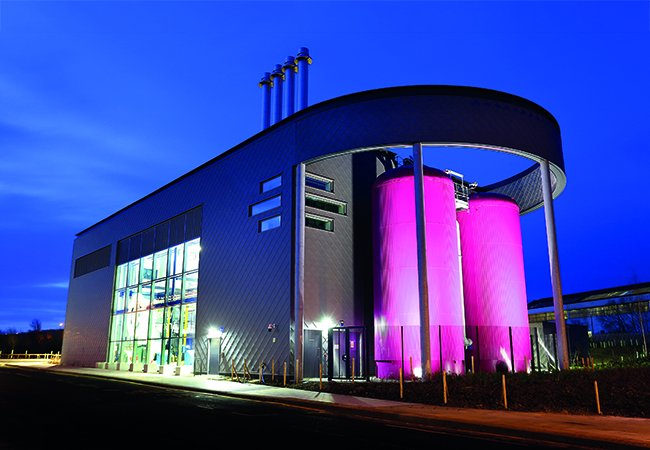
The Gateshead energy centre at night
Decarbonising heat in existing homes remains one of the biggest challenges to overcome to reach the UK’s net zero commitment.
With around 80% of the 2050 housing stock already built, and heating accounting for roughly a third of national carbon emissions, local authorities need scalable, low carbon retrofit pathways to decarbonise heat.
Only 3% of heat is currently supplied via heat networks, but this must grow to around 20% by 2050 to meet national climate targets. Low-temperature heat networks (LTHNs) have been identified as the lowest-cost route to low carbon heat in the UK, which has an abundant heat resource that could support LTHNs: mine water.
A joint study by Ordnance Survey and the Coal Authority (now the Mining Remediation Authority) identified more than six million homes and 300,000 offices and businesses that are located above abandoned coal mines. It’s uncertain how many sites can practically supply heat, but the potential is not just theoretical.

Work on the heat network near the homes on the pilot project
Mine water typically sits between 10°C and 20°C, and around 15°C in Gateshead. This is upgraded via water source heat pumps to about 80°C for the Gateshead District Energy Network (GDEN).
LTHN connection strategies to date have focused predominantly on large commercial buildings or existing communal heat network systems. A major question is whether low-rise existing housing, designed for 80/70°C gas-boiler systems, can perform effectively on LTHNs.
Connecting individual homes, especially low-rise social housing designed for standalone boilers, remains relatively novel and challenging. The core technical issue is that LTHNs require lower flow and return temperatures because of typical network operating parameters.
In partnership with Gateshead Council and H Malone, FairHeat worked on a retrofit pilot project to connect 16 social homes, between 50 and 75 years old, to the GDEN. The pilot explored whether acceptable comfort conditions could be maintained without major upgrades to internal heating systems, offering a potentially scalable and cost-effective model for decarbonising UK housing stock.
The GDEN, owned by Gateshead Council, serves approximately 350 homes and more than 23 key buildings and businesses with heat through a district LTHN. Since it started supplying heat in March 2017, it has evolved into a major infrastructure scheme, supplying domestic, commercial and public sector customers. As the GDEN expands, attention has turned to how to connect existing housing stock efficiently.
The approach
The pilot involved 16 terraced and semi-detached social houses in Gateshead. Individual gas boilers were removed and replaced with heat interface units (HIUs), each supplied with heat directly from the GDEN.
HIUs were installed in secure, weatherproof external cupboards, with pipework routed to the boiler’s former internal location. This keeps the district heating system outside the house and simplifies maintenance access.
Replacing radiators and internal pipework is costly, disruptive and time-consuming. For this reason, radiator upgrades were excluded to trial a practical model for the rollout of LTHN connections.
UK homes were typically designed for high space-heating temperatures of around 80/70°C (flow/return), giving an average water temperature of 75°C. Lower average temperatures reduce radiator heat output, but historical oversizing of heating systems often allows for reduced output without major retrofit work.
The GDEN primary network typically supplies heat to connecting buildings at flow temperatures of between 75°C and 80°C at the point of connection. If rolled out at scale, a local substation would probably reduce HIU supply temperatures to around 70-75°C.
This restricts space-heating circuits on the house side of the HIU plate heat exchanger to operate at approximately 65°C flow, significantly lower than in traditional boiler operation. By installing pressure independent thermostatic radiator valves, space-heating return temperatures of approximately 55°C were achieved across existing radiators. So, in practice, the average radiator temperature achieved during the pilot was around 60°C.
The key question was whether these reduced temperatures could still maintain resident comfort through the winter months.
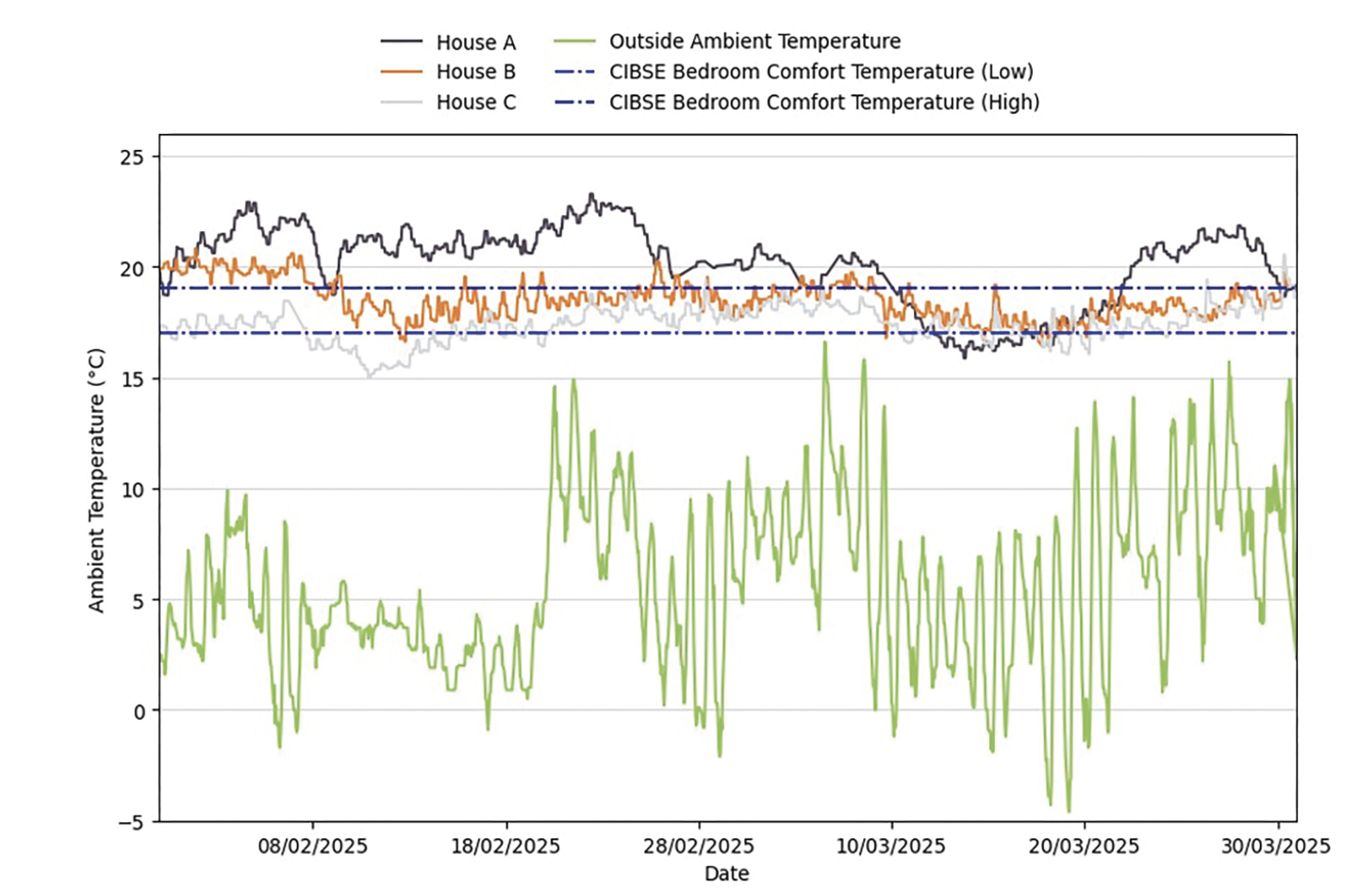
Ambient temperature sensor data for bedroom 2 throughout the test. The red marker outlines the week with the coldest average outdoor temperature
Given the constraints of time, cost and access, it was not deemed practical to undertake detailed heat-loss and radiator-output calculations for each home. Instead, performance was assessed through a combination of acceptance testing and monitoring of ambient room temperature.
Acceptance testing, as set out in CIBSE CP1 guidance, was carried out to ensure that HIUs were commissioned correctly and meet key performance criteria. This included domestic hot water (DHW) delivery at 50°C to the kitchen tap and a space-heating flow temperature of 65°C to radiators.
Space heating is the limiting factor, constrained by network temperature, as the flow temperature requirement exceeds that for DHW. This is probably the case for most houses with existing radiator systems.
To understand space-heating performance, ambient room temperatures were monitored in three representative houses – referred to as Houses A, B and C – during the latter part of the heating season.
Each house was equipped with a gateway and four temperature sensors, located in the living room, kitchen and the two largest bedrooms. Sensors were positioned to avoid interference from heat sources within rooms. Room-temperature data was recorded hourly between 31 January and 31 March 2025, alongside external ambient conditions. A full heating-season dataset would have been preferable, but the test period was constrained by retrofit timelines. The test period captured low external temperatures, close to design conditions.
Comfort performance was assessed against CIBSE Guide A, recommended comfort temperatures and, where known, resident-defined comfort preferences. This distinction proved important, because resident behaviour and expectations may differ from CIBSE comfort benchmarks.
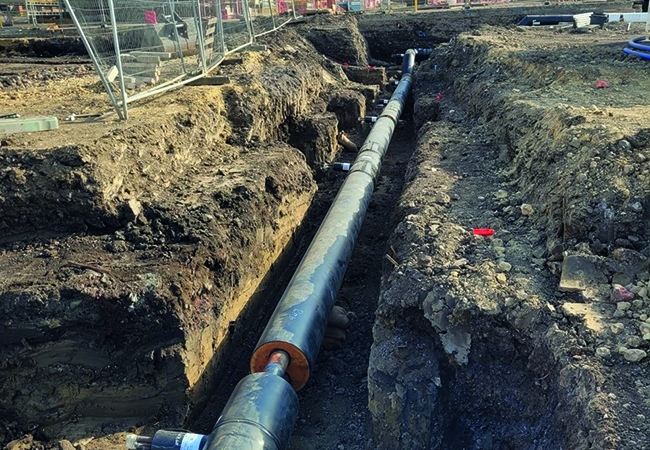
The mine-water borehole, left, and heat network pipes
Results
Across the three monitored houses, eight out of 12 rooms achieved defined comfort setpoints during the coldest week of the monitoring period. Importantly, this was achieved without replacing radiators. In Houses A and B, bedrooms and kitchens consistently maintained temperatures at or above the lower end of CIBSE comfort benchmarks, within a 1K tolerance (see Figure 1).
Living-room temperatures in the measured houses remained mostly stable. One house dipped later in the season, which appeared to coincide with changes in occupant behaviour rather than system limitations.
In House C, generally, temperatures were lower than the CIBSE benchmarks. Based on a conversation with the resident, their chosen space-heating setpoint was understood to be 17°C. This is generally at the bottom end of, or below, the CIBSE comfort temperature range, depending on the room. This highlights that resident behaviour and expectations may differ from CIBSE comfort benchmarks.
Several challenges and limitations were identified that should be addressed in future testing to improve data accuracy and interpretation. Gaps in remote heat-meter data because of connection issues made it difficult to conclusively separate system space-heating performance from occupant behaviour. This has since been rectified, but without clear confirmation of when heating was enabled, dips in room temperature cannot always be attributed to low flow temperatures.
Resident behaviour emerged as a key factor and comfort expectations were unknown in two of the three homes. Some occupants appear to prioritise energy cost savings over meeting conventional comfort benchmarks. This highlights the importance of engaging with residents early to understand their typical space-heating usage patterns and setpoints.
Test duration and sample size are also limitations. It would be better if an increased sample size is monitored if the HIU retrofit works are rolled out across more houses. This would capture a representative sample of house types and user behaviour.
Conclusions
This pilot demonstrates that existing social housing can be connected to LTHNs without major internal heating upgrades. Required return temperatures were maintained to the GDEN network, indicating that system efficiency was not significantly compromised by the connections.
Most monitored rooms in the pilot achieved comfort conditions at reduced operating temperatures, supporting the viability of this approach at scale. To strengthen these conclusions, further temperature monitoring across more retrofitted homes is recommended.
Overall, the project is a promising start to a practical, scalable pathway for using LTHNs and mine-water heat to decarbonise heating in social housing.