
Historic England report
A report commissioned by Historic England has concluded that closed-loop water source heat pump (WSHP) systems are a viable and readily available way to discreetly decarbonise heating systems in historic buildings.
The report, Heat pumps in historic buildings. The viability of water source heat pumps in historic buildings (bit.ly/4sNEW02), explores how well-designed WSHP systems perform in practice, and how they can be integrated efficiently with existing pipework and radiators.
Looking at five historic buildings that have had WSHP systems installed, the report sought to identify examples of best practice that have enabled good system performance, as well as common mistakes that have led to poor performance. The intention was to use the findings from the case studies to inform future work and strategy, particularly in identifying the design, control and maintenance factors that determine whether WSHP systems perform effectively in historic buildings.
Visits to the five case study buildings – located in Somerset, Cambridgeshire, Warwickshire, North Yorkshire and Norfolk – took place between February and April 2023, with engineers from Max Fordham carrying out site surveys. They also questioned building users on thermal comfort, noise levels, running costs, control management and maintenance.
With many stately homes built close to a body of water, the report concluded that WSHPs can be particularly suitable, offering a more visually discreet solution than an air source heat pump (ASHP) system and a more straightforward installation than a ground source heat pump.
When used for conservation heating, WSHPs can operate efficiently with existing radiators and pipework, minimising the cost, disruption and visual impact of upgrading.
In terms of effectiveness, the report suggests that issues with system performance are often the result of its configuration rather than the WSHPs themselves. Only one of the five sites in the case study experienced ‘significant difficulties’ extracting heat from the source water, because of an open-loop setup.
Noise levels were similar to other heating system components (as they are often installed in plantrooms).
Controls were another key factor in optimising the performance of WSHP systems, with the report highlighting the importance of building users having a good understanding of how to use controls to maximise efficacy. However, it found that the availability of skilled maintenance and installation contractors could be an issue.
Other Historic England heat pump guides are available. Read a summary of ASHP studies in large buildings.
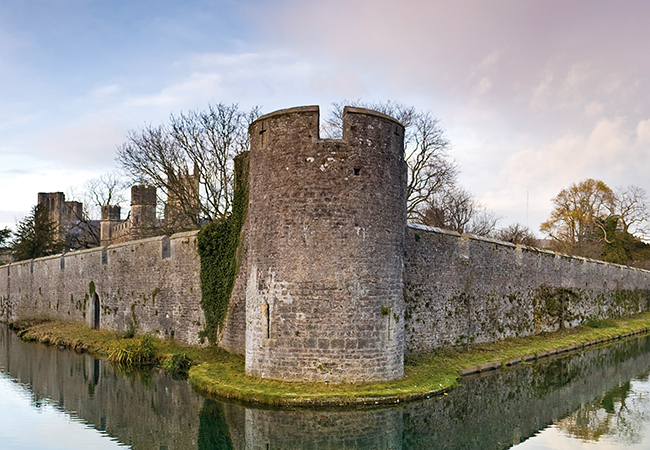
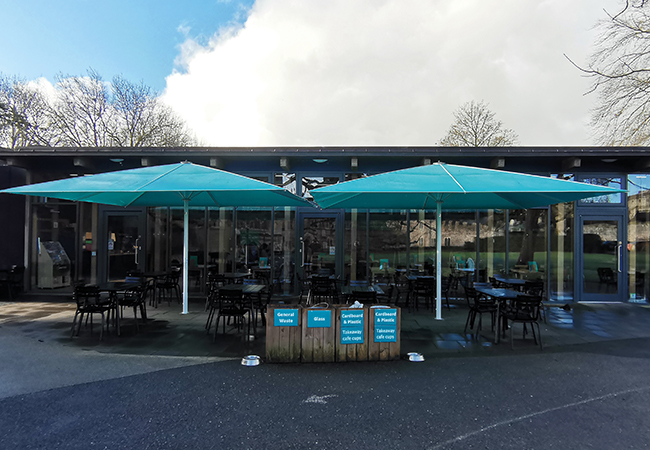
Site 1 Medieval Bishop’s Palace outbuildings
This Somerset site used a Dimplex SIH 20TE 20kW WSHP to heat the outbuildings. A closed-loop collector placed within the moat on a sunken platform provided the heat source, so had no visual impact on the building.
Underfloor heating was used in the toilets, learning centre and cafe, while radiators heated the office. A 500-litre hot-water cylinder serves these, and there were no issues with temperatures, apart from in the learning centre, and no noise issues from the WSHP.
An energy management company evaluated the site and found an operating coefficient of performance (COP) of only 0.75. System settings were altered to improve the COP to 2.5, which was still lower than the expected 3.0; suboptimal performance can be caused by the WSHP targeting a high flow temperature, or a large temperature difference across the flow and return for the WSHP, but the cause wasn’t clear.
The report states that a WSHP in the main palace would reduce energy use and running costs compared with the current direct electric system.

Site 2 Jacobean-style house
In 2018, a 204kW WSHP system replaced the oil-boiler heating system at the Grade I-listed country house in Cambridgeshire, parts of which date back to 1135. It uses six CTC EcoPart 434 WSHPs with an open-loop collector.
The open-loop WSHP system extracts and returns water from a small watercourse on the site. Five 34kW units provide conservation heating and domestic hot water to the main house, and one 34kW unit delivers comfort heating to the staff cottage, with heat primarily delivered through existing radiators in the main house and new radiators in the cottage.
The installation had no visual impact on the building and the basement plantroom produced no noise issues. However, the engineers found that the WSHPs were not working. Although functioning as designed for 12-18 months, a lack of river maintenance, personnel changes and collapsed system maintenance resulted in the submersible pumps and filtration system frequently failing. Locating the pumps under a bridge (to reduce visual impact) made them difficult to maintain, with suspected blocked filters and an airlock in the pipework. Mild steel, rather than stainless steel, components also caused damage. Finding a contractor to fix it proved difficult. The client was interested in converting the open-loop system into a lower-maintenance closed-loop one for this and future projects.

Medieval Bishop’s Palace outbuildings
Site 3 Mansion house
Constructed in 1570, the mansion house has been extensively modified, including significant renovations and extensions in the 1920s and 1930s.
Three Dimplex WSHPs were used to heat the main house, office accommodation and flats on this site, with all three connected to a shared closed-loop collector on a sunken platform in the lake next to the house.
A single 75kW WSHP and a 1,000-litre buffer vessel provided conservation heating to the main house, which used the existing historic radiators to deliver heat. Heating for thermal comfort was provided on separate circuits to the offices and flats, powered by a 40kW and 20kW WSHP sharing a 500-litre buffer vessel. The offices and flats used modern radiators.
The research engineers found the system well designed, but when they compared what had been installed to a schematic of the design, a non-return valve appeared to be missing, reducing the heating system flow temperature by allowing return water to mix with the outgoing flow. This reduced efficiency and meant insufficient heat was delivered to some parts of the building.
Lower-temperature conservation heating allowed existing large, cast iron radiators to meet heat output requirements. Separate WSHPs for thermal comfort and conservation heating allowed each to be sized to its purpose, enabling each WSHP to operate at the lowest possible temperature and maximising efficiency.

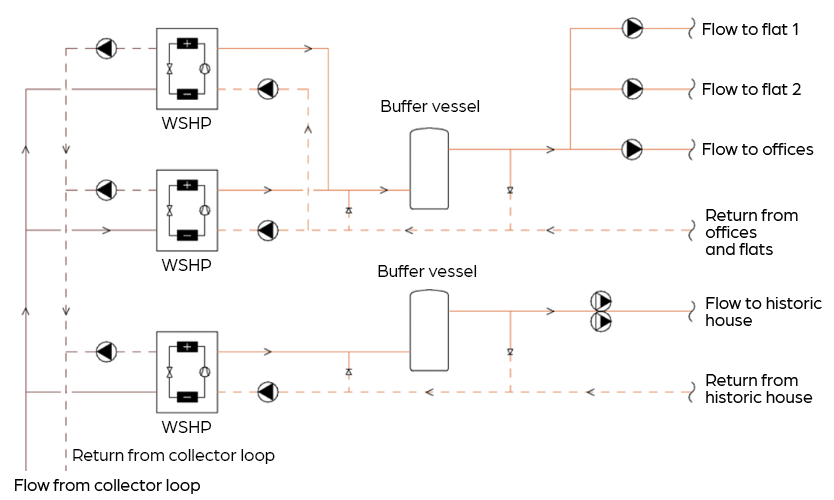
Site 3 Schematic of heating using separate WSHPs for conservation heating and thermal comfort
Site 4 Stately home
Construction of the building began in 1699 and was completed in the 1750s, with additions during the 19th century, plus extensive restoration after a fire.
Two 144kW Dimplex SI 100TE WSHPs were installed in 2009, using a closed-loop collector system to collect heat from a pond. They provide heating to all heated areas of the main house and hot water to the west wing.
In 2020, two 73kW Dimplex SI 75TU WSHPs were installed to provide heating to additional areas of the west wing and to accommodate the installation of more hot-water appliances. The total heat pump capacity was 97W.m-2.
There was minimal visual impact from the system installation in the basement plantroom, and no noise issues. Using the historic radiators saved money, but leaks in some needed repair.
The report acknowledges the foresight of ensuring the system is set up to allow more heat collectors to be added. The WSHPs appeared to be in good working order, although the engineers found pipework insulation was damaged in places, potentially leading to condensation, corrosion and leaks.
The report highlights the lack of temperature control, with the pipework configuration allowing it to be set as only one zone for the whole building. Some rooms in the east wing had low thermal comfort levels.

Site 5 Stately home
Two Dimplex SI 130 and SI 75TU WSHPs were installed in this Grade I-listed 17th-century stately home in Norfolk in 2016, providing heat pump capacity of 205kW, and extracting heat from a nearby lake in a closed-loop system.
The WSHPs, which deliver 50W.m-2 capacity (of usable floor area), provide conservation heating to visitor areas and comfort heating to staff offices and accommodation, using historic radiators that were fed by an oil-fuelled boiler.
The lake’s proximity made the water source an excellent choice for high-efficiency heating, with minimal visual impact or noise issues from the plantroom. Thermal comfort was excellent, with staff and volunteers feeling comfortable in all areas. However, the report cites a lack of zoning control of the heating as an issue.