
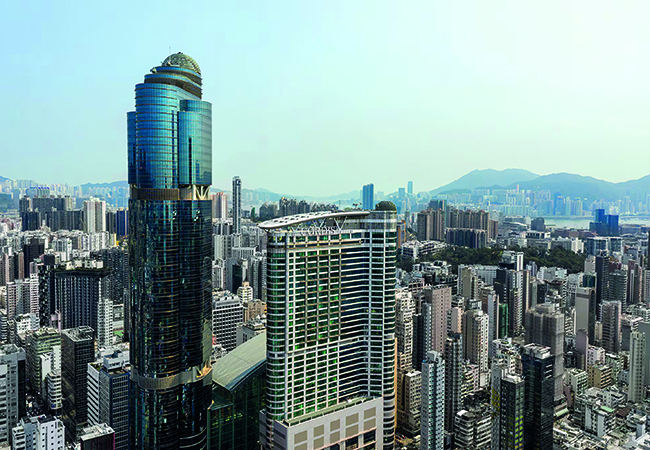
Cordis Hotel HK with Mong Kok View
An innovative cooling as a service (CaaS) business model gaining momentum in Hong Kong is enabling building owners to cut carbon emissions in their cooling systems without large upfront capital outlay.
Notable deployments include Shui On Centre in Wan Chai, Nina Tower in Tsuen Wan, Manulife Financial Centre in Kwun Tong, Laws Commercial Plaza in Lai Chi Kok, MCP Discovery at Metro City Plaza in Tseung Kwan O and Cordis Hotel Hong Kong in Mong Kok.
Projects are delivered through a partnership between the building owners and energy solutions provider CLPe. Using the CaaS model, high-efficiency cooling systems are retrofitted and supported by AI-powered platforms that optimise energy use and enhance system reliability.
Retrofits in Hong Kong often face severe constraints, such as restricted plant space for new equipment and existing structural capacity
Projects adopt BIM and multi-trade integrated mechanical, electrical and plumbing (MiMEP) technologies to streamline installation, shorten project timelines and boost performance.
The CaaS model, a specific application of the broader energy as a service (EaaS) framework, fundamentally shifts the approach to building infrastructure from simple equipment ownership to a performance‑based service.
For these projects, CaaS is delivered through a build-own-operate-transfer (Boot) arrangement, where public or private organisations grant a private company a concession to finance, construct and manage a large infrastructure facility.
Under the CaaS, CLPe provides the funding, design, installation, operation and maintenance for the new system. By paying a monthly subscription the building owner does not have to make an upfront capital investment or pay for separate maintenance contracts.
CLPe engineers operate and maintain the system 24/7, and guarantee performance and energy efficiency for typically 15-20 years. This long-term commitment prioritises efficiency and reliability to ensure predictable life-time performance.
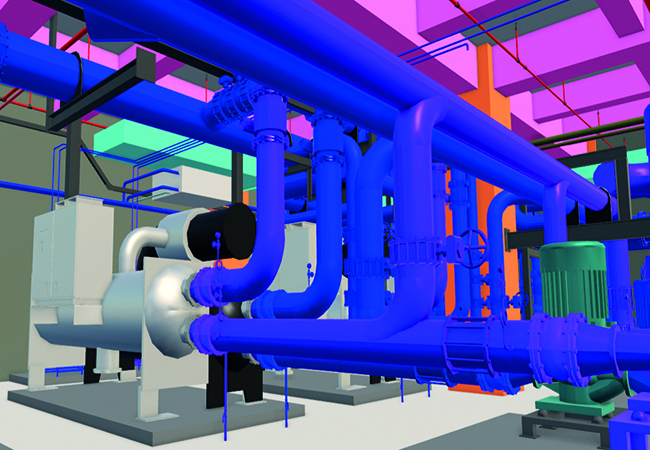
Chiller plant in the BIM model and in situ
Reducing risk
Retrofits in Hong Kong often face severe constraints, such as restricted plant space and headroom for new equipment, and existing structural capacity limiting additional load.
This can increase complexity and restrain new technology adoption. Furthermore, the logistics of moving heavy equipment to the upper floors of a high‑rise present lifting challenges.
Under a standard owner‑operated model, risks associated with adopting complex high‑rise cooling systems – including pressure containment, complex system control and long‑term maintainability – act as a deterrent, particularly in retrofit scenarios.
Under the CaaS model, these risks sit contractually with the energy solutions provider over the full Boot term. This fundamentally alters engineering decision‑making, enabling system configurations to be selected on the basis of life‑cycle performance rather than installation simplicity.
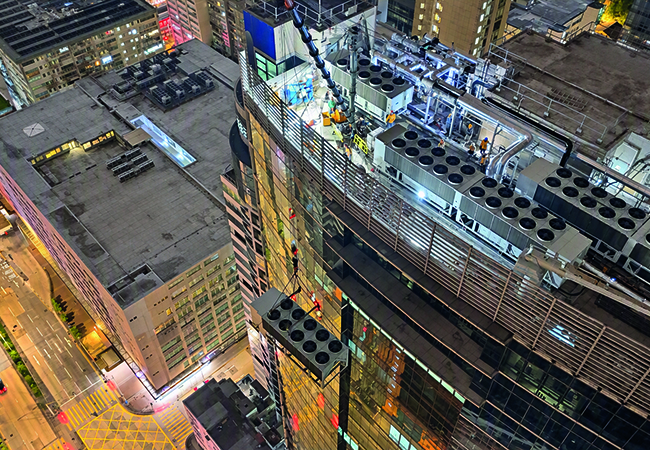
Hoisting a chiller into position on a roof
High-rise challenge
Cooling retrofits were particularly challenging because of buildings’ height, continual occupation during installation and the spatial constraints of converting operational systems.
To navigate these, MiMEP offsite techniques, supported by BIM, were adopted. Because the project involved retrofitting in existing buildings, accurate 3D scanning was used to create a BIM model reflecting true site conditions.
This digital approach allowed stakeholders to visualise potential clashes early on. Once the design was finalised, MiMEP modules were prefabricated off site with high precision. This strategy yielded significant efficiency gains, including 50% time savings on construction1 (see panel, ‘Project benefits’).
A CaaS project involved converting an air‑cooled chiller system into a water‑cooled system, resulting in a significant reduction in electricity costs for the building owner1.
Air-cooled chillers reject heat directly to ambient air, with their efficiency declining as outdoor dry-bulb temperatures rise. Water-cooled systems use cooling towers to reject heat through evaporation, potentially achieving lower condensing temperatures and improved efficiency, particularly in hot climates.
Re‑engineering in high‑rise buildings introduces significant hydrostatic pressure challenges. In Hong Kong, continuous vertical water columns often extend from the basement to the roof, generating extremely high static pressures at the lower sections of the system – well beyond the pressure ratings of standard commercial valves, pipework and heat exchangers.
Under a CaaS contract, failure to manage these risks would directly undermine system availability obligations (at the time the system is fully operational) and long‑term life‑cycle cost certainty.
To mitigate this, some projects require a building to be divided into multiple hydraulically isolated pressure zones. Plate heat exchangers located at intermediate plant floors separate static pressure while enabling efficient thermal transfer between zones.
Each circuit therefore operates at manageable pressure limits, reducing the likelihood of leakage, component fatigue and unplanned outages over the contract term.
Modern plate heat exchangers can be designed for approach temperature differences of around 1K. This allows the pressure-management arrangement to be introduced with only a small temperature penalty.
The result is a high‑efficiency water‑cooled system that maintains consistent cooling performance across the full height of the building, while significantly reducing risk associated with the long-term performance obligations of the CaaS model.
Environmental responsibility is core to CaaS project design, demonstrated by the use of low-GWP hydrofluoroolefin (HFO) refrigerant chillers.
The CaaS model includes a sophisticated software layer employing AI and machine learning. By analysing real-time data, learning usage patterns, and predicting load and weather shifts, it continuously optimises multiple control variables. This real-time optimisation delivers 10-15% energy savings, even without hardware upgrades2.
Big‑data analysis is also used to conduct preventive maintenance, identifying potential faults before they cause downtime.
The retrofits serve as robust examples of how CaaS can revolutionise building management. By combining state‑of‑the‑art hardware, advanced construction methods and intelligent software, highly efficient and innovative cooling solutions are delivered.
In Hong Kong, buildings account for around 90% of electricity consumption, including 60% for offices, retail and commercial. This makes the enhancement of building services essential for the city to achieve its target of carbon neutrality before 2050. Decarbonising at scale requires a shift from asset ownership to performance-based cooling. CaaS has an important role to play and could be applied to around 42,000 private buildings and 8,000 government buildings across Hong Kong.3
CaaS projects have been implemented successfully in Hong Kong and extended to cities across the Greater Bay Area on the Chinese mainland. Applications include standalone building cooling and distributed district cooling systems, with some featuring thermal energy storage.
The model is gaining traction as an innovative pathway to accelerate decarbonisation and support sustainable development.
The completed projects show that decarbonising existing buildings at scale requires a shift from asset ownership to performance-based cooling infrastructure.
Project benefits
About the author
Alvin Tsz-Yeung Lo is director of decarbonisation business at CLPe, honorary secretary of CIBSE Hong Kong Region (2026-27 session) and honorary treasurer of BEAM
CLPe is a wholly owned subsidiary of Asia-Pacific power firm CLP Holdings. It’s won multiple awards, including the Hong Kong Institution of Engineers Building Services Division Excellent Building Award 2026 – Grand Award
References:
1 MIC/MIMEP Achievement Award 2025, Construction Industry Council, Hong Kong, pp31
2 Hong Kong Green Building Council (n.d.) TKO Plaza Case Study, Retrofitting Hub(Accessed 22 October 26
3 Decarbonising Hong Kong Buildings Policy Recommendations and Next Steps, pp15, December 2020 HKGFA/Civic Exchange