
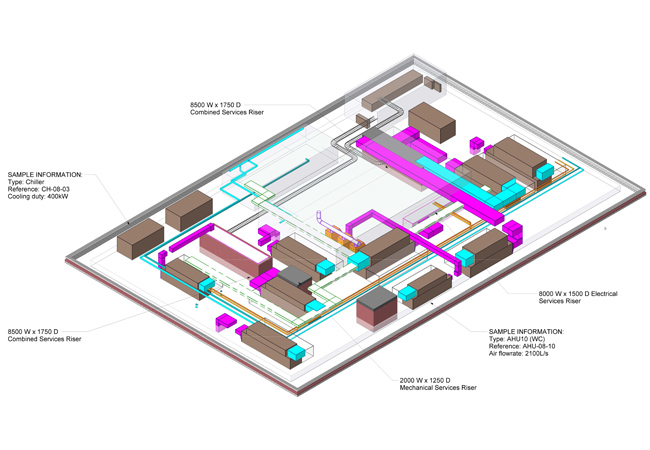
Extract of a Stage 3 exemplar drawing from BG6
Design teams on construction projects look very different from even a decade or two ago.
Alongside architects, structural engineers and building services consultants, a wide range of specialists now have early involvement in projects.
Their expertise is essential for delivering increasingly sophisticated buildings, but it creates a fundamental coordination challenge: who’s responsible for each part and how do they need to collaborate?
BSRIA’s BG6 Design Framework for Building Services has long provided a robust structure for answering that question. It established common design activity proformas to allocate activities and responsibilities across project teams
The new BG6 takes that base into a digital format. Launched on 6 November 2026, it’s a collaboration platform allowing project teams to define tasks to be done, assign them to the right parties, and align on the deliverables.
It helps coordinate the contribution from the many specialists who work on today’s high-performing buildings, including environmental consultants, acousticians, façade engineers, fire specialists, controls engineers, smart building consultants, BIM and information managers, and commissioning specialists, not to mention manufacturers and suppliers.
Beyond the spreadsheet
Responsibility matrices are usually created in spreadsheets and exchanged between clients, consultants and contractors. The difficulty is that a spreadsheet becomes a static tool in a digital world.
Projects change. People join, responsibilities move, procurement decisions alter the sequence of design and assumptions may no longer be valid.
Multiple copies of a spreadsheet can circulate through email or document-management systems, creating uncertainty about which version reflects the agreed position and commercial risk for everyone involved.
The result can be redesign, programme delays, additional cost and, ultimately, disputes about responsibility.
The online platform is intended to make it easier to maintain and update design responsibilities throughout a project, rather than relying on periodically revised and circulated responsibility matrices.
Instead of allocating responsibilities once, then filing the document away, teams can work within a common framework, maintaining total clarity as the project develops.
A comprehensive update to the BG6 framework
The BG6 technical content and activity schedules have been comprehensively reviewed and expanded, in consultation with more than 50 representatives from across construction1. Some of the most important changes come at Stage 3 and 4.
RIBA Stage 3 Spatial Coordination
Fully revised descriptive text for Stage 3 includes more prescriptive requirements for spatial coordination. For example, the new guide emphasises
To achieve this, designers following BG6 must make appropriate allowances for systems not yet designed, including specialist/contractor’s designed portion packages, supports, fixings , and space for maintenance, operation and replacement.
Lack of space is one of the major issues causing late and disruptive changes. On this matter, BG6 now aligns with the 2020 update to the RIBA Plan of Work (when Stage 3 changed from Developed Design to Spatial Coordination).
BG6/2018 subdivision (teal) vs the new BG6 (yellow)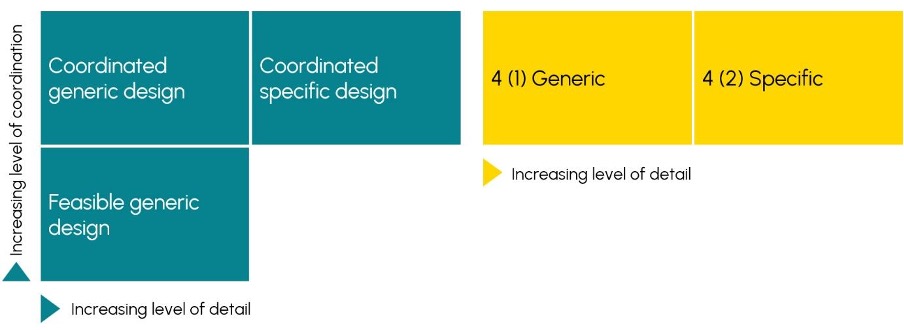
RIBA Stage 4 Technical Design subdivision
One of BG6’s important structural principles is the subdivision of Technical Design at RIBA Stage 4. The previous edition of BG6 divided Stage 4 into three distinct phases. Following industry consultation, Stage 4 has been simplified to 4(1) Generic and 4(2) Specific (which includes the selection of specific plant items).
[picture caption] BG6/2018 subdivision (teal) vs the new BG6 (yellow)
Although termed ‘generic’ (that is, only performance ratings specified), the design details at the end of Stage 4(1) will be finalised , leaving only the ‘specific’ equipment selections to be determined, with minor modifications to enable integration that should not affect the overarching design of the system. BG6 makes it clear that design outputs at Stage 4(1) Generic and 4(2) Specific are to be coordinated.
Making these responsibilities explicit gives consultants, contractors and specialists a common basis for agreeing what information is expected, from whom and at what point.
Building Safety Act, accountability and the golden thread
The Building Safety Act 2022, and the regulations introduced under it, have increased the industry’s focus on competence, accountability and demonstrable compliance substantially. BG6 can support these requirements by providing a structured approach to allocating and documenting design responsibilities.
The platform provides an auditable log of who made assignments, who was assigned to which activity and role, if changes were made, and any comments added. At the moment, it doesn’t notify users of changes to allocation, but they can see all changes – in order of most recent – when they log in.
The platform can also add links to other project information – for example, to a common data environment – though, currently, this is a weblink not a connection, such as an API.
Ultimately, BG6 is about a simple question: who’s responsible for what?
This supports the principles behind the golden thread: maintaining reliable information so that important decisions and responsibilities can be understood as a project progresses, rather than reconstructed afterwards.
The ‘helicopter view’ provided by the BG6 framework also enables decisions to be made about the right parties to be leading the design of a particular system at any point in the process. This helps ensure that the most appropriate party, with the right skill set, is leading the design of key safety systems.
What does this mean for engineers?
For building services engineers, the value becomes clearest at the interfaces.
Consider a congested plantroom or riser, for example. Mechanical equipment may have requirements for maintenance access; electrical containment needs routes and separation; branches and crossovers all require additional space; acoustic treatment can affect available space; devices to preserve the integrity of fire compartmentation may be required; controls specialists need sensors, panels and interfaces; and commissioning engineers need systems that can be accessed, tested and demonstrated. None of these exist independently.
A technically correct piece of design undertaken in isolation can still create a problem for the project. By identifying who leads, supports and reviews individual activities, BG6 provides a mechanism for exposing these problems earlier. The principle also extends to commissioning.
Rather than treating commissioning as an activity that appears towards the end of construction, the framework identifies requirements and responsibilities from the outset, when there’s still time for them to influence design decisions.
The same thinking applies at different scales. A major hospital, laboratory or commercial development might involve dozens of organisations and hundreds of interfaces. But a school refurbishment, or smaller commercial projects, still need clarity about who’s producing calculations, coordinating controls, selecting equipment or developing specialist design.
Ultimately, BG6 is about a simple question: who’s responsible for what?
As projects become more specialised and regulatory expectations increase, relying on unwritten assumptions is no longer acceptable
Moving BG6 into a collaborative digital environment offers project teams a practical way to make responsibility visible and keep it current, and helps ensure that the boundaries between designers don’t become the gaps through which problems fall.
About the author
John Taylor is BG6 product manager at BSRIA
BSRIA will be demonstrating the new BG6 platform at London Build 2026 on 25 and 26 November – at 12:30 – on stand C180 and on the CIBSE Build2Perform stage at Elemental.
More information at www.bg6.io
REFERENCES
1 BG6 collaborators