

Replacing gas boilers with heat pumps is central to decarbonising commercial buildings, but the implications extend beyond the plantroom. A recent research exercise highlights how electrical capacity, heating coils and distribution systems can determine whether an apparently straightforward retrofit is technically feasible.
A study published in Energies in June 20261 – by Darren Kelly, Akhtar Kalam and Shasha Wang, from Australia’s Engineering Institute of Technology – examines two important considerations: the additional electrical demand associated with heat pump installation and the ability of existing heating systems to operate at lower water temperatures.
Using a commercial office building as a case study, the researchers assess the implications for the wider heating system. The study is principally a design-point analytical assessment, rather than a monitored demonstration of an operational retrofit.
From thermal demand to electrical capacity
The study considers a multi-storey Australian office building with a gross floor area of approximately 15,000m², heated by gas-fired boilers. The researchers assessed the consequences of replacing these with air source heat pumps (ASHPs).
Using a heating capacity screening figure of 1,900kW and assuming a heat pump coefficient of performance (COP) of 2.0 under winter design conditions, the researchers calculated a peak electrical demand of approximately 957kW, including associated plant loads.
By comparison, the governing peak electrical demand of the existing heating and cooling plant was 399kW, occurring during cooling operation. The calculated increase of approximately 558kW illustrates the potential significance of heating electrification for a building’s electrical infrastructure.
However, this represents an upper-bound screening assessment, rather than a prediction of the building’s actual maximum electrical demand after conversion.
Heat pump performance under peak heating conditions and the coincidence of other electrical loads will influence the additional capacity required.
Additional demand may affect transformers, switchboards, distribution cables and the available electricity supply. Obtaining additional capacity can introduce considerable expenditure and programme delays.
An assessment should therefore consider the building’s existing electrical load profile alongside the anticipated operation of the proposed heating system, rather than simply adding the maximum demands of individual plant items.
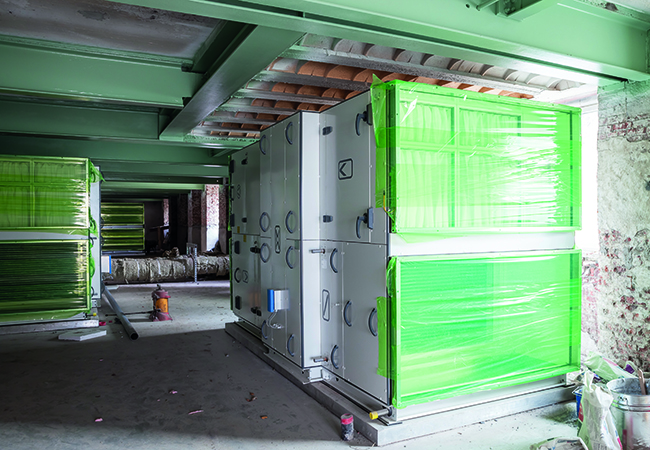
An air handling unit being installed in an existing building
What happens to existing heating coils?
The second significant finding concerns the performance of existing air handling unit (AHU) heating coils at reduced water temperatures.
Heat pumps generally operate more efficiently at lower heating-water temperatures, but reducing water temperature also reduces the temperature difference driving heat transfer from the coil to the airstream.
The researchers examined 13 existing AHU heating coils, assessing their performance when heating-water temperatures were reduced from a conventional 70°C entering-water condition to a 55/45°C flow-and-return arrangement.
Their calculations indicated heating capacity shortfalls generally between 21% and 29% relative to the scheduled coil duties. Under design heating conditions, this could result in insufficient supply-air temperature, extended warm-up periods or difficulty maintaining internal temperatures.
The researchers considered the adjustments necessary to recover the original heating duties. Their calculations suggested that water-flow increases of approximately 40% to 100% could be required in some cases, while the necessary increases in overall heat-transfer conductance, or UA, ranged from approximately 30% to 80%.
Increasing water flow alone cannot necessarily compensate for reduced water temperature. Coil performance also depends on heat-transfer surface area, airflow rates, circuit arrangements and entering-air conditions. Where the existing coil cannot provide sufficient heat transfer, replacement or modification may be necessary.
How much heating capacity is really needed?
The study highlights a potentially important distinction between installed heating capacity and the actual heating requirements of a building.
The researchers used 1,900kW as the heating capacity basis for assessing the electrical implications of replacing the existing boilers with heat pumps. However, the combined scheduled heating duties of the building’s 13 AHU coils amounted to approximately 1,046kW – just 55% of that figure.
Neither necessarily represents the building’s actual peak heating demand. The larger figure reflects the existing plant capacity assessment boundary, while the smaller represents the scheduled AHU coil duties. The distinction matters. At an assumed COP of 2.0, providing 1,900kW of heat requires approximately 950kW of electrical input, compared with approximately 523kW for 1,046kW of heat.
The implication: before assessing the electrical infrastructure required for heating electrification, engineers need to establish the building’s actual peak heating demand, rather than simply adopting existing boiler capacity
The implications for pumps and pipework
Increasing water flow has consequences elsewhere in the heating system. For a given heating duty, reducing the temperature difference between flow and return water requires a corresponding increase in water mass flowrate. For example, reducing the design temperature difference from 20K to 10K would approximately double the required flowrate.
Higher flowrates increase frictional pressure losses through pipework, valves and fittings. Pumps may need to operate at higher speeds or be replaced, potentially increasing electrical consumption. Control valves and balancing arrangements may also require reassessment, while existing pipework may limit achievable flowrates.
Designers must therefore balance heat pump efficiency against terminal unit capacity, distribution requirements, and the cost and disruption of modifying the existing installation. Existing boiler installations may have been designed decades ago, using assumptions about occupancy, ventilation, internal gains and building fabric that no longer reflect present operation.
Subsequent improvements to the building fabric or controls may have reduced heating demand, while changes in ventilation requirements or building use may have increased particular loads.
Reassessing heating requirements using operational data, measured performance and appropriate load calculations can establish whether existing AHU coils and other heat emitters can satisfy the revised demand at lower temperatures.
Coils that appear undersized against their original scheduled duties may prove adequate for actual heating requirements. Similarly, reducing peak demand may allow smaller heat pumps to be installed, reducing electrical infrastructure requirements and capital costs.
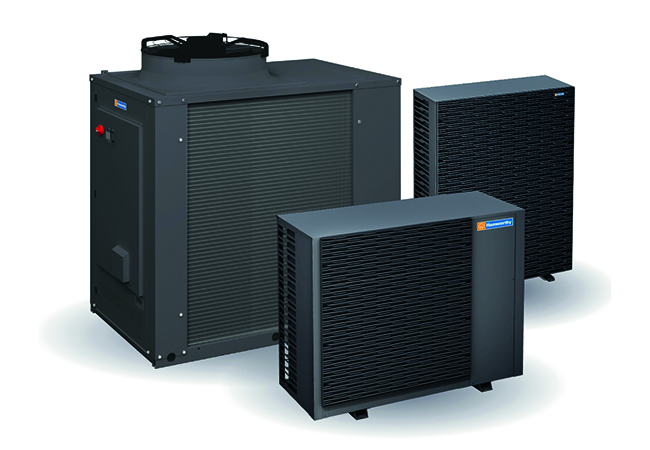
Tyneham 290HT commercial heat pumps from Hamworthy Heating
Designing the whole system
The study does not provide a complete techno-economic assessment of commercial heating electrification, or establish the annual energy savings, carbon reductions or financial returns from the proposed conversion.
Its principal contribution is to bring together two constraints that can otherwise be considered separately: the electrical implications of replacing combustion-based heating and the compatibility of existing hydronic systems with lower-temperature operation.
Perhaps the most important lesson from the Australian research is that the starting point for a commercial heat pump retrofit should not be the capacity of the boilers being removed, but the heating duty the building actually needs – and whether its existing systems can deliver that duty at temperatures compatible with efficient heat pump operation.
References:
1 Kelly, D, Kalam, A and Wang, S (2026). Electrical demand uplift and coil performance constraints in air source heat pump retrofits for commercial office buildings. Energies 19(13), 3018.