
For an alternative way to access this module, CIBSE member, Jos Brownlie provides a video reading the module: Module 261 recording
The need for dehumidification across different sectors is driven by the requirement to improve manufacturing efficiency, preserve artefacts and building structures, and protect human health. While specific humidity requirements vary widely between applications, the underlying objective is to manage the interaction between water vapour in the air and the materials, processes or occupants within a space. Understanding these interactions relies on basic psychrometric principles relating to air temperature, moisture content and relative humidity.
This module focuses on dehumidification systems, whether duct-mounted or supplied as self-contained non-ducted units, whose primary function is moisture removal, rather than dehumidification occurring incidentally as part of comfort cooling. It examines the principles and application of two established technologies, condensing and desiccant dehumidifiers, exploring operating characteristics, typical applications, energy implications, and integration considerations.
In buildings occupied by people, humidity is a key determinant of comfort, health and usability. While temperature is often the primary focus of environmental control, excessive or poorly controlled humidity can cause discomfort even when thermal conditions appear acceptable. This can result in occupants being uncomfortable, despite compliance with temperature-based design criteria.
High relative humidity impairs the body’s ability to regulate heat through perspiration, leading to sensations of stuffiness and overheating, while low humidity can cause dry skin, irritation of the eyes and respiratory tract, and increased susceptibility to airborne infection. Humidity also plays a significant role in indoor air quality. Elevated moisture levels promote the growth of mould and dust mites, both of which are associated with adverse health outcomes.
In modern, airtight buildings, moisture generated by occupants, activities and ventilation air can accumulate unless actively managed, particularly during mild or humid weather, when cooling systems operate intermittently or not at all.
Beyond occupant comfort, uncontrolled humidity threatens the integrity of buildings and their contents. Condensation on cold surfaces can lead to corrosion of metal components, decay of timber, and deterioration of finishes. Environments with sustained internal moisture generation, such as swimming pool halls, are especially vulnerable, and typically require dedicated dehumidification to protect the building fabric and maintain safe and comfortable conditions.
In museums, galleries and archives, humidity stability is often more important than absolute humidity level. Fluctuations in relative humidity cause hygroscopic materials such as paper, canvas and wood to repeatedly absorb and release moisture, leading to dimensional change and long-term damage. Maintaining a stable humidity equilibrium is therefore critical to the preservation of sensitive artefacts.
In industrial environments, dehumidification is frequently driven by process requirements rather than comfort. Excess moisture can disrupt manufacturing processes, degrade product quality and shorten equipment life. In some specialist applications, very low humidity levels are required to prevent chemical reactions with atmospheric moisture.
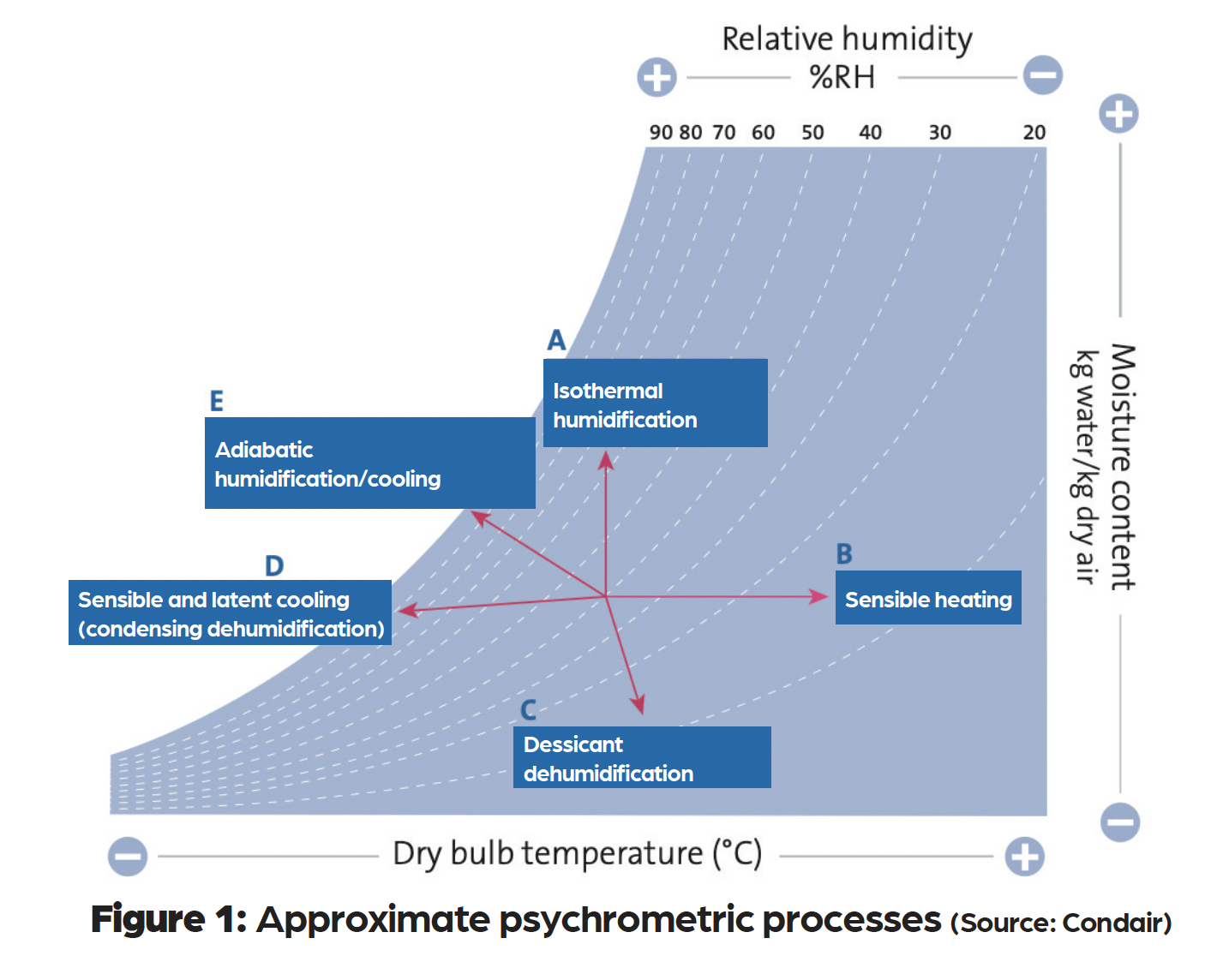
The two established dehumidification techniques that this CPD considers further are:
- Condensing dehumidifiers, which remove moisture by cooling air below its dew point and condensing water vapour (process D in Figure 1)
- Desiccant dehumidifiers, which remove moisture by sorption, using hygroscopic materials (process C in Figure 1).
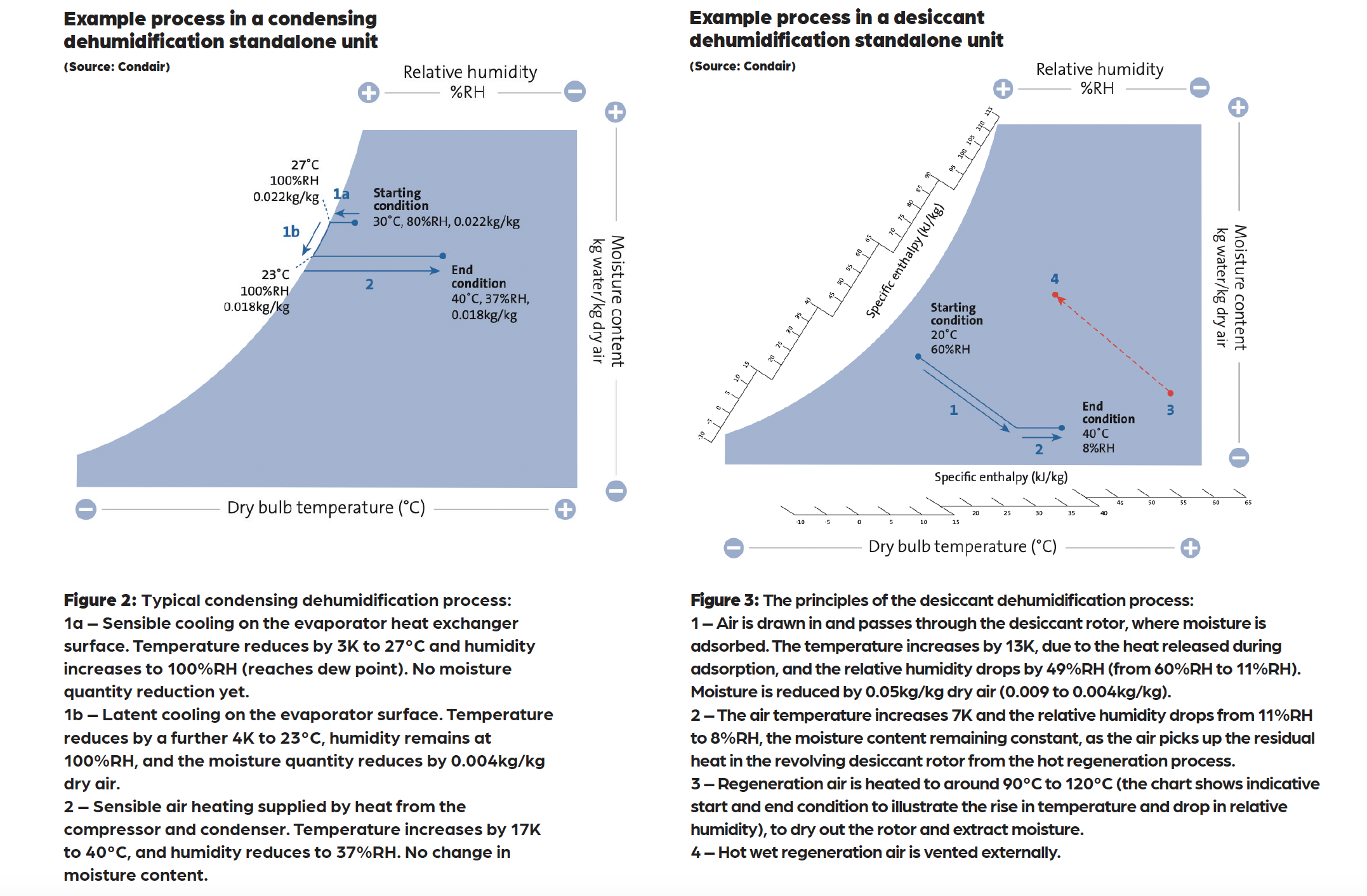
Condensing dehumidification is based on cooling air below its dew point so that water vapour condenses and can be removed. In conventional air conditioning systems, this is achieved using cooling coils supplied with chilled water or direct expansion refrigerant.
Standalone condensing dehumidifiers use a self-contained refrigeration circuit. Air passes over an evaporator coil where it is cooled below the dew point, causing moisture to condense and drain away. The dried air is then reheated as it passes over the condenser before being returned to the space, avoiding unwanted cooling of the room.
The performance of cooling-based dehumidification is constrained by coil temperature and the risk of frost formation. As a result, condensing dehumidifiers operate most effectively at moderate to warm air dry-bulb temperatures, typically in the range of 15°C to 36°C. Performance decreases at lower temperatures as the cooling coil approaches freezing conditions.
In comfort and building applications, condensing systems are commonly designed to maintain humidity levels in the range of around 45 to 55% relative humidity (RH). Humidity control tolerances are typically wider than those for temperature control, reflecting both sensor limitations and the slower dynamic response of latent loads. Achieving lower humidity levels or tighter control is possible but generally requires increased system complexity and higher energy use.
Under typical comfort conditions, condensing dehumidifiers generally consume less energy per kilogram of water removed than desiccant systems. Specific energy consumption commonly lies in the range of approximately 0.5-1.5kWh per kilogram of moisture removed, depending on operating conditions and system design.
Condensing dehumidifiers are usually simple to install, typically requiring only an electrical supply and provision for condensate drainage. They are commonly used to provide local humidity control directly within a space and may be either fixed or portable units.
Condensing dehumidifiers are well suited to applications where:
- Air temperatures are moderate to warm
- Target humidity levels are above approximately 45-50%RH
- Control tolerances are relatively relaxed.
Common applications include swimming pool halls, commercial and industrial spaces with moderate humidity requirements, and museums or archive stores where humidity stability is required within a moderate range.
Desiccant dehumidifiers remove moisture from air through sorption, typically using a slowly rotating wheel coated with a hygroscopic material such as silica gel. As humid air passes through the wheel, water vapour is adsorbed onto the desiccant surface. To enable continuous operation, the desiccant must be regenerated. This is achieved by passing a separate stream of heated air through another section of the wheel, driving off the absorbed moisture. The warm, moist regeneration air is then exhausted to outside.
Because desiccant systems do not rely on condensation, they can operate effectively across a wide temperature range, typically from approximately -30°C to 40°C. They can achieve low humidity levels and low dew points that are difficult or impractical to reach using cooling-based systems.
Desiccant dehumidifiers also offer tighter humidity control than condensing systems, with control tolerances typically of the order of ±2%RH. In specialist industrial applications, placing desiccant units in series allows extremely low humidity levels to be achieved.
As mentioned above, desiccant dehumidifiers generally consume more energy per kilogram of moisture removed than condensing systems, typically in the range of approximately 1.0-3.0kWh per kilogram. Energy use is dominated by the regeneration heater.
Desiccant units are usually fixed installations. They may be located either within the space being treated or externally, depending on access, temperature and maintenance factors. The regeneration air exhaust must be ducted, with careful attention to condensation risk and drainage.
Desiccant dehumidifiers are well suited to applications where:
- Air temperatures are low or variable
- Target humidity levels are below approximately 50%RH
- Tight humidity control is required
- Low dew points are necessary.
Typical uses include freezer stores, ice rinks, pharmaceutical and electronics manufacturing, and other processes with demanding humidity requirements.
While both technologies remove moisture from air, they are suited to different operating envelopes. Selection is typically guided by four key considerations outlined in the box.
In HVAC applications, dehumidification can reduce overall energy use by decoupling latent (moisture) and sensible (temperature) loads. Where humidity is controlled solely by cooling air below its dew point, systems may over-cool the air or require reheat, both of which increase energy consumption.
In some markets, particularly in cooling-dominated climates, dedicated outdoor air system (DOAS) configurations are used to separate ventilation and latent load control from sensible cooling. While such systems are less common in UK practice, the core principle of separating moisture control from temperature control is increasingly relevant as buildings become more airtight and sensible loads reduce. By managing humidity independently, central cooling plant can operate at higher evaporator temperatures, improving overall efficiency.
For desiccant systems, energy use is strongly influenced by regeneration strategy. Heat recovery between exhaust and incoming regeneration air can significantly reduce energy consumption, and the use of waste heat or gas in place of electricity can further improve operating economics.
In practice, dehumidification systems are controlled by monitoring air conditions against a defined setpoint. Control may be based on relative humidity or dew point, depending on the required accuracy and application. For general commercial or comfort applications, simple humidistats may be sufficient. In precision applications, dew point control offers greater accuracy and reduced sensitivity to temperature variation.
Condensing systems typically control capacity by cycling or modulating the refrigeration circuit to maintain coil temperatures below the air dew point. Desiccant systems may modulate capacity through airflow bypass or regeneration energy control, with regeneration exhaust temperature providing a useful indicator of desiccant saturation.
Regular maintenance, including filter cleaning and inspection of seals and drainage, is essential to maintain performance.
When dehumidification is integrated with central HVAC systems, it alters the way a building manages sensible and latent loads. Dehumidification processes release heat – in desiccant systems, adsorption is exothermic, and air typically leaves the unit warmer than it entered; in condensing systems, latent heat is rejected at the condenser and may need to be exhausted externally.
Hybrid strategies can offer performance benefits. Cooling-based dehumidification is efficient at higher temperatures and moisture levels, while desiccant systems are effective at low temperatures or low dew points. Combining the two can optimise capital and operating costs.
Lowering the building dew point through dehumidification enables radiant cooling systems, such as chilled beams, to operate safely, and can improve refrigeration efficiency in applications such as supermarkets.
Dehumidification is a critical element of environmental control across a wide range of building and industrial applications. Psychrometric analysis provides a useful framework for bringing these considerations together to understand how changes in air temperature and moisture content interact, but it must be applied to airflow rates and moisture generation rates to determine the required dehumidification capacity.
Recognising whether a system is required to manage transient loads, continuous evaporation, or ventilation-driven moisture ingress is key to selecting an appropriate technology and control strategy.
Condensing and desiccant technologies each offer distinct advantages and limitations, and neither represents a universal solution.
Effective system selection requires an understanding of temperature range, humidity targets, control accuracy and energy economics. Robust moisture load calculations, supported by psychrometric analysis, are essential to avoid over- or under-sizing. Where appropriate, the use of waste heat and heat recovery can significantly reduce energy consumption.
Dehumidification problems in practice often arise not from inappropriate technology selection, but from incomplete understanding of moisture loads and system interaction. A common misconception is that humidity will be adequately controlled whenever temperature setpoints are met. Latent loads are frequently dominated by ventilation air, infiltration or internal moisture generation, and may persist even when sensible cooling demand is low.
A frequent issue is underestimating the impact of operating conditions outside design assumptions. Condensing dehumidifiers selected for warm conditions may perform poorly during cooler periods, while desiccant systems may be penalised energetically if regeneration heat is poorly recovered or controlled. Control strategy is critical. Relative humidity sensors in poorly representative positions can lead to unstable operation or excessive energy use. In applications with varying air temperatures, reliance on relative humidity alone may mask underlying moisture conditions, whereas dew point control can give a more robust indication of latent load.
Dehumidification is often treated as an isolated system rather than as part of the wider environmental strategy. Failure to account for the heat released during moisture removal, or for interactions with cooling, heating and ventilation systems, can undermine both comfort and energy performance. Early coordination between dehumidification, ventilation and cooling design is therefore essential.
Ultimately, successful dehumidification depends less on the choice of technology alone and more on informed engineering judgement and thoughtful integration within the wider environmental control strategy.
Choosing between condensing and desiccant dehumidification
While both technologies remove moisture from air, they are suited to different operating envelopes. Selection is typically guided by the following four considerations.
1. Temperature
Condensing dehumidifiers are generally preferred at moderate temperatures and operate most effectively above around 15°C to 20°C. At lower temperatures, performance is limited by the risk of condensate freezing.
Desiccant dehumidifiers are generally required for low-temperature operation, as they do not rely on condensation and remain effective in sub-zero environments.
2. Required humidity and dew point
Condensing systems are well suited where the required final humidity is above approximately 45 to 50%RH. They are efficient at removing large quantities of moisture from damp air but are less effective at achieving low dew points.
Desiccant systems are better suited where lower humidity levels or very low dew points are required.
3. Control accuracy
Condensing dehumidifiers typically maintain humidity within a wider control band, often around ±10%RH.
Desiccant systems offer greater stability and precision and are appropriate where tight humidity control is critical.
4. Energy and operating economics
Where operating conditions permit, condensing dehumidifiers are often favoured owing to lower electrical energy consumption.
Desiccant systems become more attractive where low-cost thermal energy is available for regeneration, such as waste heat from other processes. They also discharge warmer air, which may be beneficial in drying applications but can require post-cooling in temperature-sensitive environments.
© Andy Pearson and Tim Dwyer 2026.
Further reading:
- CIBSE Knowledge Series KS19: Humidification
- CIBSE Knowledge Series KS20: Practical Psychrometry
- ASHRAE Handbook – HVAC Systems and Equipment (2024): Chapter 24 (Desiccant Dehumidification) and Chapter 25 (Mechanical Dehumidification).