
For an alternative way to access this module, CIBSE member, Jos Brownlie provides a video reading the module: https://youtu.be/6Xpt4Xl3kSs
With around 80% of the UK’s 2050 building stock already in place,1 representing the oldest in Europe, existing buildings play a crucial and unavoidable role in achieving national and international climate targets. These structures are likely to contribute up to 25% of the UK’s greenhouse gas emissions, making significant sustainability-driven energy performance improvements essential for reaching net zero goals.
Upgrading heating, ventilation and air conditioning (HVAC) and other mechanical, electrical, and plumbing (MEP) systems can reduce operational carbon significantly, while preserving the embodied carbon inherent in the existing fabric. Sustainability underpins the retrofit-versus-restore debate, requiring approaches that minimise environmental impact, both operationally and in terms of embodied carbon.
This process is complex, requiring engineers to weigh the efficiency and decarbonisation benefits of retrofitting modern systems against the practical and financial advantages of restoring existing ones, especially in heritage settings.
To upgrade systems effectively to meet high performance standards, a strategic and holistic approach is essential, as piecemeal interventions can result in negligible energy savings and may even lead to fabric damage or abortive work. Industry guidance typically emphasises a whole-building, fabric-first approach.
This perspective views the building as an interconnected system of materials, functions, users and services, helping to identify measures that are suitable, proportionate and sustainable. Sustainability, in this context, must encompass not only carbon reduction, but also long-term resilience, material resourcefulness and occupant wellbeing. A truly sustainable retrofit integrates technical, economic and environmental criteria into the decision-making framework.
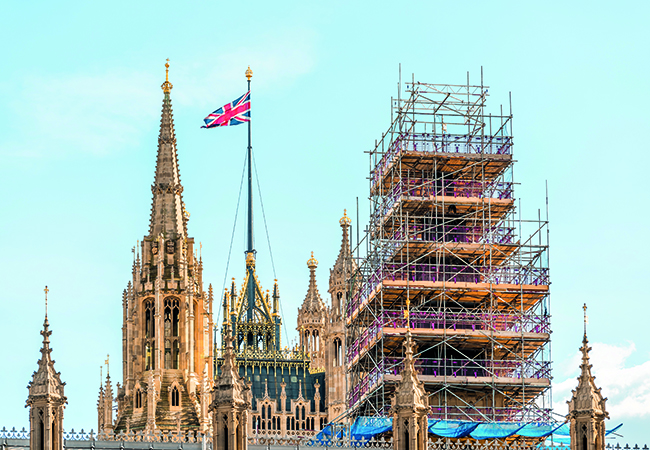
An ultimate test of the ‘restore vs retrofit’ dilemma, the ongoing work at the Houses of Parliament is tackling decades of decay by replacing services within one of the world’s most complex heritage sites
The recent renaming of the CIBSE Heritage and Retrofit Group (previously simply ‘Heritage’) highlights the zeitgeist to balance conservation principles with retrofit imperatives, stressing that interventions must deliver verifiable carbon savings while maintaining occupant health and comfort, and avoiding maladaptation.
LETI’s Climate Emergency Retrofit Guide2 further reinforces this, targeting 60-80% energy reductions in homes through deep, whole-house retrofits, with the core message being to improve the building fabric sufficiently to enable a switch to low carbon heating – such as heat pumps – thereby avoiding the lock-in of fossil fuel systems.
The energy efficiency hierarchy (as described by Historic England4) provides a high-level, structured methodology for this process, beginning with understanding the building’s context and eliminating waste, then moving to improving the efficiency of the fabric and services, and, finally, generating energy from low carbon and renewable sources
The integration of renewables is an important strategy for decarbonising building stock. Building integrated renewables (BIR) – such as solar photovoltaics (PV) and solar thermal collectors – support the move to electrified heating and reduce reliance on Grid energy. For modern commercial buildings, retrofitting focuses on achieving substantial energy and carbon reductions. Here, BIR solutions such as rooftop solar arrays, exterior wall-integrated photovoltaics and window-integrated photovoltaics can be considered to use building surfaces for energy generation. The decision is primarily driven by technical feasibility, the potential for significant energy savings and contribution to net zero targets. For historic buildings, decisions are governed by conservation principles. Changes must typically be reversible, use sympathetic materials, and minimise impact on historic fabric and character, often requiring statutory consent. The challenge is to integrate modern systems sympathetically. This may involve selecting less visually intrusive options such as roof-integrated PV or solar slates, or positioning panels on less prominent roof pitches. Here, performance benefits must be balanced with the primary goal of preserving heritage value. Retrofits must consider future climate projections. As weather patterns shift, heating and cooling demands will change, affecting the performance and optimal sizing of BIR systems. Integrating renewables
By reducing the building’s intrinsic energy demand first, the task of decarbonising the remaining load with onsite technologies becomes far more manageable and cost-effective.
This entire decision-making framework becomes more complex when dealing with historic and traditional buildings. For structures built before around 1919, which use different methods and materials than more recent buildings, a different approach is required. Retrofitting historic buildings requires a delicate balancing act between the need for energy efficiency and the imperative of preserving their heritage value and character.
The principle of minimal intervention is key – wherever possible, existing elements should be upgraded or reused rather than removed, and new installations must be reversible and unobtrusive. Measures appropriate for modern buildings can cause irreversible harm to historic fabric or conceal significant details. Any new equipment should be installed to minimise visual and fabric impact, perhaps by routing new services via existing voids or choosing compact systems that fit within existing plantrooms.
Understanding the building’s significance through a heritage impact assessment (HIA) is essential when proposing changes. A HIA is used to understand what makes a building historically significant and how proposed retrofits would impact that character (see Heritage Impact Assessment in Wales4 for further information on HIA). Compliance with Building Regulations, and local planning or listed-building consent is mandatory.
Energy performance assessments, such as EPCs, may offer only a partial picture for these buildings, and can suggest measures that are inappropriate5 for their construction or context.
The challenge is further compounded by future climate projections, which consistently indicate shifts in energy demand towards increased cooling loads. This is exacerbated by the urban heat island effect, and necessitates that HVAC systems are sized and configured for future conditions, not just current ones.
Increased insulation, if not balanced with effective ventilation and solar control, can worsen the risk of overheating, which is anticipated to rise significantly. Mitigation strategies – including effective shading, maintaining thermal inertia where possible, and purge night ventilation – become crucial.
The performance of renewable energy systems is also affected by temperature changes, and the integration of energy storage and load-shifting becomes increasingly important to manage the variability in generation and the fluctuating higher cooling-demand profiles.
While replacing old boilers with modern, high-efficiency condensing models offers an incremental improvement, a true shift towards decarbonisation involves adopting low carbon technologies. Heat pumps – whether air-, ground- or water-source – are a primary option.
Historically, their lower flow temperatures necessitated emitter upgrades, but the increasing availability of higher-temperature heat pumps simplifies integration with existing radiator systems. For a transitional approach – particularly in heritage contexts, where fabric upgrades are constrained – hybrid systems that pair a smaller heat pump with an existing boiler can provide a balance between upfront cost and carbon reduction, with the boiler retained for peak loads only.
Beyond individual building applications, heat pump technology enables the development of district and community heat networks. These can draw upon novel sources of ambient heat, including urban water bodies such as canals, or the significant waste heat from infrastructure, such as underground train systems, data centres, and other local buildings.
As buildings become more airtight through deliberate fabric improvements or incidental sealing of passive air paths, effective mechanical and passive ventilation strategies are essential to maintain indoor air quality and prevent moisture accumulation.
Mechanical ventilation with heat recovery (MVHR) systems facilitate air exchange while reclaiming sensible and latent heat from the exhaust stream, preserving internal conditions with minimal energy penalty. On the cooling side, significant energy and maintenance savings can be realised by replacing legacy chiller plant with high-efficiency options, such as oil-free, magnetic-bearing chillers, or integrating thermal storage to support peak shaving and load shifting.
Zonal comfort issues caused by poor air distribution or variable internal loads can be resolved through the deployment of decentralised fan-assisted terminals. One of the most straightforward and effective upgrades across air and hydronic systems is the retrofit of variable-speed drives (VSDs) to fans and pumps, enabling part-load modulation. Governed by the non-linear affinity laws, even modest reductions in speed can produce disproportionately large reductions in power consumption – often exceeding 50%.
However, across all environmental systems, the single most impactful opportunity for immediate energy savings can lay in the implementation of modern control strategies. Many legacy systems operate continuously or without coordination, resulting in avoidable energy use.
Retrofitting a modern building management system (BMS) can provide dynamic scheduling and demand-led operation, unlocking substantial efficiencies. Techniques such as demand-controlled ventilation – where airflow is modulated in response to occupancy or real-time CO₂ levels – can reduce fan energy and associated heating and cooling loads dramatically.
The strategic deployment of smart sensors, wireless nodes and adaptive algorithms, including heritage-sensitive settings, offers potential operational savings and can generate the data required for continuous commissioning and fault detection. Lighting retrofits – including LED upgrades, occupancy sensing, daylight dimming and time scheduling – can cut lighting energy consumption by 50-80%, while simultaneously reducing internal heat gains.
Similarly, domestic hot water (DHW) systems can be improved by insulating distribution pipework, decentralising services or transitioning to heat pump water heaters with improved seasonal performance factors. Careful consideration and implementation of metering and sub-metering will enable continuous optimisation and verification of energy savings.
System-level improvements are most effective when combined with upgrades to the building envelope. Measures such as insulating walls, roofs and floors can reduce heating and cooling loads significantly, but must be carefully designed to prevent thermal bridging and moisture issues – especially in heritage buildings.
Any amendments to the existing structure, whether involving insulation or not, require appropriate hygrothermal modelling and effective vapour control to manage condensation risks and protect the building fabric.
Further gains in thermal performance and airtightness can be achieved through window upgrades, such as secondary glazing or high-performance alternatives.
When implemented as part of an integrated strategy, these measures reduce operational carbon, enhance comfort and help extend the life of existing building services. Poorly designed retrofits, however, can introduce problems such as overheating, damp and mould. Understanding the hygrothermal behaviour of building materials is essential for mitigating these risks.
The initial investment for comprehensive retrofits can be high, and while they can offer long-term savings on energy bills, the payback period for certain measures can be lengthy. Government incentive schemes intended to bridge this financial gap have often been criticised for being complicated and short-term, as well as failing to reach all who could benefit.
To ensure quality and provide a structured approach to managing risk, the industry is developing robust standards, such as the BSI Retrofit Standards Framework,6 which already includes PAS 2035 for domestic projects and PAS 2038 for non-domestic applications. These standards, which are more fully described in the boxout ‘The PAS Retrofit Standards Framework’, mandate a rigorous end-to-end process of assessment, design, installation and evaluation, overseen by qualified professionals.
The PAS Retrofit Standards Framework
PAS 2035:2023 for domestic buildings and PAS 2038:2021 for non-domestic buildings provide a structured approach to managing risks and ensuring high-quality energy efficiency retrofits. These standards establish a detailed, end-to-end process encompassing assessment, design, installation and evaluation, helping to professionalise retrofit. Retrofit coordinators oversee domestic projects, while retrofit lead professionals manage non-domestic ones, ensuring compliance and mitigating risks.
The standards include the explicit requirement to assess the heritage significance of older and traditional buildings, ensuring that energy efficiency improvements align with conservation principles and do not compromise architectural integrity. The whole-building approach advocated by PAS 2035 and PAS 2038 acknowledges the complex interplay between retrofit measures, aiming to prevent common failures such as moisture damage and indoor air quality issues.
These standards were developed in response to widespread concerns over poor-quality retrofit work, including issues such as mould growth, inadequate ventilation and suboptimal thermal performance. Given the inherent risks of retrofit projects, PAS 2035 and PAS 2038 emphasise the necessity of trained professionals with expertise in building physics and risk management.
By introducing comprehensive assessments, structured design processes, robust installation protocols and post-completion evaluation, they address previous shortcomings associated with fragmented, measures-based approaches that often led to substandard results.
While PAS 2035 is not legally mandated, compliance is required for government-funded schemes such as the Energy Company Obligation8 and the Warm Homes: Social Housing Fund Wave 3.9 Adoption is also encouraged for privately financed retrofits. The standards serve as part of a broader sustainability framework that supports the UK’s net zero carbon ambitions and ensures that environmental, social and economic considerations are fully embedded into the retrofit process.
However, even with robust standards, a project’s success ultimately depends on the people involved. A significant barrier to scaling up retrofit is the shortage of skilled technicians and engineers with the specific knowledge of building physics and new technologies that this work requires.
Simultaneously, many building owners and occupants lack awareness of the benefits of retrofit or where to access impartial advice, making trust and clear communication essential. Studies suggest that community-based approaches can be more effective than relying solely on financial incentives for fostering consumer confidence.
Guiding project decisions relies on a robust analytical workflow. Modelling tools such as dynamic thermal simulation, which are increasingly enhanced through artificial intelligence (AI), provide the predictive baseline for retrofit strategies. This baseline must then be validated by post-retrofit performance monitoring to quantify real-world savings and to close the well-documented performance gap.
This empirical data informs life-cycle cost analysis and multi-objective optimisation, allowing for the identification of cost-optimal solutions that balance competing project objectives such as capital cost, operational efficiency and occupant comfort. In practice, the choice is rarely between a full restoration or a complete replacement, as hybrid approaches are often most effective.
This strategy involves retaining serviceable infrastructure, such as ductwork and piping, while upgrading key components such as fans, controls and heat emitters. An existing ventilation system, for instance, could potentially be brought to near-modern standards by replacing its fans and adding a heat-recovery section within the original casings.
Such a pragmatic approach aims to deliver a technically and financially viable solution that achieves significant energy savings without compromising the building’s functional or heritage requirements. Increasingly, a holistic assessment, completed by applying methodologies such as CIBSE TM657 to evaluate the embodied carbon of specified systems and materials, ensures the building’s whole life environmental performance is properly accounted for.
Upgrading the building services within the existing building stock is a key undertaking for reducing energy consumption and achieving net zero emissions. This requires a departure from traditional, measures-based approaches towards a comprehensive whole-building perspective. While the potential benefits are substantial, significant challenges must be addressed.
These include managing technical risks, navigating the complexities of historic buildings, overcoming high initial costs, addressing the critical skills gap, and ensuring that effective policy frameworks and quality standards are applied consistently.
Future efforts must focus on simplifying access to advice, strengthening the workforce through training and accreditation, and evolving standards and policies continuously to facilitate safe, effective and climate-resilient retrofits at the scale required.
Retrofitting is key
This article marks over a quarter century of CIBSE Journal CPD contributions, and choice of topic is deliberate. Retrofitting our existing building stock is an urgent global challenge, explored here through a UK lens.
Researching each of my 250-plus articles has been a valuable education, and my hope is that readers are inspired not only to deepen their understanding, but also to share that knowledge. Mentoring and supporting others – especially those entering the building services profession – is essential if we are to grow a technically capable, thoughtful and forward-looking engineering community. The CPD series will continue, but additional authors will bring fresh perspectives to the challenges ahead.
Tim Dwyer (tim@timdwyer.com)
© Tim Dwyer 2025.
References:
1 Davis, M et al, Towards a relational sociology of retrofit, Sociology, 59(3), 466-484 – bit.ly/CJSep25CPD1.
2 LETI Climate Emergency Retrofit Guide, LETI, 2021 – bit.ly/CJSep25CPD3.
3 Course handbook: Level 3 award in energy efficiency measures for older and traditional buildings, Historic England, 2025 – bit.ly/CJSep25CPD4.
4 Heritage Impact Assessment in Wales, Cadw, 2017 – bit.ly/CJSep25CPD5.
5 bit.ly/CJSep25CPD10 – accessed 22 June 2025.
6 Rickaby, P, The importance of standards for safe energy retrofit – A BSI white paper, BSI 2023 bit.ly/CJSep25CPD6.
7 CIBSE TM65: Embodied carbon in building services: A calculation methodology, CIBSE 2021 –
bit.ly/CJSep25CPD7.
8 Energy Company Obligation – bit.ly/CJSep25CPD8 – accessed 1 June 2025.
9 Warm homes social housing fund: Wave 3 – bit.ly/CJSep25CPD9 – accessed 1 June 2025.
Further reading:
- Course Handbook: Level 3 award in energy efficiency measures for older and traditional buildings, Historic England, 2024.
- Nearly-zero energy buildings – retrofitting to meet the standard, CIBSE Research Insight 3, 2020 .
- Refurbishment for improved energy efficiency: an overview, CIBSE KS12:2008.
- Design for future climate: case studies, CIBSE TM55:2014.
- Retrofitting homes for net zero, UK Parliament Energy Security and Net Zero Committee 2025.
- Fylan, F and Glew, D, Barriers to domestic retrofit quality: Are failures in retrofit standards a failure of retrofit standards?, Indoor and Built Environment 2022, Vol. 31(3) DOI: 10.1177/ 1420326X211027197.