
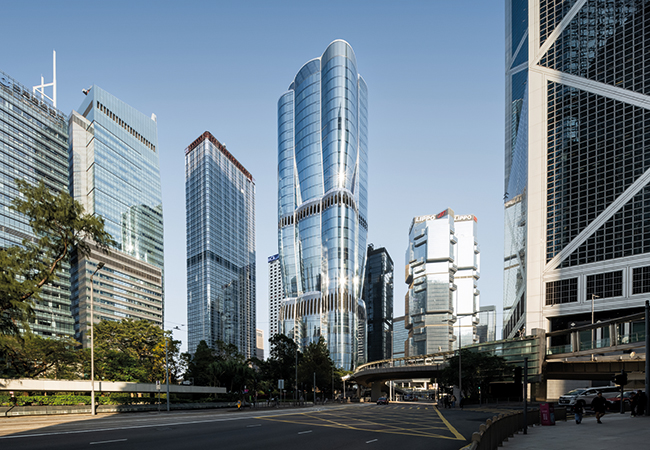
‘No-one tells you how to lead the market. You have to somehow understand what people are thinking and design something that will exceed their expectations – that is what drives us to think differently,’ says Kevin Ng, project-in-charge and senior deputy general manager at Henderson Land Development.
Project team
Developer: Henderson Land Development Co
Design architect: Zaha Hadid Architects
Lead architect: Ronald Lu & Partners
MEP & BIM consultant: WSP
Sustainability and IT consultant: Arup
Glass façade consultant: Eckersley O’Callaghan
Façade lighting consultant: Speirs Major
Main contractor: Hip Hing Construction
Ng was talking about The Henderson, the developer’s latest office tower, which has recently opened in one of the most prestigious locations in Hong Kong. Designed by Zaha Hadid Architects, the tower takes inspiration from the Bauhinia flower, Hong Kong’s official symbol. The 36-storey building stands out with its distinctive silvered, curved, glass façade, which gives it a sleek, futuristic look, almost like three clusters of silver petals stacked on top of each other.
Each cluster creates a visual pinch point in the structure: at the base, where it hovers above the city’s walkways; midway up, around the hidden plantroom floors; and just above the sky garden and refuge area. The top of the tower features a glass-roofed banqueting and event space, which won Project of the Year – Innovation at the 2025 SFE Façade Awards.
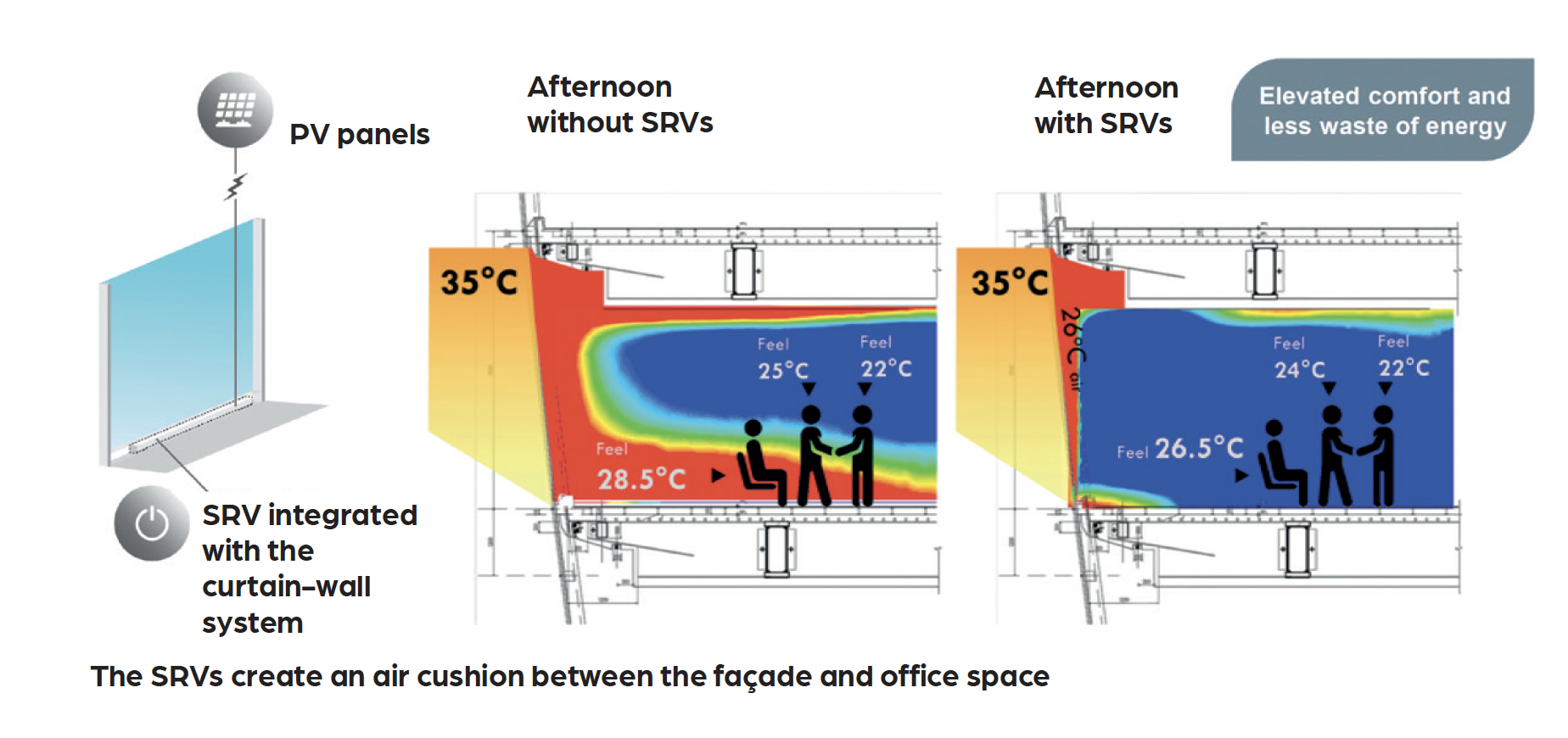
The SRVs create an air cushion between the façade and office space
To ensure The Henderson exceeded market expectations, Henderson Land Development worked with MEP engineers WSP and sustainability and IT consultants Arup. The result? A building packed with innovations, including the world’s first AI-powered elevator control system (see panel, ‘How AI optimises lift operation’) and patented solar-responsive ventilators (SRVs). It also launched a new environmental, social and governance partnership model with tenants, to boost the building’s sustainability impact (see panel, ‘Empowering occupants’).
Empowering occupants
The impact of user behaviour on operational carbon emissions can be significant. At the design stage of this scheme, the project team set out to harness data-driven digital technologies to make workplaces more sustainable.
An app enables employees and tenants to control workplace systems such as window opening, window blinds and room temperature. The expectation is that giving tenants control will lead to a reduction in carbon emissions in response to the outdoor climatic condition.
Occupants have reacted positively to enhanced user controllability features. ‘This demonstrates that empowering users with direct control over their office environment encourages more sustainability-conscious engagement with the building’s tenant-orientated digital ecosystem,’ says Edward Chan, head of the green building sub-committee at Henderson Land Development.
The smart app gives users a contactless journey from street to floor. Multiple access methods allow users to pass through turnstiles and security checkpoints without having to touch surfaces. This includes novel multipoint contactless technology developed for The Henderson. The app enables automatic lift calling, floor selection and designated floor assignment.
It is amalgamated with the digital twin and the integrated tenant experience analytic platform, which tracks and analyses tenant journeys throughout the building, and facilitates analysis of ESG-related data to share with tenants.
The Henderson launched the industry-first partnership programme in Hong Kong, a three-way collaboration that engages corporate tenants and individual users in pursuing ambitious and data-driven sustainability goals.
Participants earn sustainability credits by engaging across four key pillars: carbon neutrality; health and wellbeing; partnership for good; and integrated culture. These credits are redeemable for a range of benefits.
To support tenants on their carbon-neutrality journey, analysis from The Henderson’s digital twin provides energy, water and waste performance data for ESG reporting and global sustainability benchmarking.
The tower’s tight footprint, bold curves and glass façade made the engineering particularly complex (see panel, ‘Typhoon-proof façades’). With the core placed on the eastern side to open up panoramic views, WSP had to carefully plan where plantrooms would go and how services would be routed, while keeping ceiling heights generous.
OpenBIM and construction digitalisation played a big role in making it all fit. On office floors, for example, WSP managed to maintain a spacious 3.5m-clear headroom, even though the total slab-to-slab height is just 5m.
Typhoon-proof façades
The design team implemented elevated performance criteria for wind and water resistance to ensure long-term durability and occupant safety in the face of future extreme weather events.
Localised design wind loadings were derived from wind-tunnel testing, tailored to the building’s unique geometry and urban context.
For wind-pressure testing, the design applied an amplification factor of 1.75, exceeding the typical industry standard of 1.4, to ensure robustness under extreme wind conditions. A missile-impact test was also conducted, simulating debris strikes during typhoons.
The results confirmed that the glass remained intact within the frame, demonstrating the façade’s ability to withstand impacts even under Typhoon Signal No 10 conditions (winds of more than 118kmh and gusts of more than 220kmh).
The fully-glazed façade is formed using double-laminated, curved, insulated glass units. These four-ply units have a double-laminated outboard glazed pane incorporating solar and low-E coatings, and another double-laminated inner pane with anti-reflective coatings.
The thermal performance of the façade outperforms the overall thermal transfer value of the building envelope, as required by the Hong Kong Buildings Department.
Office floors are ventilated using what Thomas Chan, WSP executive director, building services, property & buildings, calls ‘a hybrid ventilation system’ that ‘seamlessly integrates cooling with natural ventilation, enhancing both energy efficiency and occupant comfort’.
In downtown Hong Kong, external temperatures range from 7°C to 35°C, with humidity hovering at more than 66% during the summer. The HVAC system is designed to enhance climate resilience, with the chiller plant capable of meeting 100% cooling demand even when outdoor temperatures reach 37°C.
Automatic operable windows on office floors enable natural ventilation during periods of favourable weather. Helping manage this system is an onsite weather totem accommodating weather stations that track local weather and air quality, including PM10, PM2.5, ozone, wind speed, temperature, humidity, rainfall and noise.
Weather and BMS data are fed into the digital twin, and an algorithm developed by the project team informs the occupants of the favourable period for hybrid ventilation. An app allows individuals to control the variable air volume (VAV) operation, motorised solar blinds and window actuators. For the rest of the year, mechanical ventilation delivers fresh air at 12 L·s-1 per person to office floors, based on an occupancy density of one person per 9m² of floor area, outperforming the excellent class of the local IAQ standard.
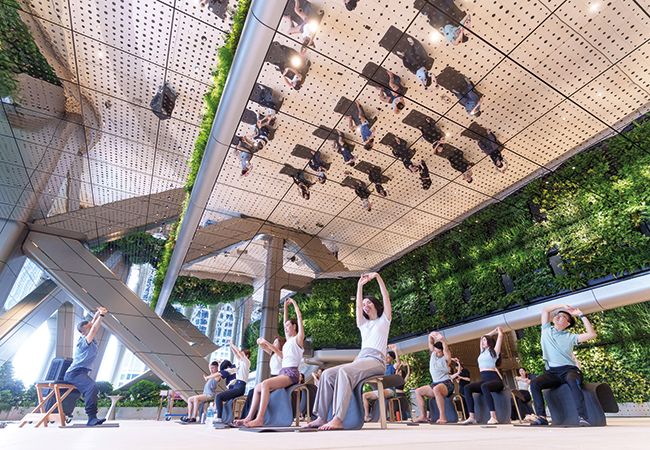
The Henderson has a distinctly futuristic look, inside and out
Air conditioning is demand controlled via VAV boxes, to minimise unnecessary cooling and fan power during partial-load conditions. Conditioned air is supplied through ceiling diffusers and drawn back via a dedicated ducted return system, ensuring optimal air quality.
To tackle the possible discomfort for those sitting behind the west-facing façade, Arup and the developer came up with a project-specific patented ventilation solution, the ‘solar-responsive ventilator’. The device boosts office ventilation and creates dedicated air circulation in the form of an air cushion, to reshape airflow within the office perimeter zone.
The units’ low-speed DC fans are powered from a 230m2 walkable photovoltaic (PV) array on top of the building and are controlled via a combination of solar sensors and real-time data from the building’s local weather station.
Multizone AHU system on one floor
The power supply system is designed with two independent substations and dual busducts, ensuring uninterrupted electricity supply. Emergency and mobile generators are provided as backup sources. This configuration achieves an exceptionally high level of reliability — more than 99.9999% — which supports the resilience requirements of a super-Grade A office.
The circadian lighting control system is engineered to promote occupant wellbeing and enhance workplace performance. Using timer-based controls, the system adjusts colour temperature and light intensity to simulate natural daylight patterns. This helps regulate the human circadian rhythm, thereby improving motivation, creativity and productivity.
Each office floor is split into four zones, each served by its own air handling unit (AHU) to allow precise comfort control (perimeter north, perimeter south, inner north and inner south). This multi-AHU configuration also ensures that, in the event of an AHU failure, the remaining units can deliver up to 90% of the total cooling load to maintain occupant comfort, provide system resilience and allow for future adaptability.
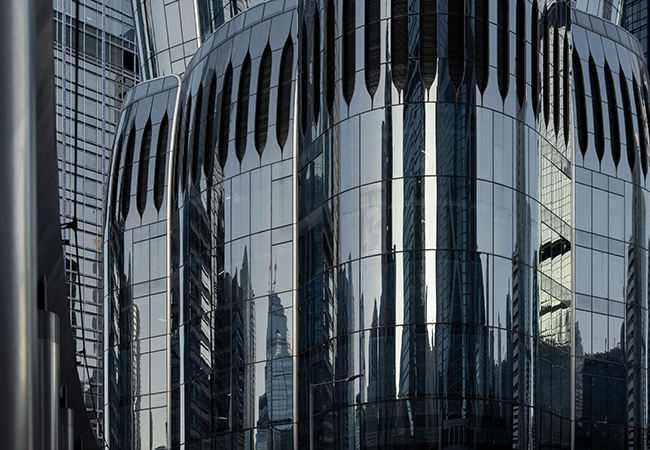
The curved, insulated glass of the façade has solar and low-E coatings on the outside, and anti-reflective coatings on the inside
The air in The Henderson is treated to a very high standard. Each AHU incorporates a MERV 13 pre-filter, a carbon filter, photocatalytic oxidation and a UV lamp. In addition to the central air purification in the AHUs, purification units incorporating UV disinfection are integrated into ceilings to neutralise airborne pathogens.
To minimise the energy needed for cooling humid outside air for the banqueting hall, the building incorporates a liquid-desiccant system. This circulates a desiccant solution to remove moisture from the air to reduce latent heat loads before the air is mechanically cooled. This eliminates the need to overcool the air to dehumidify it, reducing energy use significantly.
How AI optimises lift operation
WSP has designed an AI-based system to optimise The Henderson’s sophisticated arrangement of lifts. It works in addition to the standard destination control system, and aims to assign vacant lift cars and prevent unnecessary stops by overcrowded lifts.
The building has 12 passenger lifts to serve the office floors: six serve the low zone (ground floor to level 25) and six the high zone (levels 26 to 38). There are two dedicated lifts for the banqueting floor (level 39), which is also served by four high-zone lifts that enable large numbers of guests to exit the building speedily.
The system caters for passengers who follow others into a lift car without first making a hall call, which can lead to inefficient stops and delays. The system uses video analytics and AI technology to count the number of passengers inside the car and the lift lobbies. When this exceeds a predefined headcount threshold, the system sends a signal to the lift controller to bypass hall calls for the overcrowded lift. It then reassigns these calls to less crowded lifts.
The system also uses AI-powered tracking to monitor people movement within the lift lobby on typical floors. When a passenger is detected, but no hall call registration is made within a predetermined time interval, the system signals to the elevator controller to initiate an automatic hall call registration on behalf of the passenger and ensure efficient lift car dispatching.
‘This intelligent automation enhances lift responsiveness, particularly during high-traffic periods, and ensures that all passengers are accounted for – even when they don’t actively interact with the call buttons,’ says Andy Chan, head of E&M division at Henderson Land Development.
The lift cars also incorporate air sterilisation. The patented system developed for the project uses UV-C disinfection, air filters and IAQ sensors to sanitise the cabin.
Unlike other Grade A offices, The Henderson has return air ducts, rather than using false ceiling voids as the air return plenum. This improves room-to-room acoustics and air quality.
A central chiller plant provides cooling to the AHUs, primary air units and fan coil units. This is located in the double-height mechanical plantroom on levels 10 and 11, freeing up roofspace for a garden overlooking Hong Kong’s Central Business District. To address global warming risks and maintenance concerns, the central chiller plant comprises eight variable-speed drive, high efficiency air-cooled screw chillers with a cooling capacity of 967kW. By combining chiller plant optimisation with machine learning, operation patterns can be uncovered and optimised, leading to energy savings. The use of air-cooled chillers also eliminates the risk of legionella associated with water-cooled systems.
The Henderson’s occupants can use an app for contactless movement from the street to their workspace
The chilled-water system is resilient and can maintain 100% cooling capacity, even with two chillers offline or when outdoor temperatures rise to 37°C. To ensure cooling is available during power cuts, one chiller is designated as ‘essential’ and is backed up by an emergency generator. When power is restored, the system is designed to support a rapid restart within a minute.
To capture rainfall and reduce water consumption, The Henderson incorporates 35m3 of rainwater-harvesting tanks for irrigation. Condensate drain water collected from the air conditioning is used for the water-mist system, which can cool down the air-cooled chillers.
Since opening in 2024, The Henderson has earned an impressive array of certifications including: Well and Leed Platinum Pre-certifications; and China Smart Building Label and China Healthy Building Design Label. It has Platinum status for digital infrastructure (WiredScore) and intelligence (SmartScore), and with dual Platinum ratings in active travel (ActiveScore) and transport (ModeScore), The Henderson is setting a new benchmark for world-class connectivity and green travel.