
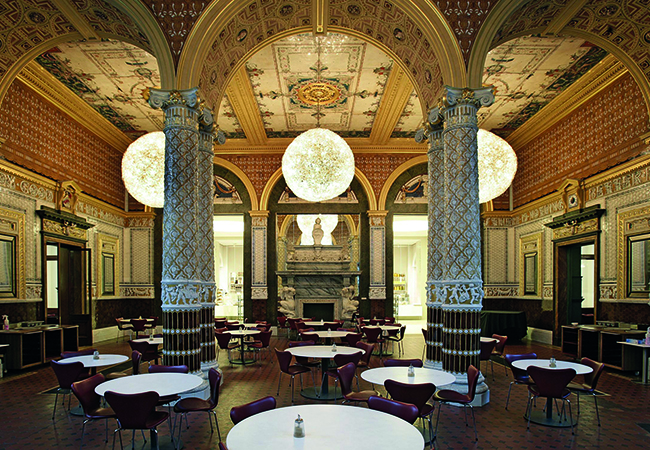
The V&A Cafe, the world’s oldest museum restaurant
When building services engineers talk about retrofit, the focus is typically on improving performance – upgrading the fabric, plant, lighting and controls to reduce carbon emissions. But what if they are not the principal measures by which people who use and operate a building judge whether a retrofit has been successful?
Research by UCL’s India Golding, with the V&A Museum in South Kensington, London, aimed to establish what retrofit success means for a museum. She interviewed more than 30 stakeholders – working in estates, projects, conservation, curatorial teams, design, security, visitor experience and senior management – to understand what they expect a retrofit to deliver.
While energy and carbon were important, they sat alongside other factors, such as protecting the museum’s collections and historic fabric, the visitor experience, and accessibility. Engineers cannot, therefore, assume the main objective is to minimise energy use. The first question may instead be: what conditions does this museum actually need to provide and for whom – or what? This is particularly important when existing building services plant reaches the end of its life.
One participant described the replacement of chillers serving existing galleries. New equipment was selected to satisfy the existing cooling demand. Essentially, the old machine was replaced by a newer machine capable of providing the same service. This is understandable, because museums cannot allow environmental conditions protecting valuable collections to deteriorate while engineers experiment with alternative strategies.
However, should replacement plant automatically reproduce the conditions and loads inherited from existing installations, or is it an opportunity to reconsider what is required?
Conventional building services measures – such as energy efficiency, carbon reduction and regulatory compliance – were most frequently raised by those responsible for measuring and reporting them. Other stakeholders judged projects differently. A curator may be concerned with presentation and access to a collection; a conservator may focus on environmental stability; and estates teams must keep ageing, often complex buildings operating reliably.
None of these objectives is wrong; the challenge is reconciling them. Changes to humidity or temperature limits to save energy must not be at the expense of acceptable environments for collections and occupants. Early engagement with those responsible for these should be part of the design process.
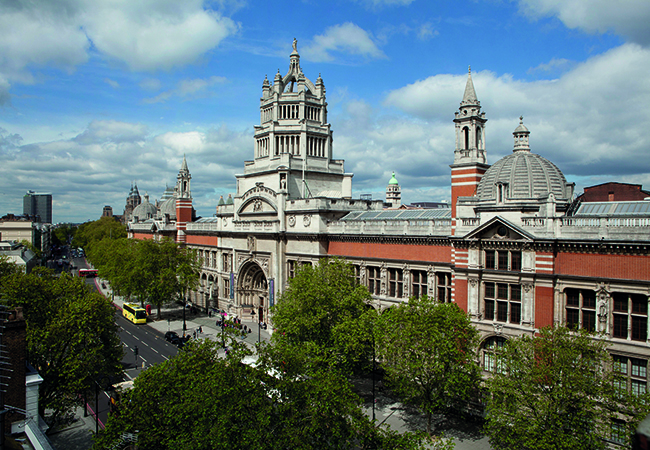
The V&A Museum in South Kensington
Should we replace the plant at all?
Whole life carbon was not explicitly raised by those interviewed, but tended to emerge indirectly through discussion of the consequences of installing new equipment. As one participant put it: ‘It’s quite interesting that we think about installing new plant to save energy. There’s something counterintuitive about the fact that we are manufacturing a new thing to save on energy.’ This is an important observation.
For fossil-fuel retrofits, operational carbon savings can rapidly outweigh the embodied impact of new plant – but that balance becomes less clear as buildings and systems decarbonise. As operational carbon falls, embodied carbon associated with manufacturing, transporting and installing new plant becomes proportionately more significant, so replacing a heat pump with a slightly more efficient one is problematic
Increasingly, the decision may become not simply ‘what is the most efficient replacement?’, but ‘does this equipment need replacing yet?’ Extending plant life, modifying controls or reconsidering environmental requirements might sometimes prove a better whole life intervention.
Museum plant is expected to last for many years, while operating conditions change over time. That means considering future climate conditions, changing energy supplies and potentially changing patterns of museum use. Simply replacing existing equipment according to historically measured demand risks locking today’s assumptions into another generation of building services. Conversely, designing for every conceivable future extreme risks oversized plant and unnecessary embodied impact.
A broader measure of retrofit
Golding intends to develop criteria for evaluating museum retrofit that capture environmental, economic, social and cultural value. Judging by her research, successful retrofit may be less about making a building conform to a predetermined definition of low-energy performance and more about understanding which services need to be provided – and finding the lowest-impact way of providing them.
Do museums need fixed environmental conditions?
There is an interesting parallel between Golding’s research and changing thinking on thermal comfort and collection care.
CIBSE TM52 The limits of thermal comfort: avoiding overheating established an adaptive approach to assessing overheating, moving from reliance on a single, fixed temperature. This approach, reflected in CIBSE Guide A, recognises that temperatures people find uncomfortable change with outdoor conditions.
Conservation thinking has become less prescriptive. BS EN 16893:2018 provides the standard for buildings and rooms used for heritage collections, while the joint Declaration on Environmental Guidelines from the International Institute for Conservation of Historic and Artistic Works and International Council of Museums – Committee for Conservation supports a more flexible and sustainable approach to environmental control.
It recognises that specifications should take account of needs of collections, the building and the local climate, and that collection care should not automatically assume air conditioning. Passive and lower-energy approaches should also be considered.
This direction has been reinforced by the Bizot Green Protocol, formally adopted by the Bizot Group at Museum COP in 2023. For many classes of hygroscopic objects, the evolved guidelines indicate temperatures of 16-25°C and 40-60% relative humidity, while recognising that more sensitive objects may require tighter control.
Neither people nor artefacts necessarily require a single, tightly controlled environmental condition. Establishing the conditions needed, and where, before determining the systems required to maintain them could provide significant opportunities when retrofitting museums.