
‘Five stars is excellent, but that’s just the starting point for us. We see this building as having a lot more to give,’ says Brad McHale, principal mechanical engineer at Arup. McHale is talking about the speculative office building 11&12 Wellington Place, Leeds, which has made history by becoming the first new building in the UK to achieve a NABERS UK 5* Energy Rating.
Project team
Client: Federated Hermes MEPC
Architect: TP Bennett
MEP engineer & NABERS consultant: Arup
Main contractor: Wates
Breeam: Mainer Associates
Project manager and quantity surveyor: Gardiner and Theobald
Structural engineer: Curtins
‘There’s been a big monitoring piece during the NABERS’ UK reporting period, which has given us access to lots of data from within the building. It also means we have lots of opportunity to further optimise its operation,’ McHale adds.
NABERS UK is an adaptation of the highly successful rating programme NABERS that operates in Australia. Administered by CIBSE in the UK, NABERS UK Design for Performance (DfP) provides a rating, from one to six stars, for new-build offices, with six stars classed as ‘world leading’. Unlike design-based energy ratings, NABERS UK measures and rates the energy use of offices in operation – requiring ongoing monitoring, validation and improvement – resulting in long-term energy savings and carbon reductions. This makes it much more accurate than an Energy Performance Certificate as a guide to a building’s energy performance. As McHale explains, it also helps identify areas for savings and improvements to minimise the gap between a building’s design intent and its actual operational energy use.
Office 11&12 is part of the Wellington Place estate, a mixed-use development of 15 plots of office, leisure and retail space by developer MEPC/Federated Hermes, located close to Leeds railway station. It was conceived as two separate buildings, each comprising a steel frame, a rigid concrete core and composite concrete floor decks. As their design evolved, however, a glazed link was added to the fourth floor and to the floors above, to create larger floor plates on the upper levels. The building services still serve the blocks individually to allow floors to be sub-divided for letting.
Arup has been involved with the Wellington Place Estate from the outset, having been appointed to provide MEP services to 11&12. Alex Price, associate at Arup, says the consultancy’s initial MEP scheme, designed before the Covid-19 pandemic, was ‘typically based on a 4-pipe fan coil unit [FCU] system served by a gas-fired boiler and electric chillers’.
Post-pandemic, NABERS UK had just been launched and the developer made the decision to commit to achieving a 5-star NABERS UK energy rating for the scheme’s base build, to help future-proof its investment. Arup’s role was duly increased to include ‘NABERS UK consultant’. To achieve the 5-star target, there had to be a significant reduction in the scheme’s operational energy demand and its reliance on fossil fuels had to end.

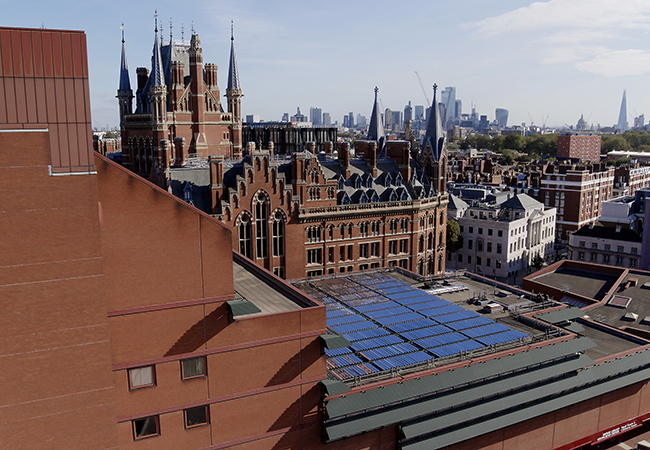
PVs and plant on the rooftops of 11&12 Wellington Place
Fundamental to the NABERS’ rating process are detailed energy models and simulations to demonstrate to independent assessors that the proposed design is capable of achieving the 5-star energy target in operation.
The building had already received planning approval and the Cat A services design was under way, so any enhancements had to be achieved without significant changes to the form or appearance of the 21,200m2 blocks.
‘We had to work very closely with [contractor] Wates to establish the exact equipment their supply chain was proposing to use to develop our model,’ explains Price. ‘We also had to establish the control strategy, operating temperatures, and how the BMS was going to be set up so that we could run the model and work out where improvements had to be made to ensure the building would achieve 5 stars.’
Enhancing the existing design was a challenge, especially as Arup had to build in a buffer for when the design was reviewed. ‘With 11&12, we were already at work-stage four, so we knew what systems were going in and there was limited impact we could make to the overall services strategy,’ adds Price. ‘We aimed for 5.5-stars with our model, knowing there is a buffer for variations in the building’s real-life operation.’
‘Five stars is the starting point for us’ – Brad McHale
Having such a detailed energy model enabled Arup to quickly review the impact of proposed changes to the building envelope and services design. For example, it was clear that the thermal performance of the building’s envelope would need to be enhanced.
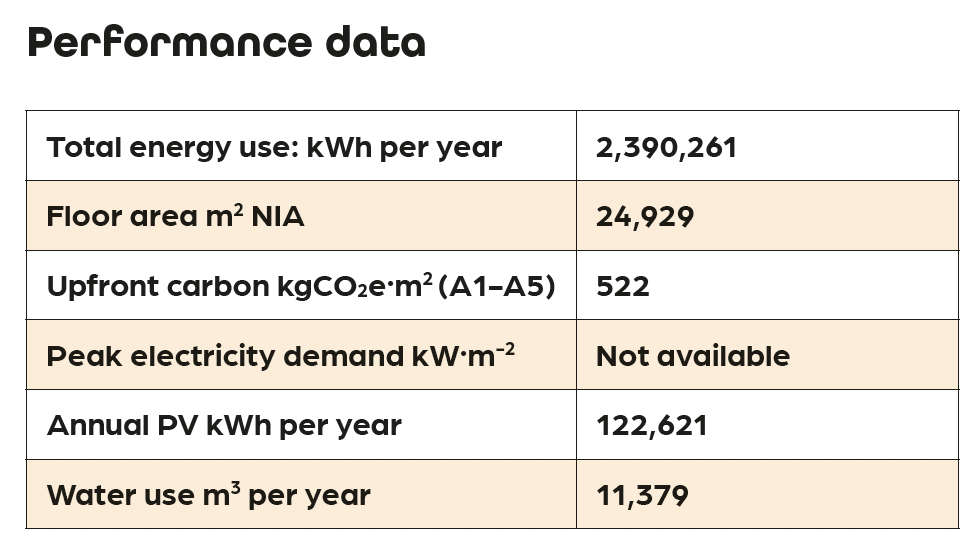
The model showed this could be achieved by upgrading the full-height, double-glazed units to high-performance triple-glazed units, without changing the building’s appearance. In addition, the area of roof-mounted solar photovoltaic (PV) panels was increased from 500m2 to 700m2 to generate additional electrical power.
The gas-fired boilers were replaced with two roof-mounted Daikin 4-pipe air source heat pumps (ASHPs), each sized for 66% of total load. Each of the R134a units contains two, separate refrigerant circuits with an inverter-driven compressor on each. There is a cold heat exchanger/evaporator, capable of supplying 794kW of cooling at 13/7oC (at 35oC ambient) and a hot heat exchanger/condenser supplying 632kW of heat at 45/50oC (at -4oC ambient).
The ASHPs are capable of heat recovery from the cooling circuit when supplying both heating and cooling.
From the rooftop, the heating and cooling pipework drops down a riser in the central core of each block to serve ceiling-mounted 4-pipe FCUs on the office floors.
Arup’s energy model of its proposed design was assessed by an independent design reviewer (IDR), which, in this case, was Buro Happold. The assessor reviewed the scheme and made recommendations for how the design could be enhanced. ‘We went through the feedback, some of which we were able to take on board, some we were not because of project and programme constraints,’ says Price.
Once the design was finalised, the IDR’s report was submitted to a NABERs-accredited assessor, who confirmed the design’s ability to achieve the targeted energy performance once the building was occupied and operational. It was then awarded a Design Reviewed Target Rating of 5 stars so construction could begin.
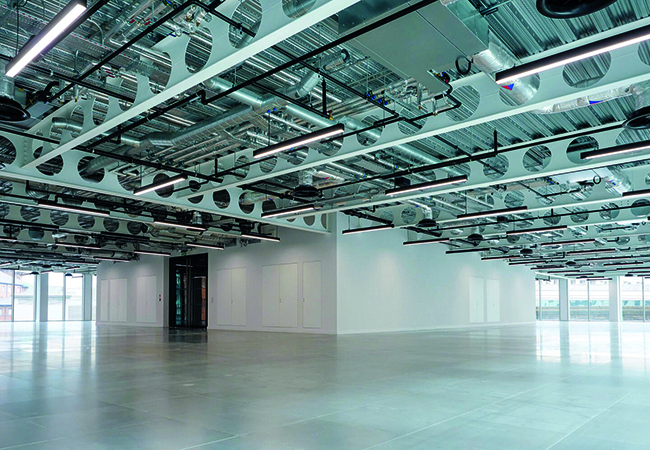
Heating and cooling is provided through ceiling-mounted 4-pipe FCUs
The blocks’ construction was completed in March 2023. For NABERS in-use energy consumption to start, the building has to be 75% occupied by tenants. It is down to individual tenants how they fit out and operate their floors, so Arup provided guidance to ensure tenants keep within strict design limits. It was not long before the building was fully let, including to Arup, which moved into the building in 2024.
Once all the tenants were in situ, the NABERS Energy process began. The team had just 12 months to optimise the building’s operation to substantiate that it was performing in line with the energy model so it could be awarded a 5-star performance rating.
Every week, building manager CBRE and controls specialist NG Bailey review the metered data and compare the readings with those projected in Arup’s energy model (see panel, ‘The benefit of energy monitoring’). ‘We have a monthly meeting with them to see where we can make improvements,’ says Price.
The benefit of energy monitoring
By David Freestone, director at CBRE Leeds Office, and Connor Mann, assistant building manager
As property managers, CBRE implemented a proactive, data-driven strategy during the NABERS UK energy monitoring and operational assessment period. While the extensive metering initially presented some challenges, it became a key advantage – helping detect and resolve performance anomalies quickly through weekly review meetings with the energy team at NG Bailey.
Collaboration with occupiers ensured that tenant fit-outs and operational adjustments were managed without compromising data integrity. We set clear parameters within the BMS, limiting occupier control of environmental settings and requiring formal change requests. This provided traceable evidence for all adjustments and maintained a consistent monitoring baseline. Regular engagement with occupiers reinforced awareness of the importance of stable energy performance to support the shared goal of achieving the NABERS UK rating.
Control and strategy optimisations included correcting circuits misallocated during fit-outs, resolving 24/7 FCU operation and implementing an air source heat pump (ASHP) lead/lag strategy (cutting usage by 21.8%), and using an optimised ASHP schedule (reducing energy by 40.9%).
Aligning interlocked optimiser start times with plant availability further reduced consumption. Overall, the monitoring period strengthened operational control, enhanced transparency and delivered efficiency gains, establishing a firm foundation for performance improvement. The IDR rating review process helped ensure tools and metering were in place to enhance management capabilities, and the accreditation process assisted collaboration across energy management strategies.
The biggest step-change with NABERS, according to McHale, is that you have to be ‘much more tuned into’ the system controls.
‘In the past, as long as the fan coil units were delivering the required heating and cooling output, you could argue that the system was functioning correctly. For NABERs, the system had to function correctly and we had to work out how to maximise its energy efficiency to help meet the performance standard,’ he says.
As a tenant, Arup is also assessing how the building’s performance could be further optimised. ‘Moving onto levels three and four of the building is a massive opportunity for learning,’ says McHale. ‘We’ve done an internal study of our demise and we have a lot of optimisation suggestions that we want to share with the landlord, which could be applied building-wide.’
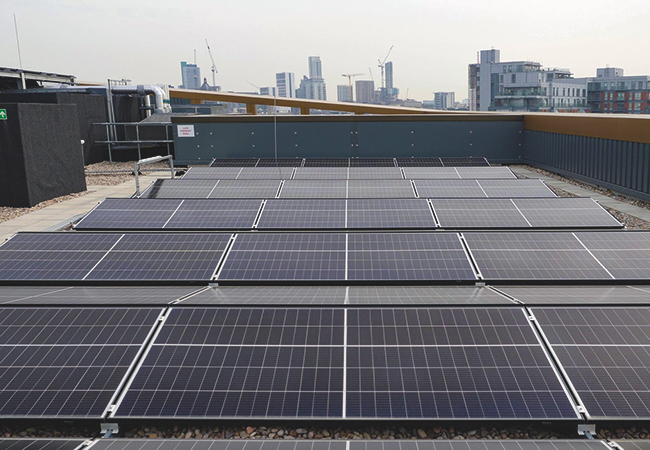
The area of roof-mounted solar PV was increased to generate additional electrical power
With the building services operation optimised, Hoare Lea verified its energy performance as part of the NABERS UK certification process. In September 2025, the scheme was awarded a 5-star NABERS Energy rating for in-use energy consumption after 12 months occupancy. Impressively, it also achieved Breeam Outstanding and a Fitwel level 2 rating. (Fitwel is a US developed building certification system that focuses on health and wellbeing.)
The 5-star energy rating demonstrates that the building is performing as intended, but the team is aiming higher. ‘CBRE and NG Bailey want to see further improvements,’ says McHale.
‘They did most of the work to optimise its performance, but we were involved in conversations with them about where further efficiencies could be made and those conversations are continuing.’ McHale is considering how the heating and cooling systems could be further optimised: ‘We now understand what that peak-load occurrence looks like on the heating system, which should allow us to shave a couple of degrees off the top end of the heating system [flow temperature] to improve the efficiency of the heat pumps.’
The team is looking at the chilled water flow and return temperatures. Currently, these are set at 7oC flow/14oC return. ‘It might be possible to optimise this system by increasing the chilled water temperatures and still be able to meet peak building-load requirements,’ McHale says.
Another option being assessed is the fresh air supply and its potential to provide passive cooling. ‘We have a fresh air supply from the air handling units that supplies at a fixed temperature, but we’re looking at adopting a dynamic temperature setpoint driven by demand on the floor plate,’ explains McHale. ‘The idea is that we could get enough passive cooling potential to prevent us from having to run the chilled water circuit under certain circumstances.’

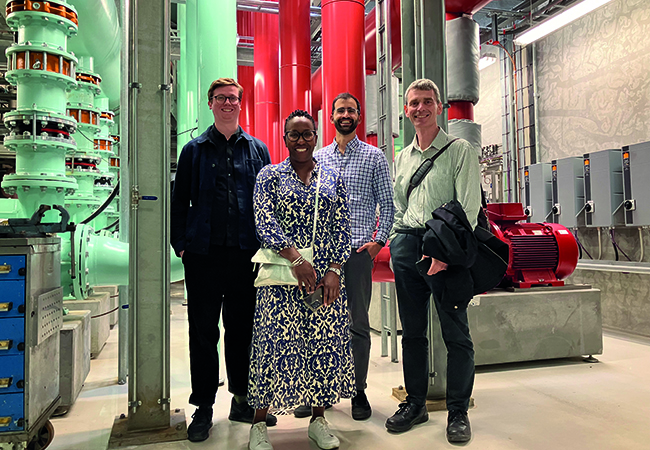
The 4-pipe air source heat pumps
Further enhancements could be made, he adds: ‘That’s why we say 5 stars is the starting point, because we’re keen to see just how much more this building has to give.’
They won’t have long to wait. The next NABERS certification review is in June 2026. By then, the team hopes to be able to target a 5.5-stars rating for energy in use. ‘We’ve set a baseline, now the aim is to keep improving on that,’ Price says.
Saffron Hill to be rated under NABERS UK
While NABERS DfP has been developed for new buildings, NABERS Energy for Offices measures and rates the actual energy use of existing offices.
CIBSE will be applying NABERS UK Energy for Offices to its head office at Saffron Hill, London. This will allow the Institution to measure and rate the building’s energy performance based on actual operational data for the existing building. It will then use the insights gained from the certification process to inform a refurbishment and improvement plan for the office.
CIBSE expects the exercise to reduce its carbon footprint and operational energy use, while the ongoing assessment process will drive continuous improvement over time. In so doing, the Institution is demonstrating its commitment to NABERS UK, as its administrator, while holding itself accountable to the same high standards it promotes.
NABERS UK has recently expanded to include ratings for whole buildings and individual tenancies. Currently, NABERS UK only rates the energy performance of offices. In Australia, however, NABERS is used to rate the performance of apartment buildings, data centres, shopping centres, public hospitals and hotels. The ratings also extend beyond energy to cover water, waste, indoor environmental quality and carbon neutrality. Currently, 19 buildings are registered under NABERS UK Energy for Office ratings, and CIBSE hopes to continue increasing its scope and offering. The Institution is keen to hear from users of the scheme about how it can be further expanded to support their needs.
Visit cibsecertification.co.uk/nabers-uk for more information.