
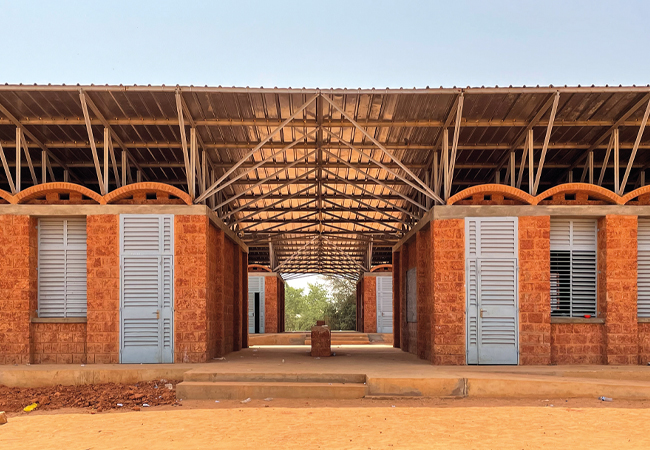
A college project in Niamey, Niger, has demonstrated how it is possible to create comfortable spaces using passive services design in the most extreme climate conditions.
Niger is a country of arid deserts, nomadic populations and little centralised infrastructure, where daily temperatures can climb to 45°C.
Max Fordham and architectural charity Article 25 worked on the refurbishment of Collège Amadou Hampaté Bâ, combining a passive ventilation design with the high thermal mass of the local laterite stone to achieve internal temperatures up to 8K cooler than external air temperatures on the hottest days.
The project team also minimised reliance on local infrastructure by using a solar-powered pump to access well water and incorporating an independent drainage and sanitation system with latrines that is emptied every six years.
The works completed at the 1,200-student school include the refurbishment of existing classrooms, water and electrical services upgrades, two additional classroom blocks (totalling eight classrooms), new administrative facilities and sanitary latrine blocks.
The design of Hampate Ba, and another Article 25 project in Burkina Faso, was influenced by the architect Francis Kere.
Designing for extreme climates
Ventilation was at the core of the classroom design, and the team had to address multiple environmental challenges including soaring heat, dust storms and erratic electricity supplies.
‘Wherever we can, we try to push the envelope in terms of environmental performance, with a focus on local material and passive design,’ says Toby Pear, senior architect at Article 25.
Pear says the dusty environment meant mechanical ventilation was not an option because of the ongoing maintenance that would be required. It also meant less reliance on an unreliable electricity system, says Lidia Guerra, senior engineer and partner at Max Fordham. ‘We also didn’t want to implement a system that would increase costs for the school,’ she says.
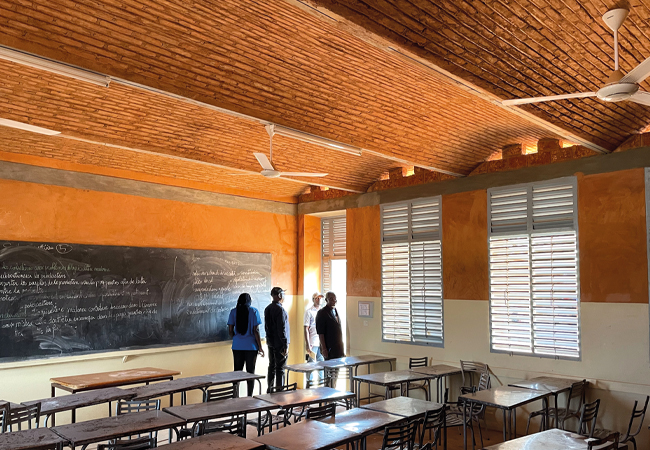
The exposed laterite brick ceiling in a classroom
Max Fordham’s passive design strategy includes the use of cross-ventilation, thermal mass and a distinctive steel fly roof, which extends over the top of classroom ceilings made of laterite bricks. ‘Buildings are orientated to catch prevailing north-south winds. The roof is angled to create a cavity of varying size above the classroom ceiling, increasing wind speed and removing heat. This overhangs on either side to shade the walls, preventing direct solar gain,’ explains Guerra.
‘Louvres are included that can be opened or closed to improve ventilation and block sunlight and protect students from dust,’ she adds. There are also ceiling fans in several of the classrooms to increase airflow.
Walls are constructed from laterite stone, a red-orange dense material that offers excellent thermal mass, slowing the release of heat into internal spaces during the day and helping to moderate indoor temperatures. Pear is keen to see more use of the stone in local buildings ( see panel ‘The benefits of using laterite stone’).
Laterite bricks are cut from iron- and aluminium-rich soil common in tropical regions; soft when quarried, they harden on exposure, providing a durable, low-cost and thermally stable building material. Laterite is a hugely underused resource in Niger, according to Pear. ‘The default is to use imported cement for blocks, but this has high embodied carbon. ‘We wanted to use this project as an example that shows how it can be beautiful, cheap and perform well,’ he says. Each laterite block was cut by hand, then left to dry and harden in the sun for at least a month. A contractor from a neighbouring country ensured quality and trained local masons for the project, laying the foundation for future laterite-based building in the region (see panel ‘Opportunities for local women’).The benefits of using laterite
Guerra says it’s important not to over-rely on design principles used in temperate climates. In the UK, she says uncontrolled air leakage is a problem but in Niger, natural air movement can be a benefit. Laterite adds to this by allowing moisture to diffuse through the walls, helping regulate conditions indoors.
Lighting strategies were adapted, too. Rather than aiming for the high daylight factors common in UK schools, the goal in Niger was to have smaller openings to maintain cooler indoor temperatures. A daylight factor range of 1-1.5 was targeted, lower than UK norms.
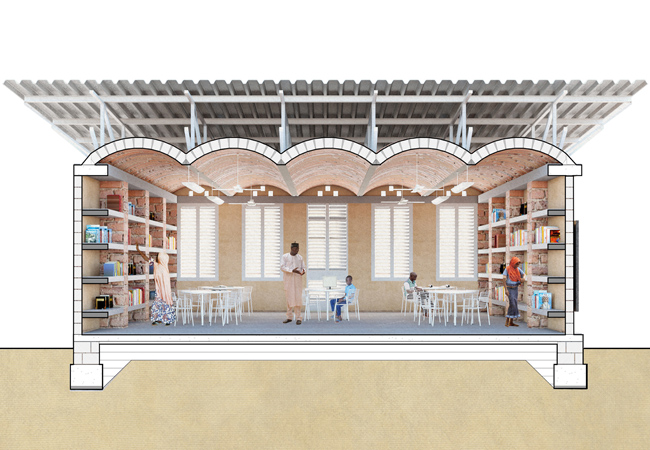
3D section view of the library showing the double roof
Pear emphasises the importance of community buy-in. ‘If you don’t have it, projects like this fail. We made sure proposals were co-developed with students and staff so they want to learn in those spaces.’
Guerra says she had to think differently about how things would be installed, and how people will use them. ‘You don’t always have to go for the solution with all the bells and whistles – consider the end user and find that balance.’
‘You can’t assume standard practice will work. Every detail matters,’ agrees Pear. ‘It’s not just about the most technical solution.’
Creating opportunities for women
A core goal of the project was to provide vocational training, especially for young women, a group largely excluded from the construction process in the region.
With encouragement from the contractor, a cohort of recent female graduates from the school shadowed the construction team, gaining skills and confidence.
While a broader vision of female-led contracting was curtailed by the Covid pandemic, the project planted vital seeds for change.‘At first the idea was laughed off, but by the end, it was a real success,’ says Toby Pear.
The results
Temperature sensors inside the classrooms monitor performance. Compared with older classrooms that lack a fly roof, the new structures demonstrated a significantly better thermal profile. ‘Feedback was overwhelmingly positive. It’s still hot, but bearable,’ says Pear.
The comfortable environment was most notable later in the day, when students would return to do homework as it was cooler than home, proving the design would be well suited to continuously inhabited buildings such as hospitals or homes, says Pear.
The potential of the design for similarly extreme environments across Africa and the rest of the world was recognised when the project became the first NGO project to win a RIBA International Award for Excellence.