
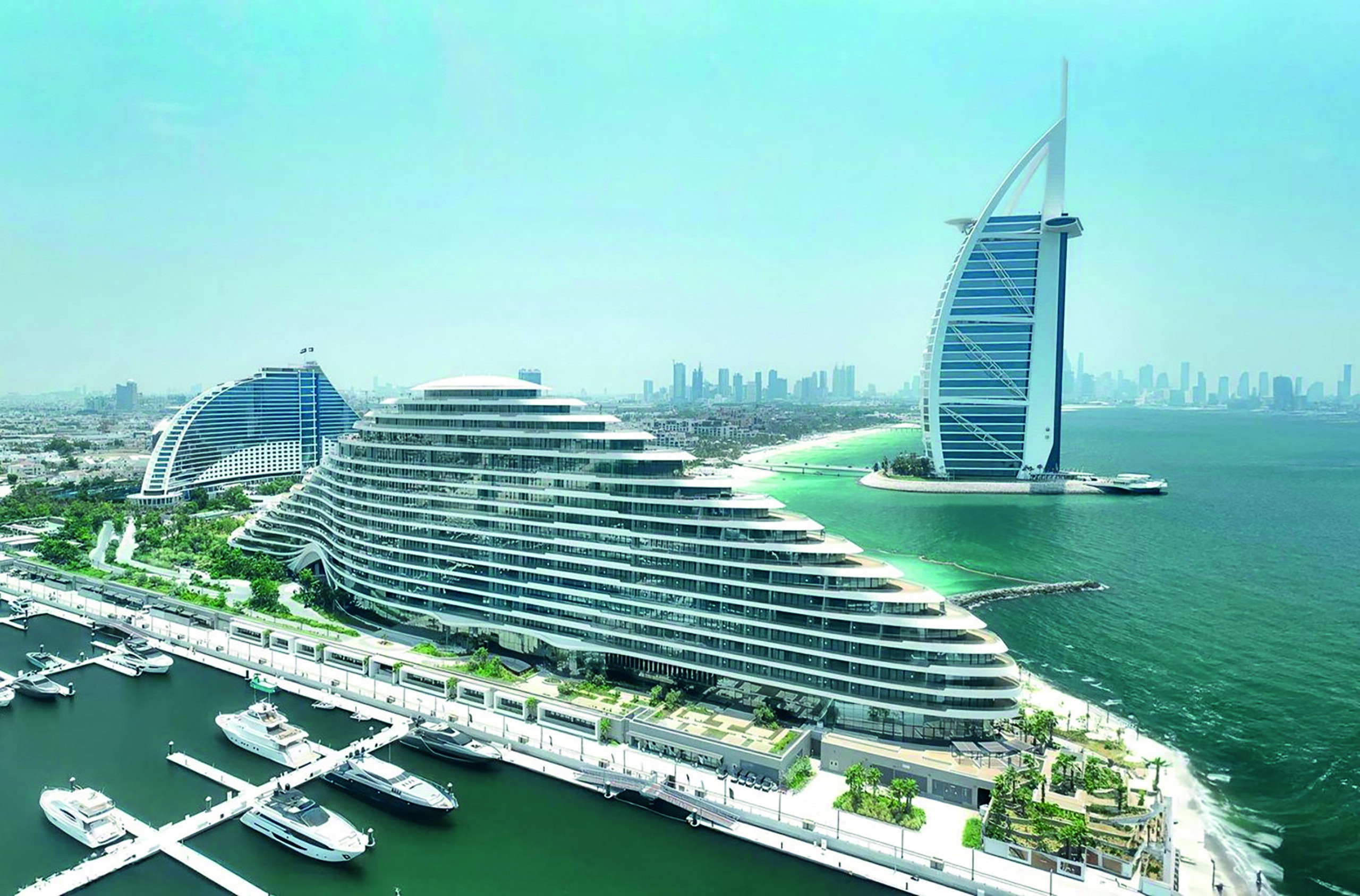
Coastal companions: The Marsa Al Arab takes its place alongside the Jumeirah Beach Hotel (left) and the Burj Al Arab
The Jumeirah Marsa Al Arab emerges from the Dubai shoreline like the billowing sail of a giant dhow. Its dramatic, double-curved architecture celebrates Dubai’s maritime heritage, but beneath this fluid form lies something equally ambitious: a future-focused mechanical, electrical and plumbing (MEP) strategy delivering world-class comfort, resilience and energy efficiency in one of Earth’s most demanding coastal climates.
Opened earlier this year, the 12-storey, 386-key luxury resort was designed by Killa Design for client Jumeirah/Dubai Holding. Design and build contractor ASGC appointed Ramboll to deliver the building services engineering.
Project team
Client: Jumeirah/ Dubai Holding
Architect: Killa Design
MEP: Ramboll Middle East
Main contractor: ASGC
What followed was an intensive, BIM-led design and coordination effort that pushed the boundaries of digital engineering. The result impressed far beyond the project team: at the 2025 CIBSE MENA Awards, Jumeirah Marsa Al Arab was named Mechanical Project of the Year and MEP Project of the Year.
For Imran Shaikh, director of MEP and specialisms at Ramboll Middle East, the brief was unambiguous: ‘Deliver a luxury resort that embodies the architectural ambition and exceeds international hospitality benchmarks without compromise on performance, comfort or sustainability.’
The building’s geometry shaped everything. The tower is sinuous and wavy in plan; its amorphous floor plates diminish in area as they rise. Conventional straight-line horizontal service routes were fractured and vertical risers had to meld seamlessly around the guest rooms while remaining within the architectural volume.
Compounding the challenge was what Shaikh calls ‘a clean roof mandate’, eliminating any opportunity to place plant and equipment externally. As a consequence, the majority of plantrooms were concentrated in the basement, supported by a critical distribution void on Level 2, above the public spaces.
In Dubai’s coastal climate, cooling design is the dominant engineering challenge
Killa Design’s free-form architecture demanded early ground rules for the service runs. ‘We had to establish vertical and horizontal strategies from day one,’ says Shaikh. ‘Without this, every riser would have been coordinated in isolation, with 10 different consultants involved each time; it would have taken forever.’
To navigate the constraints, Ramboll deployed computational design and full 3D BIM coordination from project inception. Continuous digital workshops between Ramboll, ASGC, the architects and the specialist trades created an iterative cycle of rapid decision-making.
Parametric models were used to test routing scenarios, refine voids and visualise clashes. Structural, architectural and MEP geometries evolved in tandem, allowing opportunities for concealed service routes to be built into slabs, beams and shaped soffits.
This digital workflow extended into construction. Ramboll’s site team used the coordinated models to sequence installations, validate mock-ups and flag deviations early. Weekly leadership forums kept all stakeholders aligned across overlapping design and build phases – a necessity in a programme that Shaikh describes as ‘intense’, with its overlapping construction and design milestones, which required early procurement decisions. The result was a fully coordinated design delivered at speed, with key service strategies locked in early enough to protect the contractor’s schedule.
Climate-responsive design
In Dubai’s coastal climate, cooling design is the dominant engineering challenge. Ramboll used early-stage modelling to shape the sinuous balconies and wraparound terraces to shade the floor-to-ceiling glazing and keep cooling loads to a minimum. ‘We used shading as much as possible to reduce the cooling load on the building – a delicate balance for a luxury hotel, because, obviously, they want the best views possible,’ says Shaikh. High-reflectance finishes on upward-facing surfaces further reduce solar absorption.
The district cooling provider placed strict limits on available capacity, intensifying the need to drive down loads and avoid oversizing. For a Dubai hotel, Shaikh says it is conventional to assume 80% cooling diversity. For Jumeirah Marsa Al Arab, Ramboll refined the load modelling through simulations and operational scenario analysis, to demonstrate that a 65% diversity factor was achievable. ‘We had to demonstrate rigorously that the systems would perform under all realistic operating conditions,’ says Shaikh.
The chilled-water system operates with a 9K ΔT (5.5°C supply, 14.5°C return) across the plate heat exchangers on both the primary and secondary loops – a substantial improvement over the typical 6–7K ΔT. This wider temperature differential reduces flowrates, enabling smaller pipe sizes, lower pumping energy, reduced frictional losses and more compact secondary equipment.
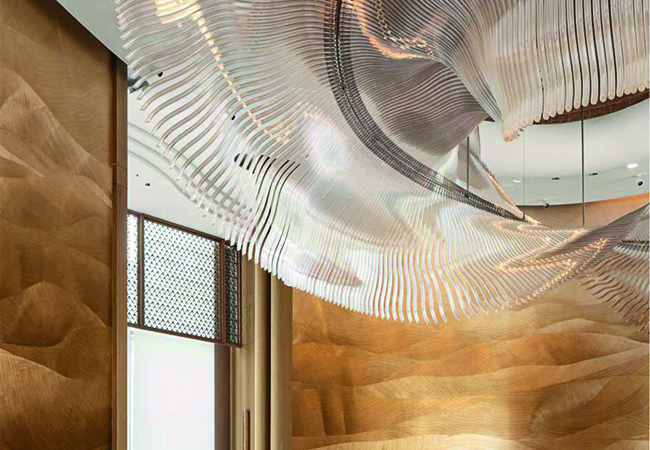
Practical beauty: The client’s brief was to deliver architectural ambition without compromising on performance, comfort or sustainability
Chilled water distribution rises from the basement to the Level 2 services gantry, above which risers extend upwards to serve the guest-room floors. Standardised riser modules and corridor service assemblies improved buildability, cut material waste and helped improve safety on site – an innovation that no doubt contributed to the project logging more than 20 million hours worked without a lost-time incident.
Dubai’s warm climate eliminates the need for space heating, so guest rooms are served by 2-pipe fan coil units, sized to keep rooms at a comfortable 23°C. The guest room management system (GRMS) detects when the room is unoccupied, raising the cooling setpoint to 27°C to reduce energy use and adjusting the lighting accordingly. When a guest checks in, a signal is sent from the PMS to the GRMS to return the setpoint to 23°C. The GRMS also turns off the cooling when the balcony doors are opened. Cooling, fresh air and other guest-room services are delivered through dedicated risers, to enable maintenance without disturbing guests, which was an operational requirement.
Fresh air treatment is one of the highest energy loads in Gulf climates. At Marsa Al Arab, outdoor air can enter at 34°C dry-bulb and 32°C wet-bulb, carrying significant moisture. Fresh air handling units (FAHU) processes ambient air at 34°C/32°C through an enthalpy wheel, pre-treating and dehumidifying to a neutral humidity condition of 12.5°C/12°C. The sensible wheel then reheats mixed return air to 20-22°C before it is supplied to the space. This approach prevents over-cooling of the guest rooms in winter, reduces humidity and the risk of surface condensation, and cuts HVAC energy consumption ‘by up to 30%’, says Shaikh.
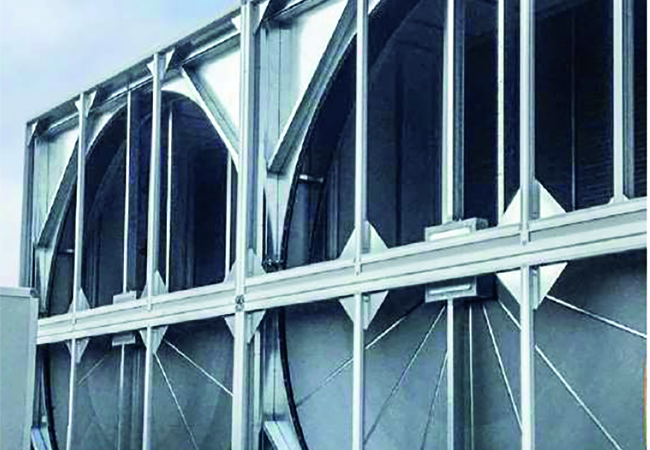
Dedicated fresh-air air handling units incorporate dual heat-recovery wheels
Fresh air is supplied to lobbies, restaurants and large public areas via AHUs with recirculation facility. Fresh air supply rates to these spaces are controlled by CO₂ and occupancy sensors. Fresh air supply to the guest rooms is constant volume, with extract via bathrooms. Given the risk of contamination from salt-laden sea air, CFD modelling was used to identify appropriate fresh-air intake locations and to avoid recirculation zones, helping maintain good air quality. Kitchens, spas and gyms have dedicated ventilation systems, with treated make-up air to avoid condensation risk at extraction points and treated exhaust to minimise odours.
Ventilation is also provided to the basement car parks at 3ACH under normal conditions; this can ramp up to 6ACH based on CO levels and up to 10ACH in smoke-control mode.
Cold, hot and grey water
District cooling is also used for the potable water cooling. Supply temperatures of the desalinated potable water supply can be as high as 40°C, so the hotel filters the water, and then cools and stores it at a more guest-friendly temperature of around 20°C. Cooling also reduces the risk of Legionella, which is further minimised by the use of copper-silver ionisation units in the storage tanks and automated flushing regimes for pipework in high-risk areas.
Four modular liquefied petroleum gas-fired condensing boilers, having total capacity of 1,856kW, feed eight calorifiers providing 52m³ of hot-water storage, serving the hotel and adjacent residences that were also part of the development.
In the hotel, hot water is divided into high- and low-zone circuits to maintain consistent pressure while minimising pump head. Thermostatic mixing valves cap outlet temperatures at 43°C and low-flow fixtures are used throughout to reduce total water consumption. The building is also pre-plumbed for future grey-water recycling from showers, wash basins and laundry systems. The grey water will be treated to irrigation quality, alongside condensate recovery from the AHUs and treated sewage effluent. Smart sub-metering across all major systems supports ongoing water efficiency and leak detection.
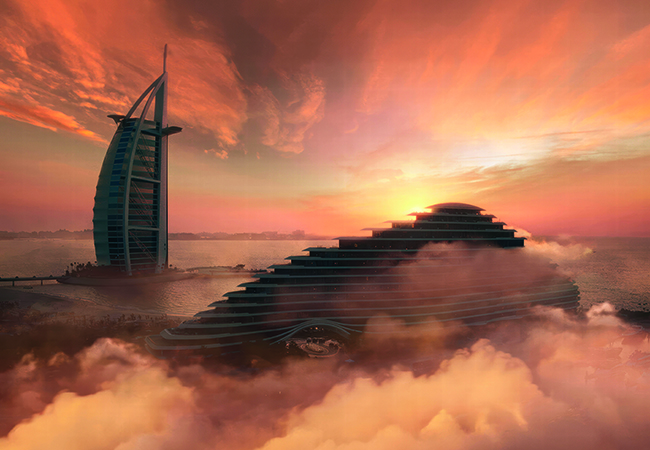
Sailing into the sunset: The Marsa Al Arab and Burj Al Arab are designed to celebrate Dubai’s maritime heritage
Electrical power is supplied by three Dubai Electricity and Water Authority substations, with busbar distribution to sub-mains on each level. Three diesel generators provide backup power, supporting resilience for a 24-hour hospitality environment.
All lighting is LED, controlled by a DALI dimming system using daylight sensors and occupancy detectors. Exterior lighting uses photocells and timers to minimise energy use.
Operational feedback has been positive and Ramboll continues to support the facilities team as full-year data is compiled. Early indications suggest that the building is tracking close to predicted performance, particularly for cooling loads and exhaust air energy recovery.
Luxury hospitality engineering
Jumeirah Marsa Al Arab sets a benchmark for integrated engineering in complex hospitality environments, with Ramboll’s digital-first, collaboration-driven approach enabling the team to deliver systems that support the architectural vision . Behind the sweeping curves and shimmering façade lies an engineering strategy shaped by rigorous simulation, clever zoning, high-efficiency cooling, smart controls and a uniquely holistic water system.
It is a reminder that luxurious hospitality is not simply defined by finishes, spaces and views, but also by the invisible systems that deliver comfort, sustainability and operational resilience. No wonder the CIBSE judges were impressed.
Digital innovation
One of the project’s most innovative contributions was Ramboll’s development of a dynamic, physics-driven corridor coordination tool. Using a Grasshopper-based software tool built with the Kangaroo2 physics engine and spreadsheet-driven inputs, the team developed a rule-based method for arranging MEP services in congested corridor cross-sections. The tool:
- Allowed engineers to drag, drop and reposition services with real-time clash detection
- Enforced rules for clearances, insulation and code compliance
- Produced rapid, annotated cross-sections ready for CAD export
- Reduced design errors and accelerated coordination, even for less experienced engineers.
- This shifted the workflow from manual correction to proactive optimisation, improving the speed, precision and confidence of the engineering process.
For more on the CIBSE MENA Awards see here.