

CIBSE’s conference on building safety last month moved beyond legislative theory to consider the operational reality of designing and delivering safer buildings.
The keynote speech at CIBSE Building Safety 2026: Delivering safer buildings in practice was given by Dame Judith Hackitt, author of the landmark Building a Safer Future report, published in 2018 following the Grenfell Tower tragedy.
Dame Judith, who currently chairs the Industry Safety Steering Group, described the progress being made under the new building safety regime and highlighted areas of concern. These include severe skills gaps in the retrofit sector, an overreliance on building control and a lack of consideration by the supply chain for construction product safety.
Dame Judith told delegates that the construction industry had to take a more proactive approach to building safety, adding: ‘It’s time to shift the debate from a focus on regulatory compliance to talking about creating and delivering safety, quality and a built environment in which we can all take pride.’
She noted that there had been much better collaboration between industry and the Building Safety Regulator over the past year, and that this had helped to ‘find workable, pragmatic solutions’ to the challenges of the Building Safety Act regime.
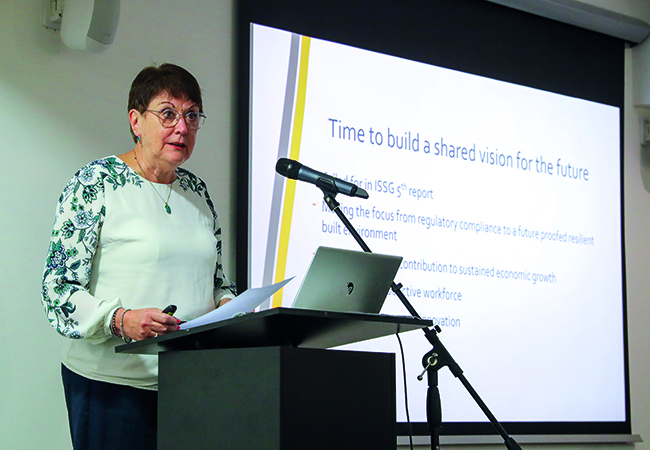
Dame Judith Hackitt
These included regular meetings between the BSR and industry representatives to resolve practical bottlenecks in the gateway system for higher-risk buildings(HRBs).
While there had been improvements in the building safety regime for new HRBs, Dame Judith said challenges existed around the safety of buildings already in occupation. There was sometimes a ‘woeful lack of knowledge and competence’ in handling refurbishments, she added, and a need for industry to ‘up its game’ in listening and caring for residents.
Key players such as managing agents and tenant management organisations were ‘very poorly equipped to deal with their new responsibilities’, she said.
As the chair of the panel that, in May, published a review of building control, Dame Judith believes the role is undervalued, not well understood and over-relied upon by industry.
‘Their sheer volume of work is exacerbated by others who are not yet raising their game in terms of what they present to building control for approval and, in the case of high-rise buildings, to the BSR,’ she said.
There was a role for building control to offer guidance to duty holders, she added, but there was a line that must not be crossed: ‘There is a balance to be struck between offering helpful advice and stepping into the space of being the designer by proxy.
‘That is why raising everyone’s competence is so critical to easing the squeeze on building control.’
Proposals in the Construction Products Reform White Paper around product regulation are also a key part of a ‘complex picture’, Dame Judith told the conference, adding that shortcomings in the heat-soaked thermally toughened glass sector, identified by the Office for Product Safety and Standards (OPSS), proved product safety was an issue.
Failure to supply the technical documentation required to verify products meet safety standards was not only the fault of manufacturers, she said, but also the supply chain for not asking for information, and ‘not seeming to care’ until the regulator took action. The General Safety Requirement in the white paper expands legal responsibility across the entire life-cycle and places a duty on everyone to be confident they are using the right materials.

Thouria Istephan (right) speaking at the CIBSE Building Safety Conference
In a morning session on competence, accountability and assurance, former interim chief construction adviser Thouria Istephan said accountability must operate at both individual and organisational levels, and she added that governance needed to be examined and internal challenge functions established in organisations.
Accountability applies to every professional, Istephan said, and they must have the courage to speak up and act, even when systems make it difficult. ‘As professional people, you have a code of ethics that says you are accountable.’
Istephan highlighted the failure of client organisations to take responsibility for competence checks since Grenfell and told the conference she was aware of clients who had done nothing in response to the inquiry. ‘Some real root-cause issues are related to clients, and them not taking an interest,’ she said.
In the same session, Jon Vanstone, chair of the Industry Competence Committee (ICC), identified the boundaries and handover points between different disciplines as a persistent source of problems. While individual teams completed specific tasks, system-wide integration was not always achieved, he said. He also criticised the current state of competence evidence, noting the difficulty in distinguishing between self-certified positions and rigorous third-party-assessed qualifications.
The ICC had identified two top systemic risks. The first is immaturity in the management of occupied buildings. ‘We focus so much on construction, we don’t think about how we’re managing, repairing and retrofitting buildings,’ Vanstone said.
The second is the introduction of regulation in areas where competence does not yet exist to deliver against it.
Dame Judith said there is an urgent need for all sectors to develop a skilled workforce that adapts to continuous change and reform. ‘Industry can no longer do the same things in the way it has always done,’ she said.
Building safety reform: what the next phase means in practice
In the session following Dame Judith’s keynote, Charlie Pugsley, acting chief executive at the BSR, noted that approval times for Gateway 2 HRB applications had nearly halved, and approval rates doubled, in the past year. He said the focus now needed to shift to ensuring competencies and behaviours were embedded throughout the construction phase.
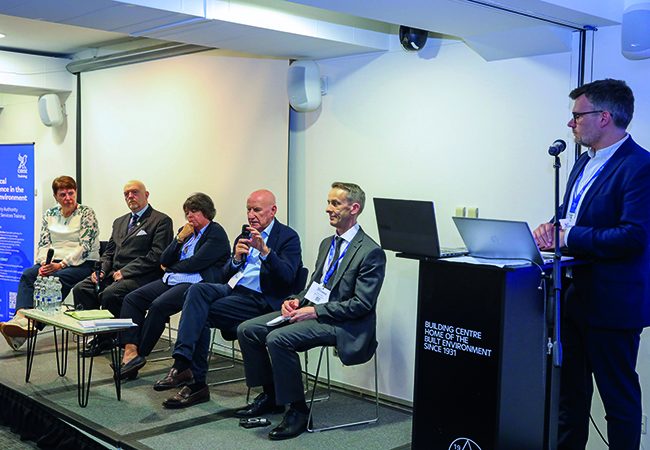
Speakers from the session on the reality of building safety reforms
‘We need to make sure that those competencies and behaviours play out so a good design actually leads to a safe building for its whole life,’ he said.
Pugsley raised concerns about proportionality in delivering building assessment certificates for buildings in occupation, warning that residents risk being priced out of their homes if access to competent professionals remained limited. He also flagged overheating as a potential future crisis, given evidence of heat-related deaths over the summer.
Jack Pringle, chair of the RIBA board, highlighted fragmentation in procurement and a race to the bottom on price as factors that contributed to Grenfell. He welcomed the principal designer role in the Building Safety Act as a means to restore architects’ oversight of the broader design team.
He also argued for reserved functions – specific, critical tasks or duties that only qualified, regulated and competent professionals are legally allowed to perform – particularly for buildings above a certain size. ‘There is little point in having regulated professions and proved-competent professionals, if anyone can make a Building Regulations application,’ he said.
Amanda Long, CEO at Code for Construction Information, said the OPSS, which is the enforcement authority for construction product safety, was doing a good job of engaging the building industry and increasing its capacity to work with manufacturers. The OPSS will be absorbed into the SCR, and Long said uncertainty about the new body was contributing to a ‘wait and see attitude’ across industry, which was slowing the pace of change.
BESA competence survey
At the event BESA director Rachel Wilkinson presented findings from BESA’s latest industry survey, showing that while 64% of respondents said they could demonstrate that their work met duty holder requirements, fewer than 50% were capturing this evidence within documented project paperwork.
Confidence in the ability to provide historical evidence of compliance dropped sharply for projects completed between five and ten years ago, and to single figures for work completed over ten years ago, creating serious concern given that the Building Safety Act has extended certain liability periods to up to 30 years.
According to the survey, over 90% of organisations still rely primarily on qualifications and certifications to verify competence, and almost one in two struggle to verify the competence of their supply chain.
Three years of tracking industry response showed that 74% of respondents had not seen a significant client-led shift away from traditional programme pressures towards risk, quality, and compliance.
It found that progress remains uneven, with SMEs in particular lacking the clarity, capacity, and systems needed to translate building safety requirements into operational practice.
Wilkinson said that BESA’s members found a two-tier compliance process: larger, more informed clients working on HRBs largely understand their responsibilities but they say that a significant proportion of client behaviours hasn’t changed at lower rise buildings that don’t fall under HRB safety requirements.