
Sponsors: GF+ 
For an alternative way to access this module, CIBSE member, Jos Brownlie provides a video reading the module: Module 267 recording
Good hydraulic design, appropriate material selection and effective commissioning are all essential if modern water systems are to remain safe, hygienic and reliable throughout their design life. Water systems rarely fail because of a single defective component. More often, failures result from a combination of apparently minor shortcomings in design, installation, commissioning or operation that, together, compromise the performance of the entire system.
Whether the consequence is an escape of water, poor domestic hot water (DHW) performance, excessive noise or deteriorating water quality, the root cause frequently lies not in one individual product, but in the way the system has been conceived as a whole.
The consequences can be significant. Escape of water remains one of the most common causes of property damage claims in the UK. According to the Association of British Insurers (ABI), insurers pay out around £1.8m every day for escape of water damage.1 Yet leaks represent only one manifestation of system failure.
Water systems may also fail because they: do not maintain appropriate temperatures; encourage stagnation; prove difficult to commission; or create conditions that allow microbiological contamination to develop. Although these problems may be less visible than a burst pipe, they can be equally disruptive, particularly in healthcare, education, hospitality and residential buildings.
Modern buildings have made the challenge more complex. Heat pumps are replacing traditional boilers, reducing heating flow temperatures and increasing operating hours. Water-saving fittings have lowered consumption, extending the time water may remain within distribution systems. Offsite manufacture and modular construction have encouraged the widespread adoption of polymer pipework, while greater emphasis on water hygiene has placed increased attention on system layout, commissioning and operational management.
These developments are closely linked. Decisions about hydraulic layout influence water age and commissioning. Pipe sizing affects flow velocity, pressure loss and water quality. Material selection determines how the system responds to temperature changes and long-term operation. Increasingly, resilient water systems depend on understanding how these factors interact throughout the life of the building.
The principles themselves remain unchanged. Potable water systems should deliver the required flow, pressure and temperature to every outlet while minimising stagnation, excessive velocities, unnecessary heat gains or losses, and the risk of contamination.
BS EN 8062 provides the overall framework for the design of potable water systems, while BS 85583 offers complementary UK guidance on their design, installation, testing and maintenance. Successful systems, however, rely on engineering judgement as much as compliance with standards.
Good hydraulic design starts with layout
Many operational problems originate during the earliest stages of design, before pipe sizes are calculated or materials selected. The layout of the distribution network determines how water moves through the building, how easily the system can be commissioned and maintained, and ultimately how reliably it performs throughout its design life.
One of the principal objectives is to minimise water age. Water that remains within pipework for prolonged periods gradually loses disinfectant residual, changes temperature and provides increasingly favourable conditions for biofilm formation. Good layouts therefore minimise unnecessary dead legs, avoid redundant pipework and encourage regular water movement throughout the distribution system.
Healthcare guidance illustrates this principle particularly well. HTM 04-014 recommends limiting the length of pipework between a circulating main and a terminal outlet to around 3m wherever practicable, thereby reducing the volume of stagnant water between periods of use. Although this recommendation is specific to healthcare buildings, the engineering principle is equally relevant elsewhere. The smaller the volume of unused water within a distribution system, the easier it becomes to maintain water quality and temperature.
Simple layouts also make systems easier to commission and maintain. Pipework should facilitate flushing, venting and balancing while avoiding unnecessary complexity. In practice, the simplest hydraulic solution is often the most reliable over the life of the building.
Once the layout has been established, attention turns to pipe sizing. Although often regarded as a routine calculation, it has a major influence on hydraulic performance and water hygiene. Oversized pipework increases the volume of stored water, reducing operating velocities and increasing water age, which in turn raises the likelihood of temperature drift and biofilm development. Good hydraulic design therefore seeks to optimise pipe sizes, providing adequate flow and pressure without unnecessarily increasing system volume.
The traditional loading unit (LU) method remains the basis of most domestic water-demand calculations, allowing the probable simultaneous demand from multiple outlets to be estimated. While it continues to provide a practical design tool, modern occupancy patterns and water-saving technologies mean it should be applied thoughtfully to avoid unnecessary oversizing. CIBSE Guide G5 provides practical guidance on the application of loading units within the wider context of building water services, complementing BS EN 806 and BS 8558.
Water velocity also requires careful consideration. Excessively high velocities increase pressure losses, noise and the potential for erosion at fittings, while very low velocities reduce the self-cleansing effect of flowing water and encourage sediment deposition.
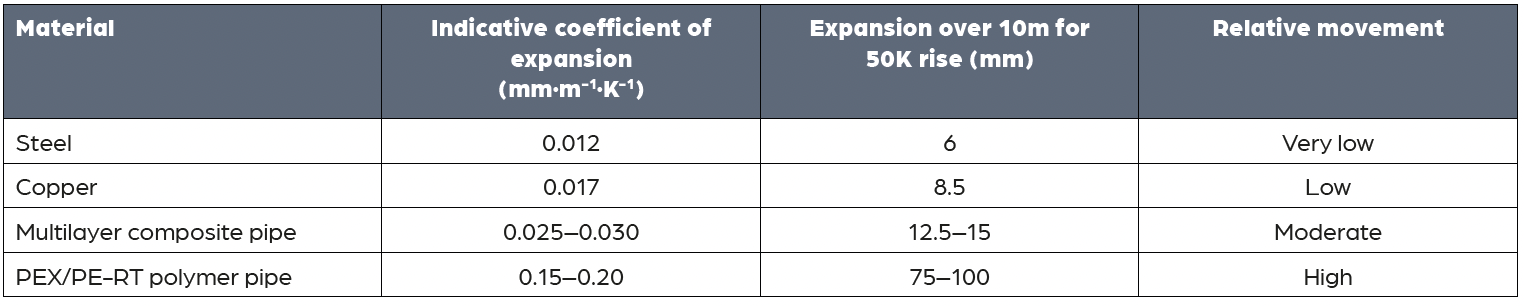
Table 1: Indicative thermal expansion for a 10m pipe run subject to a 50K temperature rise. (Actual values vary by manufacturer and pipe construction – use declared product data for calculations.)
Material selection forms part of the same design process. Copper and stainless steel continue to offer excellent performance in many applications, while polymer systems have become increasingly popular because they combine corrosion resistance, low weight and ease of installation. Modern systems include PEX, PE-RT, PP-R and multilayer composite pipe (MLCP), each with characteristics suited to different applications. MLCP, for example, combines the flexibility of polymer pipework with an aluminium layer that reduces thermal expansion and acts as an oxygen barrier for closed heating systems.
Unlike metallic pipework, polymer systems expand more when heated and therefore require appropriate support spacing and provision for thermal movement. As shown in Table 1, multilayer composite pipes exhibit significantly less thermal expansion than single-material polymer pipes, although movement must still be considered when detailing supports, anchors and changes in direction.
Successful installations therefore depend not only on selecting an appropriate material, but also on integrating pipework, fittings, valves, pumps and terminal equipment into a well-designed hydraulic system.
Balancing performance and water hygiene
DHW systems present perhaps the greatest challenge in building water engineering. Unlike space heating systems, where the primary objective is the efficient transfer of heat, DHW systems must satisfy several competing requirements simultaneously. They must provide adequate hot water at the point of use, minimise energy consumption and standing losses, and maintain conditions that discourage microbiological growth throughout the distribution network.
The principal microbiological concern is the control of legionella bacteria, which can proliferate where water remains within favourable temperature ranges for prolonged periods. HSG2746, published in support of the Health and Safety Executive’s (HSE) Approved Code of Practice L87 recommends that hot water is normally stored at not less than 60°C, while secondary circulation systems should return water at temperatures of at least 50°C.
Figure 1: Example of digitally monitored domestic hot water (DHW) circulation system incorporating automatic balancing valves and temperature monitoring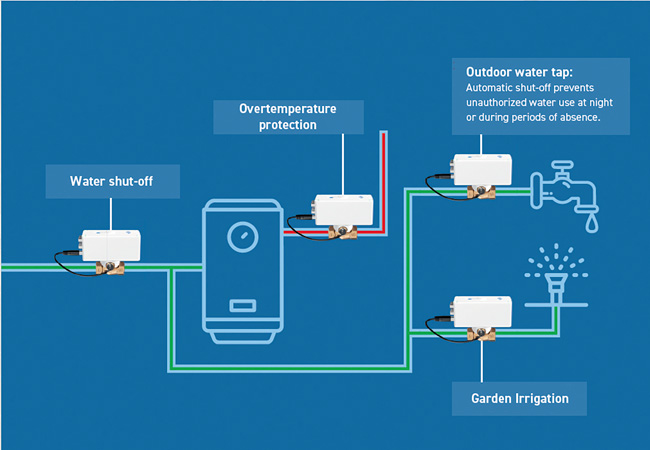
Achieving these temperatures consistently depends as much on hydraulic design as on the heat source itself. In smaller domestic and light commercial buildings, this is often achieved simply by minimising distribution volumes and keeping pipe runs short. Larger buildings, however, generally require secondary circulation systems to maintain hot water temperatures, reduce waiting times and minimise water wastage at outlets. A calorifier (the insulated hot water storage vessel) may generate water at the correct temperature, but unless circulation is properly balanced, some parts of the network will inevitably cool before water reaches the point of use. Poorly balanced return circuits often result in some branches receiving excessive circulation while others remain below the intended operating temperature.
For this reason, the design of secondary circulation pipework deserves the same attention as the supply distribution. Return circuits should be sized to accommodate the required circulation flow while limiting pressure losses and heat loss, and layouts should minimise unnecessary dead legs and ensure that all branches receive adequate circulation. Hydraulic simplicity is generally an advantage. Good design alone, however, is not sufficient. Before any system is brought into service it should be thoroughly cleaned and flushed to remove construction debris and installation residues. Guidance on pre-commission cleaning procedures is provided in BSRIA BG 29,8 reflecting the importance of commissioning in achieving long-term system performance. Systems that are straightforward to understand are usually easier to commission, maintain and adapt as building use changes over time.
Commissioning is the stage at which design assumptions are translated into operational performance. Even the most carefully designed system cannot perform as intended if balancing valves are incorrectly adjusted, circulation rates are inadequate or flushing procedures are incomplete. Successful commissioning therefore verifies that design temperatures, flowrates and pressures are achieved throughout the network, while also confirming that cleaning, flushing and disinfection have been completed in accordance with BS 8558, BS EN 806 and HSG274, as appropriate.
Automatic balancing valves, temperature monitoring and intelligent flushing systems are becoming increasingly common in larger water systems. By responding to changing operating conditions, they can help maintain hydraulic balance and water quality while providing building operators with better information on system performance. Such technologies complement good hydraulic design and commissioning, but cannot compensate for poor design or installation.
Cold water systems deserve equal attention. HSG274 recommends that cold water should normally be maintained below 20°C, yet achieving this target is becoming increasingly difficult as buildings become better insulated, summer temperatures increase and water consumption falls. Water-efficient fittings, intermittent occupancy and pipework routed through warm ceiling voids or service risers can all increase water age and allow temperatures to rise above recommended levels.
Good design remains the first line of defence. Cold water pipework should be routed away from heat sources wherever practicable, insulated appropriately and designed to minimise unnecessary stored volumes. Short branch connections, sensible pipe sizing and layouts that encourage regular water movement all contribute to maintaining satisfactory water quality.
Where periods of low demand are unavoidable, operational measures may also be required. Routine flushing has traditionally been used to replace stagnant water, but manual flushing is labour-intensive and can consume significant quantities of potable water. Automatic flushing systems offer a more targeted approach, initiating flushing only when predetermined time, temperature or usage criteria are reached. In addition to helping maintain water quality, these systems can provide valuable operational data, enabling facilities managers to identify areas of the network that experience little use and may require further investigation.
Whether the system serves heating, hot water or cold water distribution, the underlying engineering principles remain consistent. Good performance depends upon understanding how layout, hydraulic balance, material selection and operational management interact. Intelligent technologies can support these objectives, but they cannot compensate for poor design. Reliable water systems are created by integrating sound engineering principles from the earliest stages of the project through commissioning and into long-term operation.
An integrated approach to resilient water systems
The widespread adoption of polymer pipework reflects the wider changes taking place across the building services industry. Lightweight, corrosion-resistant systems are well suited to low-temperature heating, offsite manufacture and modern installation techniques, but they also require designers to consider thermal movement, support arrangements and jointing methods as part of the overall hydraulic design. Like any engineering material, polymer pipework performs best when its characteristics are understood and incorporated into the design from the outset.
Perhaps the most important lesson is that most water system failures develop gradually rather than catastrophically. An oversized distribution main, an unbalanced hot water return, an unnecessarily long dead leg or inadequate commissioning may each appear relatively minor in isolation. Together, however, they can increase water age, compromise temperatures, encourage microbiological growth and, ultimately, contribute to leaks, poor performance or premature system failures.
Good engineering therefore requires a whole-system approach. Hydraulic layout, pipe sizing, material selection, installation quality, commissioning and operational management should be regarded as complementary parts of a single design process, rather than separate activities. Intelligent monitoring, automatic balancing and flushing technologies can help building operators maintain design performance throughout the life of a building, but they complement sound engineering rather than replace it.
Ultimately, resilient water systems are created long before water first flows through the pipework. The decisions made during design determine how effectively a system can be commissioned, maintained and adapted as building use evolves. Whether the chosen distribution system is copper, stainless steel or polymer, the objective remains the same: to provide safe, wholesome water efficiently and reliably throughout the life of the building. l
© Gordon Hudson and Tim Dwyer © 2026.
References:
1 Association of British Insurers. Burst pipes and water leaks, London: ABI; 2026 – accessed 26 June 2026: bit.ly/CJJul26CPD21
2 British Standards Institution. BS EN 806. Specifications for installations inside buildings conveying water for human consumption. London: BSI; 2019.
3 British Standards Institution. BS 8558. Guide to the design, installation, testing and maintenance of services supplying water for domestic use within buildings and their curtilages – Complementary guidance to BS EN 806, London: BSI; 2019.
4 NHS England. Health Technical Memorandum 04-01: Safe water in healthcare premises, London, NHS England; 2024.
5 CIBSE Guide G: Public health and plumbing engineering, London, CIBSE, 2024.
6 Health and Safety Executive. HSG274 Part 2: The control of legionella bacteria in hot and cold water systems. Sudbury: HSE Books; 2014 (as amended).
7 Health and Safety Executive, Legionnaires’ disease: The control of legionella bacteria in water systems. Approved Code of Practice and guidance (L8). 4th ed, Sudbury, HSE Books, 2013.
8 BSRIA. BG 29/2021. Pre-commission cleaning of pipework systems, Bracknell, BSRIA, 2021